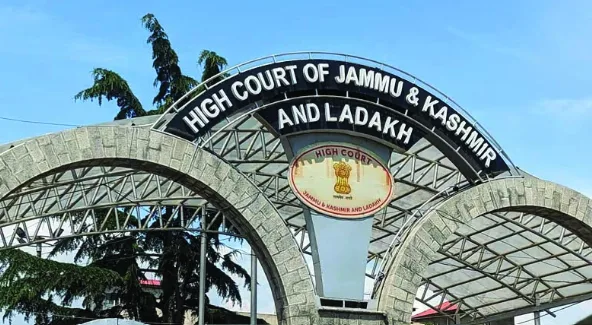
J&K High Court Strikes Down Water Usage Charges on Hydropower Projects
The High Court of Jammu & Kashmir and Ladakh has declared the imposition of water usage charges on hydropower projects under the Jammu and Kashmir Water Resources (Regulation and Management) Act, 2010, unconstitutional to the extent that the levy applies to electricity-generating hydropower projects. The Court held that the charges were, in substance, a tax on electricity generation, which the erstwhile State legislature lacked the competence to impose.
A Division Bench comprising Justice Rajnesh Oswal and Justice Sanjay Dhar delivered the judgment on October 29, 2026, while deciding three connected writ petitions filed by independent power producers operating hydropower projects in Jammu and Kashmir.
Background of the Case
The dispute arose from provisions of the Jammu and Kashmir Water Resources (Regulation and Management) Act, 2010, and the rules framed under it. The legislation authorised the imposition of water usage charges for various purposes, including electricity generation.
Government authorities subsequently issued demand notices seeking to recover water usage charges from hydropower project operators. The affected companies challenged these provisions and notices, arguing that the levy was effectively a tax on electricity generation rather than a genuine charge for water consumption.
The petitioners also contended that hydropower generation involves non-consumptive use of water, as water passes through turbines to generate electricity and is subsequently returned to the river.
What Did the Court Observe?
The Court examined the true nature of the levy and reiterated that the character of a tax must be determined by its substance and actual operation, rather than the terminology used by the legislature.
It observed that the charges were calculated with reference to the head height from which water was used to operate turbines, rather than the actual volume of water consumed. According to the Bench, this calculation demonstrated that the levy was linked to electricity-generation potential.
The Court also examined Section 185-A of the 2010 Act, which provided for the utilisation of collected amounts for purposes such as establishing hydel projects, acquiring hydropower projects, investing in transmission and distribution networks, and purchasing electricity.
Since the Government was not providing corresponding services to the hydropower operators in return for these charges, the levy lacked the necessary element of quid pro quo associated with a fee. The Court consequently held that the charges were effectively a tax.
Constitutional Question: Legislative Competence
The Bench examined the constitutional distribution of legislative and taxing powers under the Seventh Schedule to the Constitution of India.
It noted that Entry 53 of List II empowers State Legislatures to impose taxes on the consumption or sale of electricity, but not on its generation. The Court further clarified that Entry 17 of List II, which concerns water, is regulatory in nature and does not independently confer the power to impose a tax on water.
The Court therefore concluded that the erstwhile State legislature lacked the legislative competence to impose a tax on electricity generation through the 2010 legislation.
Parliamentary Adoption Argument Rejected
The Jammu and Kashmir Government argued that the 2010 Act had subsequently been adopted under the Jammu and Kashmir Reorganisation Act, 2019, and that this adoption could validate the impugned provisions.
The High Court rejected this argument, observing that the adoption of an existing State enactment under the Reorganisation Act did not transform it into an Act passed by Parliament.
It reiterated that legislation which was unconstitutional for want of legislative competence at the time of its enactment could not subsequently be legitimised merely through parliamentary adoption.
Final Decision
Allowing the three writ petitions, the Division Bench held that the Jammu and Kashmir Water Resources (Regulation and Management) Act, 2010, was ultra vires the Constitution to the extent that it imposed water usage charges on the petitioners' hydropower projects.
The Court also quashed the impugned demand notices and restrained the State from imposing any tax on electricity generation under the guise of water usage charges or any other tax.
Legal Significance
The ruling reinforces the constitutional principle that the legislative competence to impose a tax must be established by reference to the relevant constitutional entries. It also clarifies the distinction between a regulatory fee and a tax, emphasising that the actual nature of a levy, rather than its label, determines its constitutional validity.
The judgment is particularly significant for constitutional law, taxation, electricity regulation and hydropower development in Jammu and Kashmir.