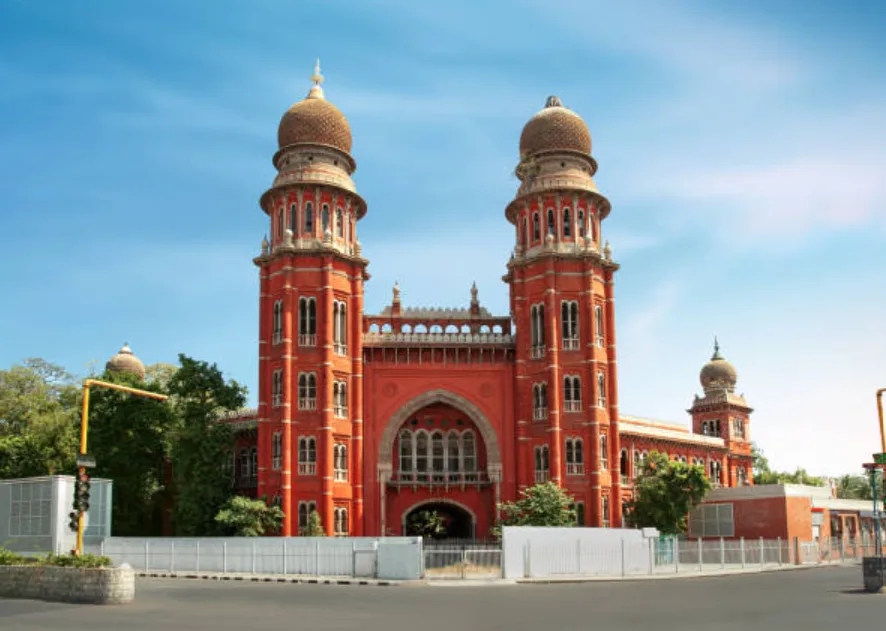
Madras High Court Directs Cyber Police to Monitor Online Attacks Against Judges
The Madras High Court has directed the Tamil Nadu Police Cyber Crime Division to actively monitor digital platforms for online content amounting to criminal intimidation of sitting judges. The Court has also directed authorities to deny permission for public gatherings or marches intended to personally target, defame or intimidate judges.
Background of the Case
The directions were issued on October 30, 2026, by a Division Bench comprising Chief Justice Sushrut Arvind Dharmadhikari and Justice G. Arul Murugan while disposing of a Public Interest Litigation filed by R. Karthikeyan in R. Karthikeyan v. Union of India & Ors.
The petition followed protests organised after a June 25, 2026 judgment delivered by the Madurai Bench of the Madras High Court concerning reservation benefits for persons who converted to Islam. According to the petitioner, certain demonstrations subsequently turned into personalised campaigns targeting a sitting judge who was part of the Bench that delivered the judgment.
The petitioner alleged that posters, public rallies and social media videos contained abusive and caste-based remarks intended to undermine public confidence in the judiciary. He sought preventive and punitive action against organised campaigns targeting sitting judges.
Freedom of Speech and Judicial Independence
The High Court emphasised that citizens have a constitutional right to disagree with and criticise judicial decisions. However, it distinguished legitimate criticism of a judgment from personal attacks against the judge who delivered it.
The Bench observed that coordinated campaigns involving abusive, defamatory or caste-based language directed at sitting judges cannot automatically claim protection under the constitutional guarantee of freedom of speech and expression under Article 19(1)(a), subject to the reasonable restrictions under Article 19(2).
The Court further highlighted that judicial independence is an essential feature of the Constitution's basic structure. Judges must be able to discharge their judicial functions independently and decide cases on the basis of law and facts, without personal threats or intimidation.
Directions Issued by the Court
The High Court directed the Tamil Nadu Police and district administrations to assess applications for public meetings, marches and demonstrations concerning judicial matters on a case-by-case basis.
The principal directions include:
- Restrictions on targeted gatherings: No permission shall be granted for public gatherings or marches intended to personally target, defame or intimidate a sitting judge.
- Immediate intervention: If a permitted assembly turns into a personal attack against a judge, the authorities concerned must immediately terminate the event and take appropriate legal action.
- Cyber surveillance: The Cyber Crime Division of the State Police must actively monitor digital platforms to identify online content amounting to criminal intimidation directed against sitting judges and initiate swift action in accordance with law.
- Investigation of FIRs: The police must complete the investigations into FIR Nos. 152 and 158 of 2026 fairly, thoroughly and expeditiously.
No Blanket Ban on Peaceful Protests
Importantly, the Court rejected the possibility of imposing a blanket prohibition on public discussions or peaceful demonstrations concerning judicial decisions. It observed that such a restriction would interfere with legitimate democratic expression.
Instead, the Bench adopted a case-by-case approach, requiring authorities to distinguish between peaceful disagreement with judicial decisions and gatherings intended to personally intimidate or defame judges.
Significance of the Decision
The ruling highlights the growing importance of protecting judicial institutions against intimidation in both physical and digital spaces. It reinforces the principle that freedom of speech includes the right to criticise judicial decisions, but does not provide an unrestricted licence for criminal intimidation or unlawful personal attacks.
The decision is significant in the context of increasing online discussions and campaigns surrounding judicial proceedings. It also places responsibility on law enforcement agencies to respond appropriately to threats against judicial independence while ensuring that legitimate democratic expression is not unnecessarily restricted.
The Madras High Court accordingly disposed of the Public Interest Litigation with the above directions.
Case: R. Karthikeyan v. Union of India & Ors.
Court: Madras High Court
Bench: Chief Justice Sushrut Arvind Dharmadhikari and Justice G. Arul Murugan
Date: October 30, 2026