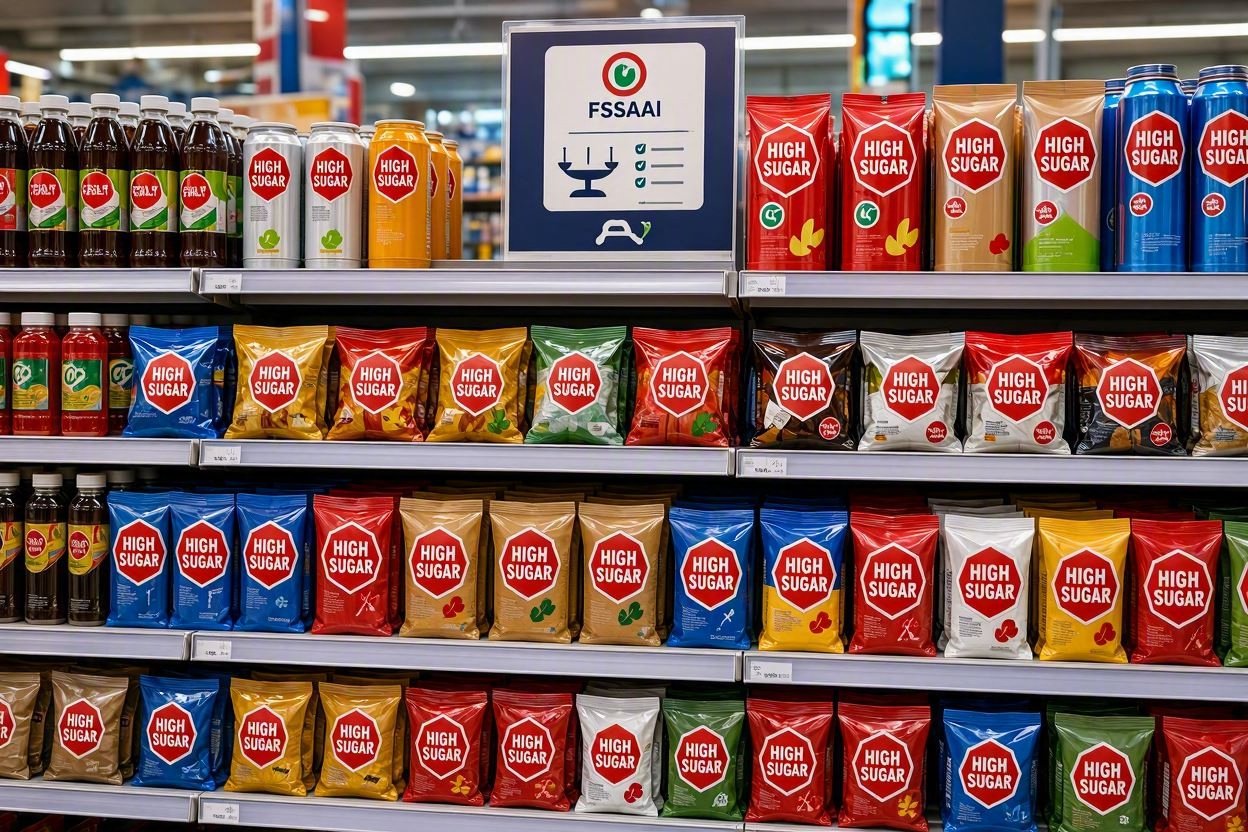
The Food Safety and Standards Authority of India (FSSAI) has taken a significant step toward introducing front-of-pack warning labels for packaged food products containing high levels of sugar, salt, and saturated fat. The development was disclosed before the Supreme Court of India during ongoing proceedings concerning consumer awareness and public health safeguards.
According to submissions made before the Court, FSSAI has agreed in principle to adopt a red-coloured hexagonal warning symbol on the front of food packages. The proposed labels would prominently display warnings such as “HIGH SUGAR,” “HIGH SALT,” “HIGH FAT,” or “HIGHLY SWEETENED BEVERAGE,” enabling consumers to quickly identify products with excessive levels of nutrients associated with obesity, diabetes, hypertension, and cardiovascular diseases.
The proposal represents a notable policy shift after years of debate over front-of-pack labelling. Public health advocates have long argued that nutritional information printed on the back of packaging is insufficient for consumers to make informed choices, particularly when purchasing processed foods. The Supreme Court had earlier expressed concern regarding delays in implementing effective warning mechanisms and urged regulators to act swiftly.
Under the framework currently being considered, products exceeding prescribed thresholds for multiple nutrients of concern may initially be required to carry the warning label. The system may later be expanded to cover products exceeding limits for any single nutrient. Certain naturally occurring food products such as milk, honey, and ghee may be exempted from the requirements.
The move aligns India more closely with international practices adopted in several jurisdictions that mandate front-of-pack warning labels as a public health measure. Studies cited by health experts indicate that clear visual warnings can influence purchasing decisions and encourage healthier consumption patterns.
The proposed regulations are expected to have substantial implications for food manufacturers, advertisers, retailers, and consumers. Companies may need to review product formulations, packaging designs, and compliance strategies once the final regulations are notified.
While the proposal is yet to be formally implemented, it marks one of the most significant developments in India's food regulation landscape and reflects increasing regulatory attention toward nutrition transparency and consumer protection.