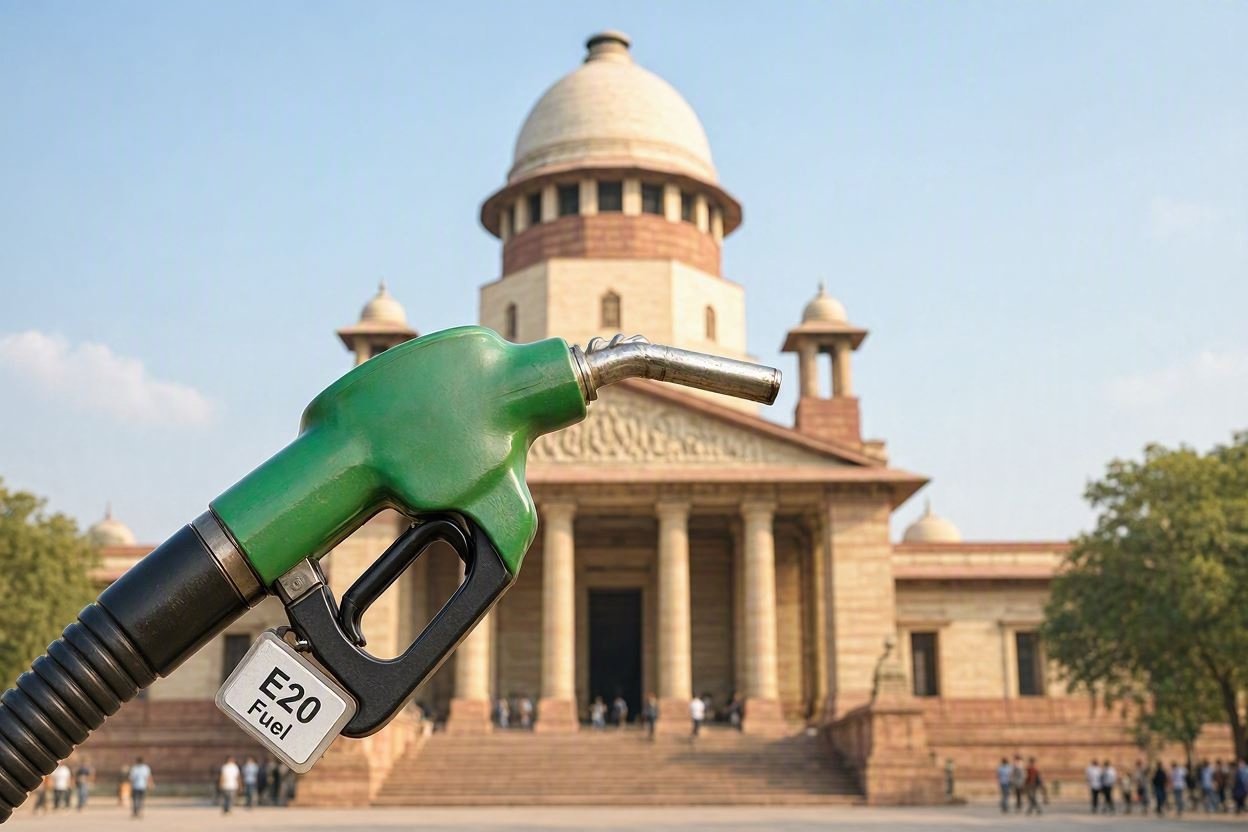
The Supreme Court of India is scheduled to hear a Public Interest Litigation (PIL) on August 31, 2026, seeking mandatory disclosure of ethanol content in petrol sold across the country. The matter is listed before a bench comprising Justice M.M. Sundresh and Justice Prasanna B. Varale.
The petition, filed by Narendra Kumar Goswami, seeks directions to the Union Government and relevant authorities to ensure that every petrol dispensing nozzle prominently displays the exact percentage of ethanol blended in the fuel being sold. The plea further requests that fuel invoices clearly mention the ethanol content to enable consumers to make informed purchasing decisions.
The litigation arises amid growing public discussion surrounding India's nationwide rollout of E20 fuel, which contains 20 percent ethanol. The petitioner argues that consumers have a right to know the composition of the fuel they purchase, particularly when vehicle compatibility and performance concerns have been raised by sections of motorists and industry stakeholders.
In addition to disclosure requirements, the plea seeks the creation of an official, publicly searchable database detailing vehicle compatibility with various ethanol blends. The proposed database would allow consumers to search by manufacturer, model, engine type, and year of manufacture to determine whether a vehicle is suitable for E20 fuel.
The petition also seeks the constitution of an independent expert committee comprising representatives from the Ministry of Petroleum and Natural Gas, Ministry of Road Transport and Highways, Bureau of Indian Standards, automobile engineers, and other stakeholders. The committee would be tasked with evaluating the real-world effects of ethanol-blended fuel on vehicle performance, engine durability, maintenance costs, warranty implications, insurance considerations, and environmental outcomes.
Further, the petitioner has requested the Court to direct authorities to formulate a national consumer disclosure protocol for ethanol-blended fuels in consultation with consumer protection bodies and technical regulators. The plea also calls for disclosure of policy files, technical studies, safety assessments, compatibility reports, and public consultation records related to the E20 rollout.
The case is expected to raise important questions concerning consumer rights, regulatory transparency, environmental policy, and the balance between India's clean-energy objectives and consumer protection obligations. The Supreme Court's consideration of the matter may have significant implications for fuel disclosure standards and public accountability in the implementation of alternative fuel policies.