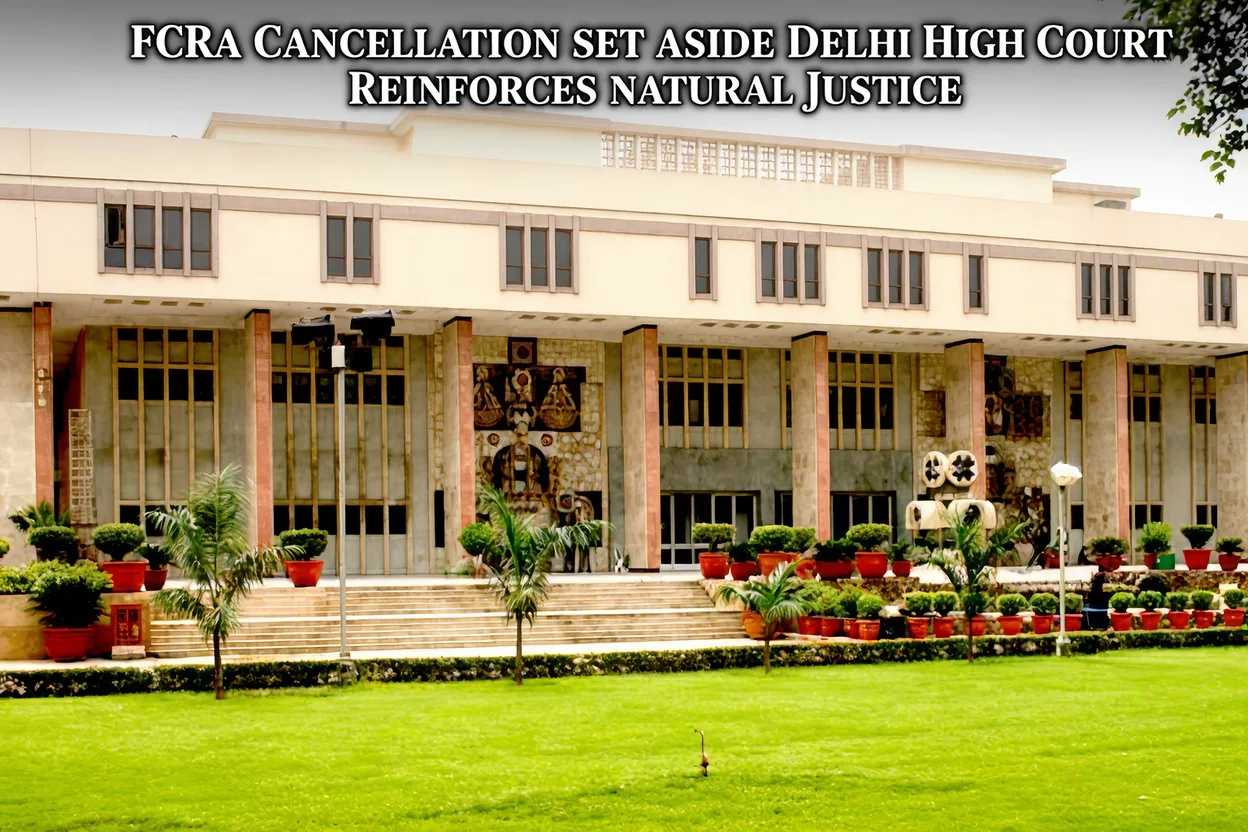
Delhi High Court Sets Aside FCRA Cancellation of Legal-Aid NGO, Calls Government Action Disproportionate
The Delhi High Court has set aside the Union Government's decision to cancel the Foreign Contribution (Regulation) Act, 2010 (FCRA) registration of the Socio-Legal Information Centre (SLIC), a legal-aid organisation founded by Senior Advocate Colin Gonsalves.
In Socio-Legal Information Centre v. Union of India, RFA 635/2022, decided on November 26, 2026, Justice Anup Jairam Bhambhani held that the cancellation order was misconceived, legally untenable, disproportionate and excessive. The Court emphasised that strict compliance with the FCRA cannot be interpreted as mechanical enforcement without considering the circumstances and nature of alleged violations.
Background of the Case
SLIC was established in 1989 and received its FCRA registration in January 1996. The organisation has been involved in providing free legal assistance, legal awareness, professional training and fact-finding initiatives concerning human rights violations. It has operated through a network of lawyers, activists and trainers across several Indian states.
Following an audit of SLIC's accounts and records in September 2021, the Ministry of Home Affairs identified six alleged violations. These included the non-disclosure of a transfer of approximately Rs. 33.73 lakh to another FCRA-registered organisation, payment of Bar Association membership fees for two advocates, rental payments for office premises, expenditure connected with international human-rights training programmes and alleged non-reporting of miscellaneous receipts.
The Ministry suspended SLIC's FCRA registration for 180 days on February 4, 2022, and subsequently cancelled its registration on October 17, 2022, under Sections 14(1)(b) and 14(1)(d) of the FCRA.
High Court's Observations
The High Court found that the cancellation process suffered from significant procedural and substantive shortcomings. It particularly emphasised Section 14(2) of the FCRA, which requires a reasonable opportunity of being heard before an organisation's registration can be cancelled.
The Court held that, considering the serious consequences of cancellation, merely issuing a show-cause notice and accepting a written reply was insufficient in the circumstances. SLIC should have been granted a reasonable opportunity of personal hearing to explain its activities and respond to the allegations.
Examining the six alleged violations individually, the Court found that the allegations did not establish the kind of diversion, misutilisation or personal gain that would justify the drastic measure of cancellation. It also noted that the organisation's foreign contributions had been utilised for activities consistent with its declared objectives of legal aid and social welfare.
The Court rejected the government's attempt to characterise SLIC's human-rights and legal-aid activities as political activism. It observed that an organisation assisting aggrieved persons in approaching courts and statutory commissions through constitutional mechanisms cannot, without supporting material, be labelled as engaging in political activity or activities affecting law and order.
The Court also criticised the government's reliance on undisclosed security inputs, observing that such material could not be kept so secret that even the Court was denied access to the basis of the serious action taken against the organisation.
Important Legal Principle
Relying on the principles governing the FCRA and the Supreme Court's observations in Noel Harper v. Union of India, the Court clarified that strict statutory compliance does not mean mechanical enforcement.
The authorities must meaningfully exercise their statutory powers, examine the evidence and consider the proportionality of the proposed action rather than impose the harshest consequence without adequate justification.
The Court also emphasised the importance of procedural fairness and the statutory requirement of a reasonable opportunity of hearing under Section 14(2) of the FCRA.
Final Decision
The Delhi High Court set aside the Ministry of Home Affairs' order dated October 17, 2022, cancelling SLIC's FCRA registration. Since the registration had already expired before the cancellation order was issued, the Court granted the organisation liberty to file or pursue its renewal application.
The Ministry was directed to decide the renewal application expeditiously, without relying on the violations forming the basis of the cancellation order that had been set aside.
Why This Judgment Matters
The decision reinforces the principles of natural justice, proportionality and reasoned administrative decision-making in the regulation of non-governmental organisations. It highlights that regulatory compliance under the FCRA must be assessed in the context of the statutory purpose and the actual evidence of alleged violations.
The ruling is particularly significant for legal-aid organisations and civil society institutions that rely on foreign contributions to support lawful social welfare and human-rights initiatives.