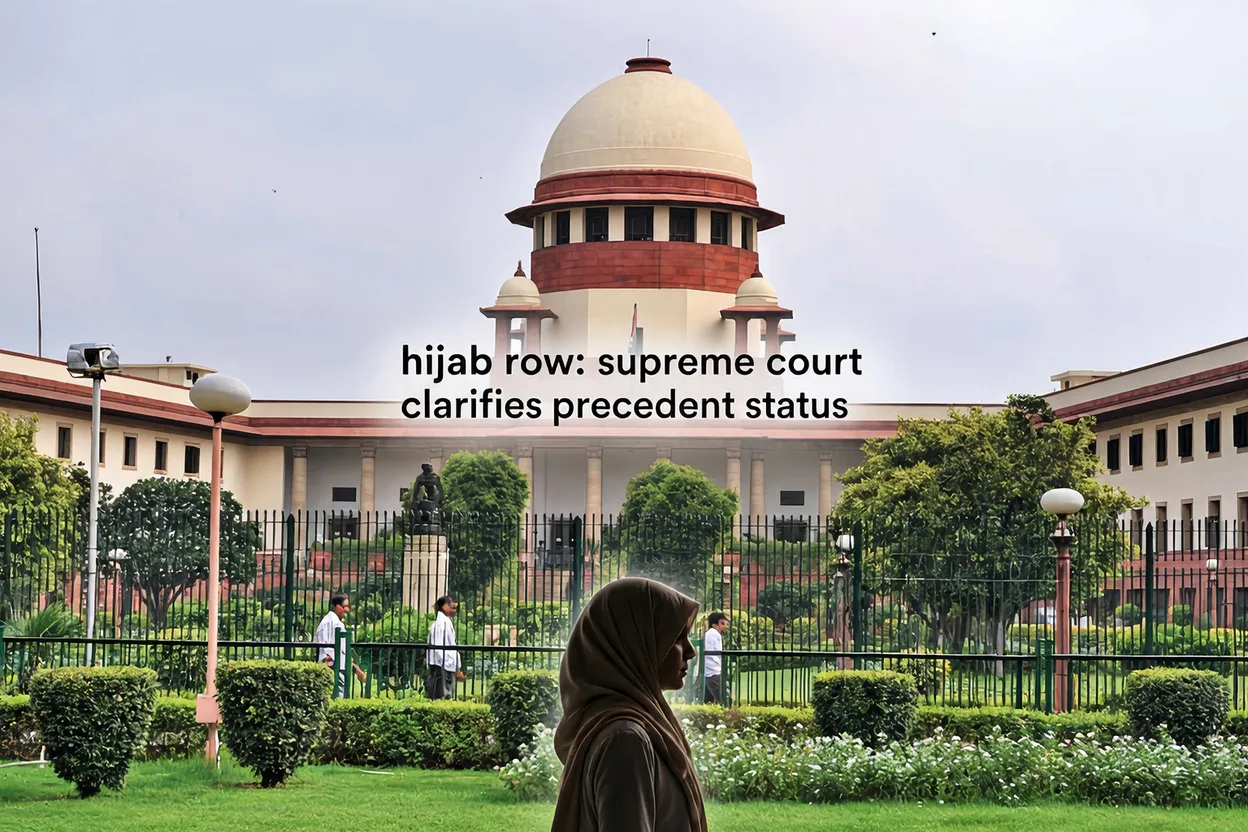
The Supreme Court of India has clarified that the Allahabad High Court's judgment holding that wearing a hijab is not an essential religious practice in Islam shall not be treated as a precedent. The development follows a petition challenging the High Court's decision concerning a Muslim student's right to wear a headscarf along with her prescribed school uniform.
A Bench comprising Justice Aravind Kumar and Justice Vipul M. Pancholi passed the order on November 20, 2026, while hearing a petition filed by the Muslim Women's Study Circle against the Allahabad High Court's judgment dated August 21, 2026. The Supreme Court issued notice to the respondents and directed that the matter be tagged with Civil Appeal No. 7095/2022, arising from the pending Karnataka hijab controversy.
The Supreme Court specifically clarified that the Allahabad High Court judgment shall not be treated as a precedent. This is significant because the broader constitutional questions concerning religious attire in educational institutions remain unresolved before the apex court.
Background of the Dispute
The controversy originated when Sukaina Rizvi, a Muslim student, was allegedly denied admission to Class XI at Tagore Public School in Attarsuiya, Prayagraj, after insisting on wearing a headscarf along with the school's prescribed uniform.
The student approached the Allahabad High Court seeking permission to wear the hijab. However, on August 21, 2026, a Division Bench comprising Justice J.J. Munir and Justice Indrajeet Shukla dismissed her petition.
The High Court held that wearing a hijab had not been established as an essential religious practice in Islam. It further observed that students could not insist on additional clothing where an educational institution maintained a uniform, bona fide and non-discriminatory dress code intended to promote discipline and institutional identity.
Challenge Before the Supreme Court
The Muslim Women's Study Circle subsequently challenged the Allahabad High Court's decision before the Supreme Court.
The petitioner argued that the High Court's findings were arbitrary and discriminatory and violated constitutional guarantees under Articles 14, 15, 19(1)(a), 21 and 25 of the Constitution of India.
The petition also raised concerns regarding religious freedom, individual conscience and access to education. It questioned the application of the Essential Religious Practices doctrine and argued that restrictions on hijab could disproportionately affect Muslim women.
The petitioner further relied on Supreme Court decisions, including Commissioner, Hindu Religious Endowments, Madras v. Sri Lakshmindra Thirtha Swamiar of Shirur Mutt and Bijoe Emmanuel v. State of Kerala, to support its arguments concerning religious freedom and individual conscience. These remain submissions made by the petitioner and have not yet been finally determined by the Supreme Court.
Connection With the Karnataka Hijab Case
The Supreme Court's decision to tag the present petition with Civil Appeal No. 7095/2022 is particularly important.
In October 2022, the Supreme Court delivered a split verdict in the Karnataka hijab controversy. Justice Hemant Gupta dismissed the appeals challenging the Karnataka High Court's judgment, whereas Justice Sudhanshu Dhulia allowed them. The disagreement left the matter awaiting consideration by a larger Bench.
By linking the present proceedings with the pending Karnataka appeals, the Supreme Court has brought another dispute involving religious attire, educational discipline and constitutional freedoms within the same broader judicial controversy.
What Happens Next?
The Supreme Court has issued notice to the respondents, including the State of Uttar Pradesh, and the challenge will proceed alongside the pending Karnataka hijab proceedings.
Importantly, the Supreme Court has not yet delivered a final ruling on whether wearing a hijab constitutes an essential religious practice or whether educational institutions can prohibit it through uniform policies.
The direction that the Allahabad High Court judgment shall not be treated as a precedent is a procedural clarification. It does not itself establish a nationwide right to wear hijab in educational institutions or finally settle the constitutional dispute.
The forthcoming proceedings may have significant implications for religious freedom, equality, educational access and the regulation of dress codes in Indian schools.
Case Details
- Case: Muslim Women's Study Circle v. State of Uttar Pradesh & Others
- Case Reference: Diary No. 69103/2026
- Order Date: November 20, 2026
- Bench: Justice Aravind Kumar and Justice Vipul M. Pancholi
- Court: Supreme Court of India
Legal Significance: The Supreme Court's clarification ensures that the Allahabad High Court's disputed hijab ruling will not be treated as a precedent while the broader constitutional questions surrounding religious attire in educational institutions remain pending.