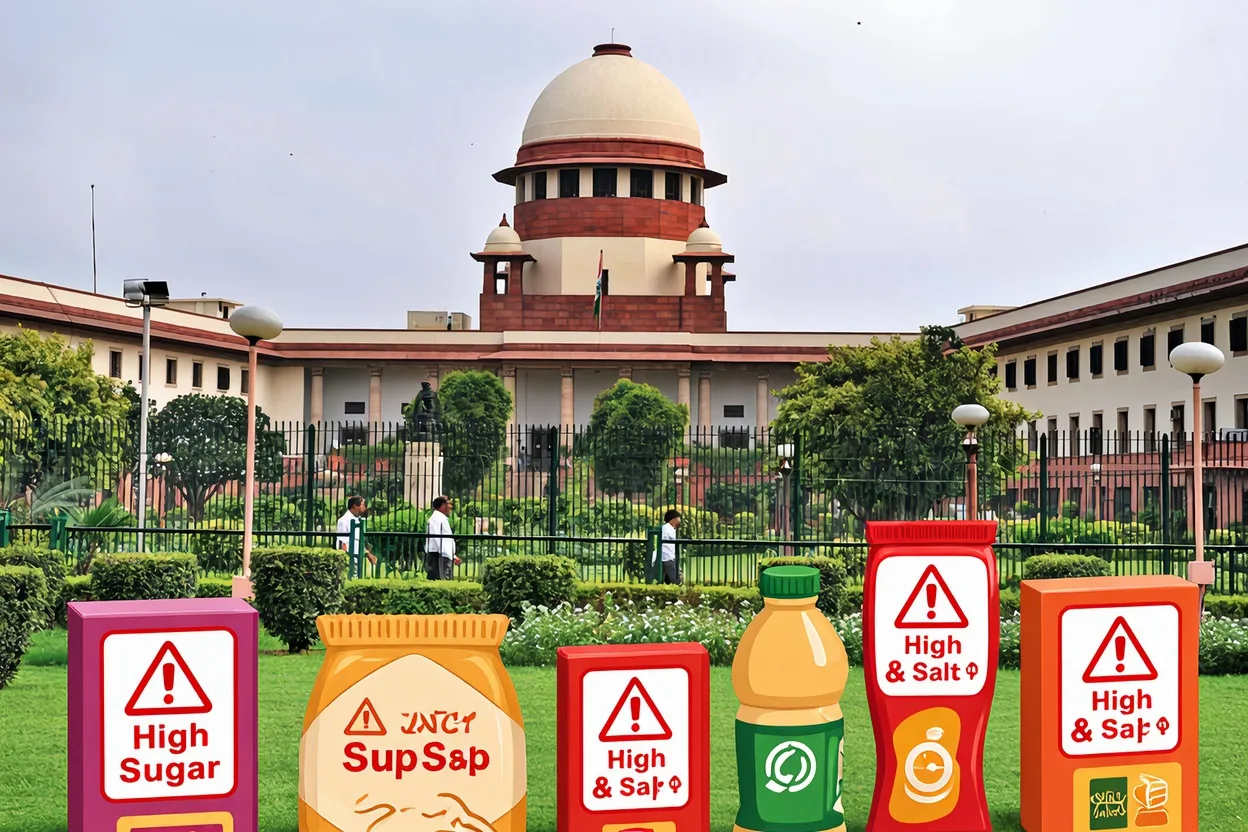
Supreme Court Questions Food Industry's Double Standards on Warning Labels
The Supreme Court of India has raised concerns over alleged double standards adopted by multinational food companies in India and other countries, emphasising the need for stronger nutritional warning labels on packaged food products. In its judgment dated November 26, 2026, in 3S and Our Health Society v. Union of India & Ors., the Court issued important directions to strengthen India's Front-of-Package Nutrition Labelling (FoPNL) framework.
Supreme Court Questions Different Standards for Indian Consumers
A Bench comprising Justice J.B. Pardiwala and Justice K. Vinod Chandran examined the regulatory framework governing nutritional disclosures on packaged food products. The Court expressed concern that certain multinational Food Business Operators (FBOs) follow stricter nutritional standards or warning-label practices in foreign jurisdictions while resisting comparable requirements in India.
The Court emphasised that Indian consumers should not receive a lower level of protection and nutritional information than consumers in other countries. It highlighted the importance of transparency in food labelling and the consumer's ability to make informed purchasing decisions.
Separate Warning Labels for Sugar, Salt and Fat
One of the significant directions concerned the proposed Front-of-Package Nutrition Labelling framework of the Food Safety and Standards Authority of India (FSSAI). The Court directed the regulator to consider total sugars and saturated fat, along with salt, as nutrients of concern rather than relying exclusively on added sugar and added fat.
The Court also emphasised the need for scientifically determined nutritional thresholds. It directed that products exceeding the prescribed limits should carry separate, standardised warning symbols indicating:
- HIGH SUGAR
- HIGH SALT
- HIGH FAT
The warnings are to feature standardised pictorial representations accompanied by the corresponding words. The Court further directed that separate red hexagonal symbols be used for each nutrient exceeding the applicable threshold instead of combining multiple warnings into one symbol. Each warning must occupy at least 4–5% of the principal display panel, subject to the directions in the judgment.
Monitoring Food Reformulation and Regulatory Compliance
The Supreme Court also addressed concerns regarding possible changes in food composition to circumvent the proposed warning-label requirements. It highlighted the need for FSSAI to monitor whether manufacturers increase the use of artificial preservatives, emulsifiers or other additives while reformulating products to avoid nutritional warnings.
The Court stressed that the regulatory framework must not be undermined through artificial changes in product composition. Food businesses must comply with applicable safety standards and regulatory requirements.
Directions to FSSAI and the Government
The Court accepted a 365-day transition period for food businesses following notification of the final regulations. However, it directed FSSAI to ensure that the transition period is not misused, ordinarily avoid further extensions and take appropriate action against non-compliant businesses.
The judgment also highlighted the importance of nutritional awareness among children. It called for effective implementation of existing school food-safety regulations and the promotion of nutrition education through interactive workshops and co-curricular activities.
FSSAI was directed to complete the regulatory process within approximately four months, including the prescribed consultation process. The matter is to be listed again after ten weeks for an update on the progress of the draft regulations.
Constitutional Significance: Right to Health and Informed Choice
The judgment highlights the connection between Article 21 of the Constitution of India, the right to health, food safety and informed consumer choice. It reinforces the State's responsibility to establish effective regulatory safeguards where commercial practices have implications for public health.
By questioning inconsistent standards and emphasising transparent nutritional disclosures, the Supreme Court has placed consumer welfare at the centre of India's evolving food safety framework.
What Lies Ahead?
The directions are expected to influence the development of India's front-of-package nutritional warning regulations. The proposed framework could significantly change how packaged food products communicate