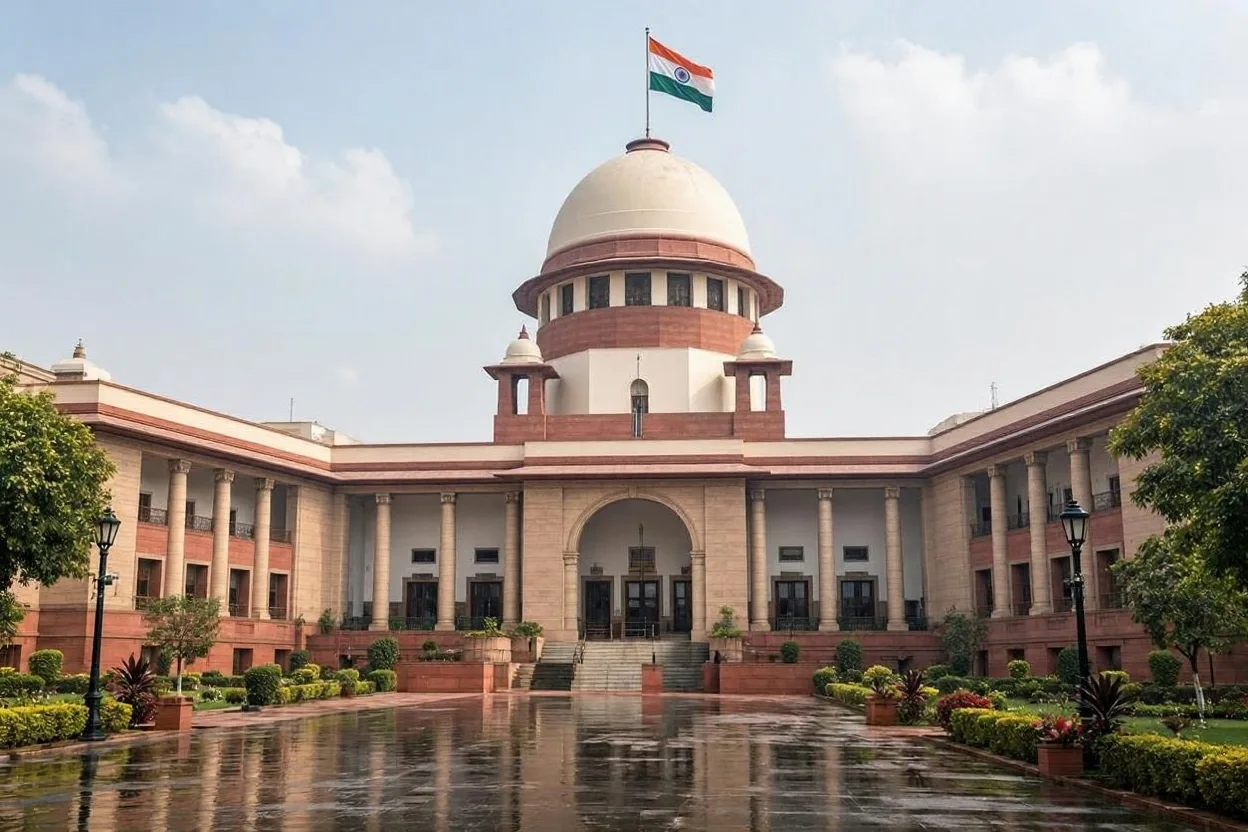
Supreme Court Declines to Entertain Plea Seeking Reduction in Minimum Age for Contesting Elections
New Delhi, November 28, 2026: The Supreme Court of India declined to entertain a writ petition seeking a reduction in the minimum age required to contest elections to Parliament and State Legislatures, highlighting the distinction between the constitutional voting age and the age qualifications prescribed for elected representatives.
A Bench comprising Justice Vikram Nath and Justice Aparesh Kumar Singh was hearing Nalla Suresh Reddy v. Union of India, in which the petitioner sought a reduction in the minimum age for contesting parliamentary and state legislative elections.
Petitioner's Argument
Appearing for the petitioner, counsel argued that the voting age had been reduced from 21 to 18 years through the Constitution (Sixty-first Amendment) Act, 1988. However, the minimum age for contesting elections remains 25 years for the Lok Sabha and State Legislative Assemblies and 30 years for the Rajya Sabha and State Legislative Councils.
The petitioner highlighted the disparity between the minimum age for exercising voting rights and the age required to become an elected representative, seeking a corresponding reduction in the eligibility criteria.
Supreme Court's Observations
The Bench expressed reluctance to entertain the petition, observing that it was not an appropriate petition for the Court to consider. When the petitioner's counsel alternatively requested a direction requiring the concerned authorities to communicate the outcome of a pending representation, the Bench suggested approaching the jurisdictional High Court under Article 226 of the Constitution.
Following the Court's observations, the petitioner's counsel sought permission to withdraw the petition. The Supreme Court accordingly ordered the matter to be dismissed as withdrawn.
Constitutional Provisions Governing Minimum Age
Articles 84 and 173 of the Constitution of India prescribe the minimum age qualifications for membership of Parliament and State Legislatures, respectively.
- Lok Sabha: 25 years.
- Rajya Sabha: 30 years.
- State Legislative Assembly: 25 years.
- State Legislative Council: 30 years.
In contrast, Article 326 provides for adult suffrage, enabling eligible Indian citizens aged 18 years and above to vote, subject to constitutional and statutory qualifications.
Legal Significance
The development brings attention to the continuing distinction between voting eligibility and eligibility to contest elections in India. The age requirements for legislative membership are constitutionally prescribed, and any reduction would require the appropriate constitutional amendment process rather than an administrative change.
Importantly, the Supreme Court did not deliver a final ruling on the constitutional merits of reducing the minimum age. The petition was withdrawn after the Bench declined to entertain it, leaving the existing eligibility requirements unchanged.