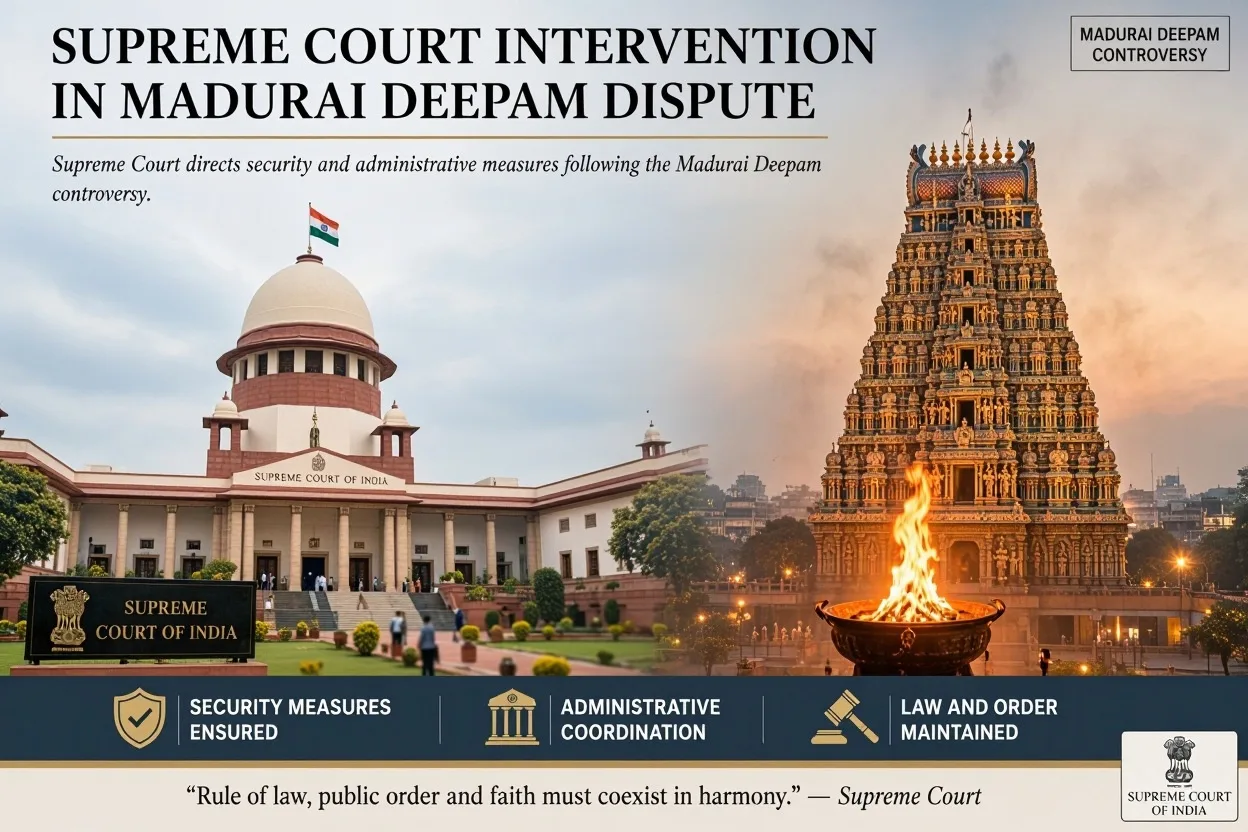
Supreme Court Escalates Action in Madurai Deepam Dispute After Alleged Disobedience of Judicial Order
The Supreme Court of India has taken significant steps in the ongoing Karthigai Deepam controversy at Thiruparankundram Hill in Madurai, Tamil Nadu, following allegations that state authorities and temple administrators failed to implement its earlier directions regarding the lighting of a ceremonial lamp at the disputed Deepathoon pillar.
The controversy intensified after the ceremonial lamp was lit at the traditional Deepa Mandapam near the Uchipillaiyar Temple on November 24, 2026, instead of the Deepathoon pillar, despite the Supreme Court's interim order dated November 20 permitting the lamp to be lit at the disputed location as a one-time arrangement.
Supreme Court Initially Declines Suo Motu Contempt Action
On November 25, a Bench comprising Justices Aravind Kumar and Vipul M. Pancholi declined oral requests to initiate suo motu contempt proceedings against the Tamil Nadu government. The Court asked the aggrieved parties to file formal contempt applications and indicated that appropriate orders would be considered after examining the applications.
The Madurai District Collector had submitted a status report explaining why the lamp could not be lit at Deepathoon. The petitioners, however, alleged deliberate non-compliance with the Supreme Court's earlier directions.
Supreme Court Issues Contempt Notices on November 27
The matter took a significant turn on November 27, when the Supreme Court considered the formal contempt applications. The Bench expressed serious concern over the alleged wilful disobedience of its November 20 order and observed that the rule of law requires every authority to comply with judicial directions.
The Court found that a prima facie case of wilful disobedience had been made out against the Madurai District Collector, officials of the Hindu Religious and Charitable Endowments Department, temple authorities and other concerned officials. It issued show-cause notices asking the concerned persons why contempt proceedings should not be initiated against them.
Temple Board Suspended; Former Judges Appointed as Receivers
Taking note of the alleged failure of the temple administration to implement its directions, the Supreme Court suspended the functioning of the temple's Board of Trustees and superseded it for the time being.
The Court appointed Justice S. Vaidyanathan, former Chief Justice of the Meghalaya High Court, and Justice V. Parthiban, former judge of the Madras High Court, as receivers to take charge of the temple's administration.
CRPF Directed to Secure Thiruparankundram Hill
The Court also directed the Central Reserve Police Force (CRPF) to take over security arrangements at the temple and the entire Thiruparankundram Hill, observing that the local police administration had failed to implement its directions.
The CRPF was instructed to maintain peace and ensure that devotees at both the temple and the nearby dargah could perform their respective religious rituals without obstruction.
Article 144 and the Authority of Supreme Court Orders
Emphasising the constitutional obligation to comply with judicial directions, the Supreme Court referred to Article 144 of the Constitution of India, which requires all civil and judicial authorities within the territory of India to act in aid of the Supreme Court.
The Bench also referred to Article 129, under which the Supreme Court is a Court of Record with the power to punish for contempt of itself. It reiterated that judicial orders cannot be treated as optional or subject to administrative interpretation.
Further Directions and Next Hearing
The Supreme Court directed the newly appointed receivers to ensure that the Karthigai Deepam was lit at Deepathoon on November 28, 2026, subject to the conditions specified in its order. It also directed the Tamil Nadu Chief Secretary to submit an affidavit detailing relevant events and communications among officials, including call detail records, and to remain personally present at the next hearing scheduled for December 12, 2026.
The Court clarified that its one-time arrangement concerning the lighting of the lamp does not finally determine questions relating to customary religious practices, title, possession or religious entitlements at the disputed location.
Legal Significance
The proceedings raise important questions concerning the enforcement of Supreme Court orders, the constitutional responsibility of executive authorities, contempt jurisdiction and the relationship between religious administration and public order.
The dispute remains subject to further judicial consideration, and the contempt notices do not amount to a final finding of guilt against the officials concerned.