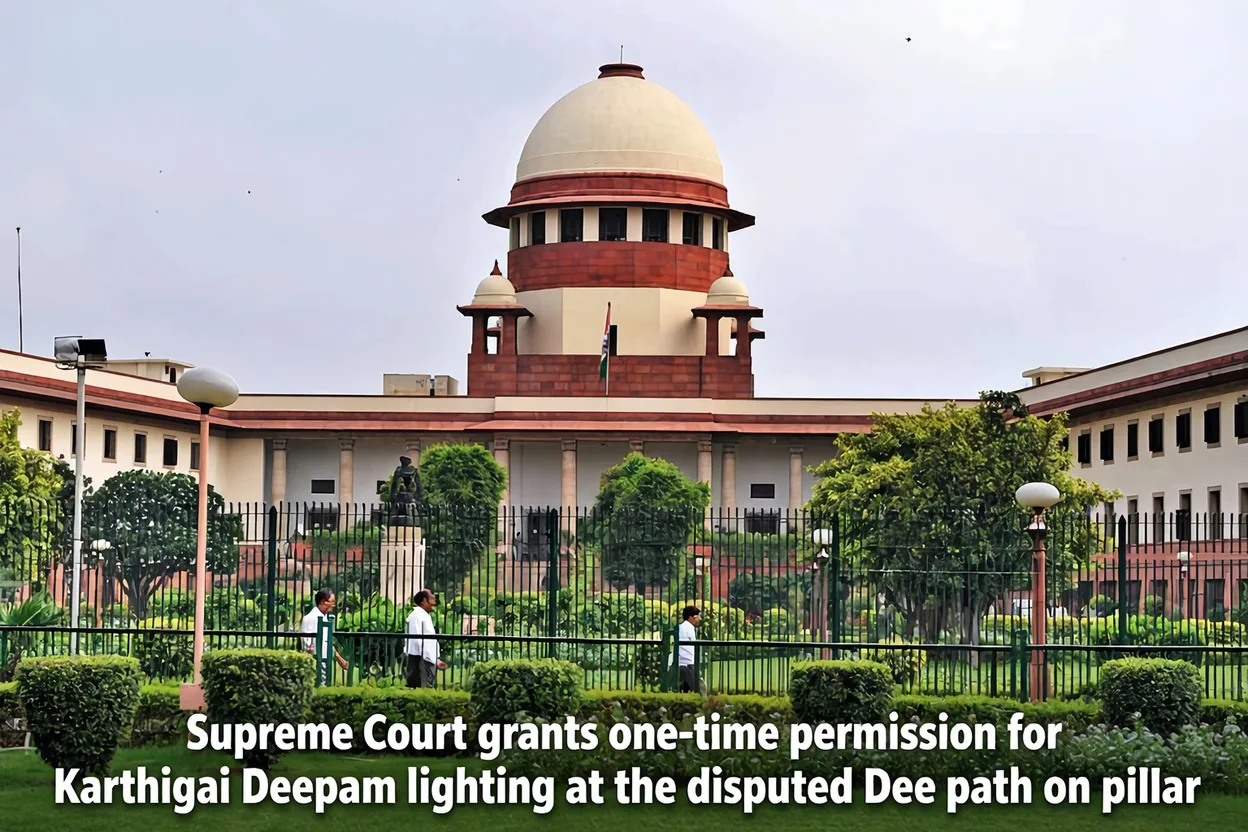
New Delhi, November 20, 2026: The Supreme Court of India has permitted the lighting of the traditional Karthigai Deepam lamp at the disputed Deepathoon (stone lamp pillar) on Thiruparankundram Hill in Madurai, Tamil Nadu, on November 24, 2026. However, the permission has been granted strictly as a one-time interim arrangement, while the Court has stayed the relevant findings of the Madras High Court.
Supreme Court's Interim Directions
A Bench comprising Justice Aravind Kumar and Justice Vipul M. Pancholi passed the interim order while hearing appeals filed by the State of Tamil Nadu challenging the Madras High Court's decision concerning the lamp-lighting ritual.
The Supreme Court permitted a restricted team authorised by the temple administration to perform the ceremony at the Deepathoon. The composition and size of the team will be determined by the Madurai District Collector in consultation with the temple's Executive Officer, the Archaeological Survey of India (ASI) and the Madurai Police Commissioner.
The Court stayed the directions contained in paragraphs 1 to 140 of the Madras High Court Division Bench judgment dated January 6, 2026, insofar as they concern the challenge before the Supreme Court.
Strict Conditions for the Ceremony
The Supreme Court imposed several safeguards to maintain public order and protect the disputed site:
- Access to the Deepathoon will remain restricted to authorised persons and necessary government officials.
- No public gathering, procession, demonstration or slogan-raising will be permitted at the site.
- The District Collector will coordinate the timing, route and duration of the ceremony.
- The Archaeological Survey of India will prescribe necessary conditions for protecting the monument and its surroundings.
- No excavation, construction, structural alteration or permanent installation will be allowed.
- The existing religious observances at customary locations must continue undisturbed.
- The functioning and lawful access to the Dargah and mosque must not be interfered with.
The Court also directed the authorised team to leave the site immediately after completing the ceremony.
One-Time Permission Does Not Establish a Customary Right
Importantly, the Supreme Court clarified that its interim permission does not recognise or enforce any claimed customary, religious or proprietary right over the disputed location.
The Court specifically stated that the permission and performance of the ceremony cannot be relied upon as evidence of an established custom, a right of access or a precedent for obtaining similar permission in subsequent years.
The larger questions concerning ownership, possession, historical usage, religious entitlement, temple administration and the scope of religious freedom under Articles 25 and 26 of the Constitution of India have been left open for adjudication.
Background of the Dispute
The controversy arose after a devotee sought permission to light the Karthigai Deepam lamp at the Deepathoon pillar situated on Thiruparankundram Hill, near the Sikandar Badusha Dargah.
In December 2025, a Single Judge of the Madras High Court directed the temple administration to light the ceremonial lamp at the disputed pillar in addition to the customary location near the Uchi Pillaiyar Temple. The directions were subsequently upheld by a Division Bench on January 6, 2026.
The State of Tamil Nadu challenged the High Court's findings before the Supreme Court, while disputes continued concerning the nature of the pillar, ownership of the land and the existence of an established religious custom.
Further Proceedings
The Supreme Court has directed the Madurai District Collector to submit a compliance report within three days after the festival. The matter is scheduled for further hearing in the second week of January 2027.
The interim order is significant because it balances the opportunity to perform a religious ceremony with public order, competing claims and the preservation of the disputed site, without finally determining the underlying legal rights of the parties.