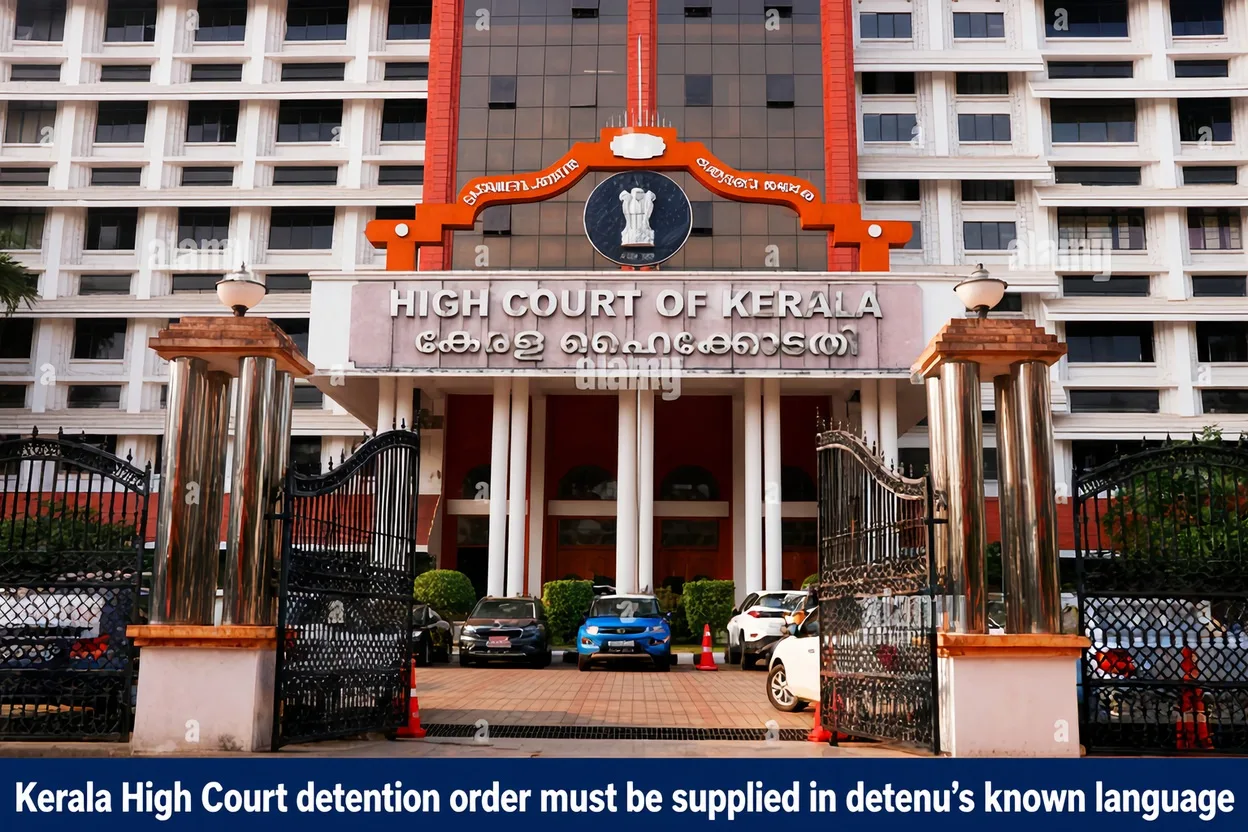
The Kerala High Court has set aside a preventive detention order after holding that supplying a detention order in a language unknown to the detenu violates the constitutional safeguards guaranteed under Article 22(5) of the Constitution of India. The Court emphasised that merely explaining the contents of a detention order orally is insufficient when the detenu is not provided with a written copy in a language he understands.
Background of the Case
In Mubashira C.P. v. Union of India & Ors., W.P. (Crl.) No. 1448 of 2026, the petitioner challenged the preventive detention of her husband under Section 3(1) of the Prevention of Illicit Traffic in Narcotic Drugs and Psychotropic Substances Act, 1988 (PITNDPS Act).
The detention order dated March 31, 2026, was issued by the competent authority and subsequently confirmed by the Government. The detenu was taken into custody in July 2026.
The petitioner argued that although Malayalam was expressly recorded as the language known to the detenu in the detention order, he was supplied with the order only in English. Consequently, he was unable to properly understand the grounds of detention and exercise his constitutional right to make an effective representation.
What Did the Court Observe?
A Division Bench comprising Justice Anil K. Narendran and Justice Muralee Krishna S. observed that the detention order had admittedly been supplied in English despite the authorities recording Malayalam as the language known to the detenu.
The State argued that the contents of the detention order had been explained to him orally in Malayalam. However, the Court rejected this justification, relying on established Supreme Court precedents, including Lallubhai Jogibhai Patel v. Union of India.
The Bench reiterated that communication of the grounds of detention requires effective written communication in a language understood by the detenu. An oral explanation, even if provided, cannot substitute the requirement of supplying translated written documents.
Article 22(5) of the Constitution
Article 22(5) provides two important safeguards to persons detained under preventive detention laws:
- The detaining authority must communicate the grounds of detention to the detenu as soon as possible.
- The detenu must be afforded the earliest opportunity to make a representation against the detention order.
The Court held that failure to supply the translated detention order deprived the detenu of a meaningful opportunity to exercise these constitutional rights.
Additional Constitutional Violation
The Court also found that a representation submitted by the petitioner's wife to the Central Government had not been considered. This omission constituted an additional violation of the constitutional safeguards under Article 22(5).
However, the Court did not accept the challenges concerning the delay in issuing the detention order or the non-supply of certain supporting documents, finding those objections unsustainable on the facts.
Final Decision
Allowing the writ petition, the Kerala High Court set aside the detention order and the subsequent confirmation order. It directed the Superintendent of Central Jail, Poojapura, to release the detenu forthwith, provided his detention was not required in connection with any other case.
Why Does This Judgment Matter?
The ruling reinforces the principle that procedural safeguards under Article 22(5) are substantive constitutional protections, not mere formalities. Authorities exercising preventive detention powers must ensure that detenus receive written copies of detention orders in languages they understand.
The judgment also highlights that the right to make an effective representation is meaningless unless the detenu is adequately informed of the grounds of detention.
Case Details:
Case: Mubashira C.P. v. Union of India & Ors.
Case Number: W.P. (Crl.) No. 1448 of 2026
Court: Kerala High Court
Bench: Justice Anil K. Narendran and Justice Muralee Krishna S.
Date of Judgment: November 20, 2026