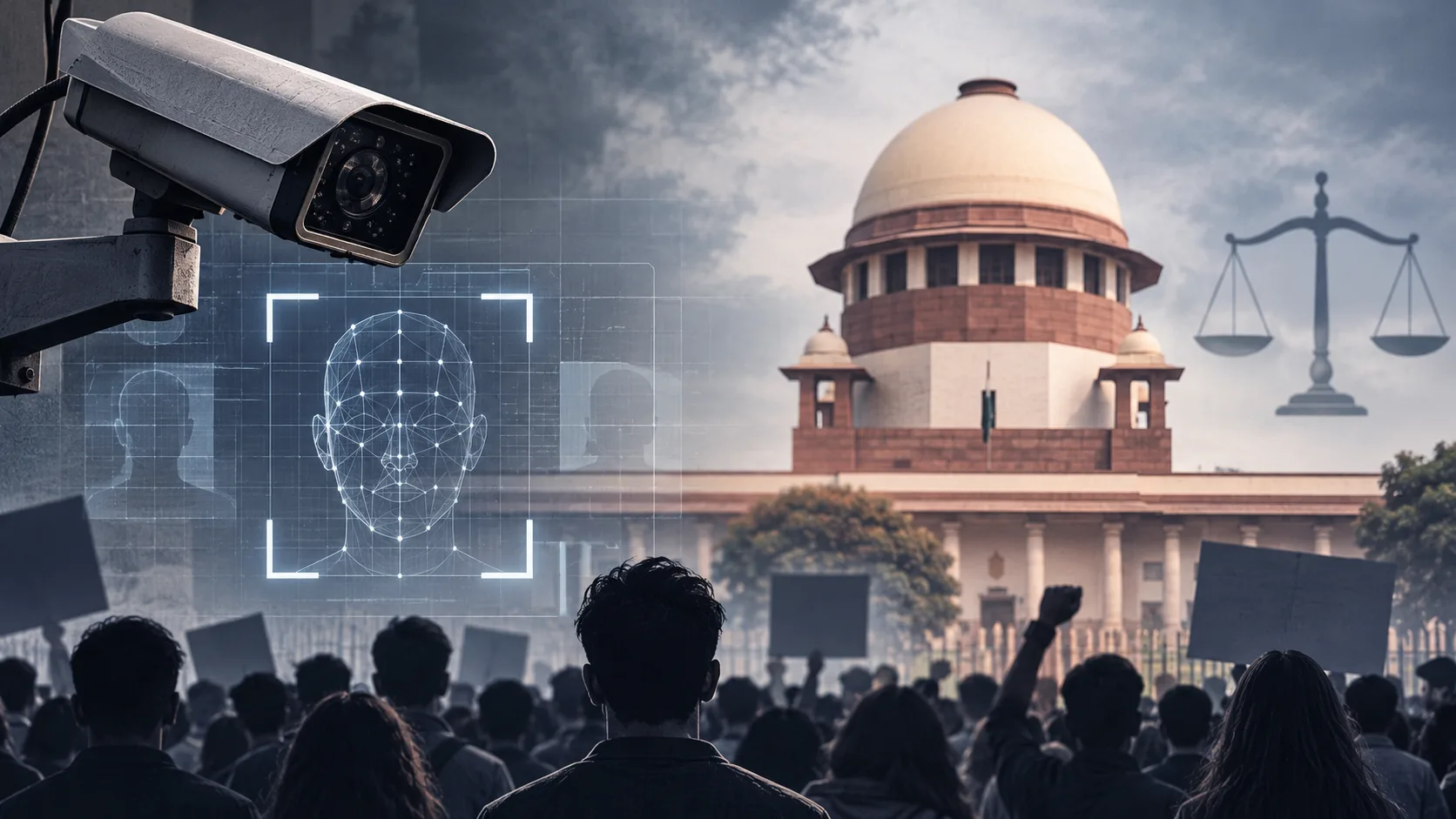
The Supreme Court of India has agreed to examine the legality and constitutional implications of police use of facial recognition technology (FRT) and other biometric surveillance tools at designated protest sites. On November 3, 2026, a bench comprising Chief Justice of India Surya Kant, Justice Joymalya Bagchi and Justice V. Mohana issued notice on a petition filed by the Software Freedom Law Centre (SFLC), raising concerns over the surveillance of individuals participating in public demonstrations.
During the hearing, advocate Prashant Bhushan, appearing for the petitioner, questioned the legal authority under which police authorities were collecting, processing and using facial recognition data. He sought disclosure of the surveillance mechanisms, their statutory basis and safeguards against misuse of personal information.
Justice Joymalya Bagchi raised an important constitutional question concerning the reasonable expectation of privacy in public places. The Court distinguished between the mere recording of a person's face through CCTV cameras and the subsequent identification, matching and utilisation of facial data through technological systems. It questioned whether the mere presence of an individual in a public place automatically diminishes their right to privacy.
Solicitor General Tushar Mehta, representing the Central Government, argued that CCTV surveillance at designated protest locations was intended to prevent untoward incidents and maintain public safety. He also questioned the petitioner's objections by referring to the widespread recording of protests by social media users. The Court, however, indicated that ordinary CCTV recording and technology-enabled identification of individuals raise distinct legal considerations.
The bench also referred to amendments to the Identification of Prisoners Act, 1920, which provide for the collection of specified biometric measurements, including iris scans, for legally recognised purposes. The discussion highlighted the need to examine the statutory authority and permissible scope of biometric data collection.
The petition also raises concerns regarding the alleged deployment of AI-assisted facial recognition systems and surveillance vehicles, including DP-Drishti and Ikshana, during demonstrations at Jantar Mantar. It seeks disclosure of relevant records, the legal framework governing surveillance and binding safeguards regulating the collection, processing and sharing of personal information.
The matter raises significant questions under Article 21 of the Constitution, which protects the right to life and personal liberty and encompasses the fundamental right to privacy recognised in Justice K.S. Puttaswamy (Retd.) v. Union of India (2017). The Court will have to consider how legitimate public-order and security objectives can be balanced against individual privacy and constitutional freedoms.
The Supreme Court has issued notice and will examine the legal and constitutional issues raised by the petition. No final ruling has yet been delivered on the legality or constitutionality of the challenged surveillance practices.