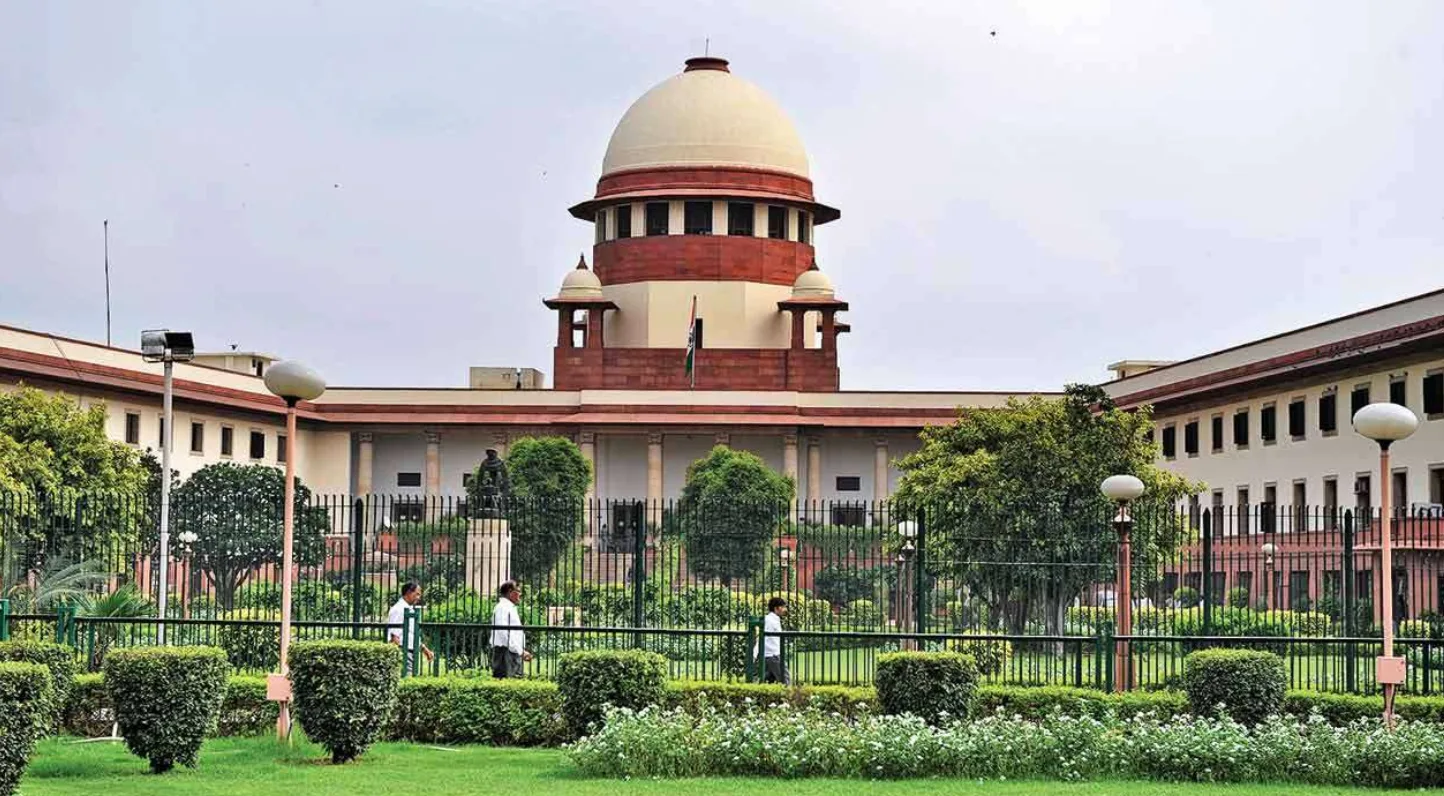
Supreme Court Says Protest Sites Cannot Be Occupied Indefinitely
The Supreme Court of India has observed that no individual, group or organisation can claim an indefinite right to occupy a designated protest site, emphasising that every citizen and organisation must have an equal opportunity to exercise the constitutional right to peaceful protest.
A three-judge Bench comprising Chief Justice of India Surya Kant, Justice Joymalya Bagchi and Justice V. Mohana made these observations on November 3, 2026, while hearing a batch of petitions concerning the recent protests in Delhi against Chief Election Commissioner Gyanesh Kumar.
During the hearing, Chief Justice Surya Kant remarked that designated protest sites must be allotted for specific periods so that farmers, workers, trade unions, journalists and other groups can also exercise their right to protest. The Bench emphasised that one organisation cannot prevent others from using a public protest venue merely because it has occupied the location first.
Balance Between Right to Protest and Right to Livelihood
The Court also examined the competing constitutional interests involved in the matter, particularly the right to peaceful protest and the right to trade, conduct business and earn a livelihood.
Senior Advocate Mukul Rohatgi, appearing for traders' associations, submitted that prolonged demonstrations had adversely affected commercial activities and caused substantial financial losses, particularly during the festive season. The traders sought restrictions on protests in Delhi for two months.
Responding to these concerns, the Bench observed that the right to livelihood extends beyond commercial establishments and includes daily-wage workers and small traders who depend on their everyday earnings.
The Court indicated that suitable public spaces should be identified for demonstrations without unnecessarily disrupting the livelihood and daily activities of others. It also stressed that permission orders should specify the duration for which a protest site may be occupied.
Petitions Also Raise Allegations of Police Excesses and Surveillance
The proceedings involved several connected petitions concerning alleged police excesses, unlawful detentions, custodial assault, restrictions on internet access, closure of metro stations and the use of facial recognition technology during demonstrations.
The Court also considered a plea by the Kirana Committee Delhi seeking restrictions on protests during the festive period. It directed the traders' associations to implead the organisations that had organised the demonstrations so that their responses could also be considered before adjudicating the competing claims.
On the surveillance issue, the Court considered concerns regarding the legal framework governing facial recognition technology and the use and security of collected biometric data.
Constitutional Significance
The observations engage Articles 19(1)(a) and 19(1)(b) of the Constitution of India, which protect freedom of speech and expression and the right to assemble peacefully and without arms, respectively. These rights are subject to reasonable restrictions under the Constitution.
The Court's observations are consistent with the principles discussed in Amit Sahni v. Commissioner of Police (2020), in which the Supreme Court held that public ways and spaces cannot be occupied indefinitely for protests.
Importantly, the November 3 observations were made orally during the ongoing proceedings and should not be treated as a final judgment or a fresh binding ruling. The connected petitions raise wider questions concerning protest rights, public order, privacy and the protection of livelihood.
Source: LiveLaw, Hindustan Times and Business Standard, November 3, 2026.