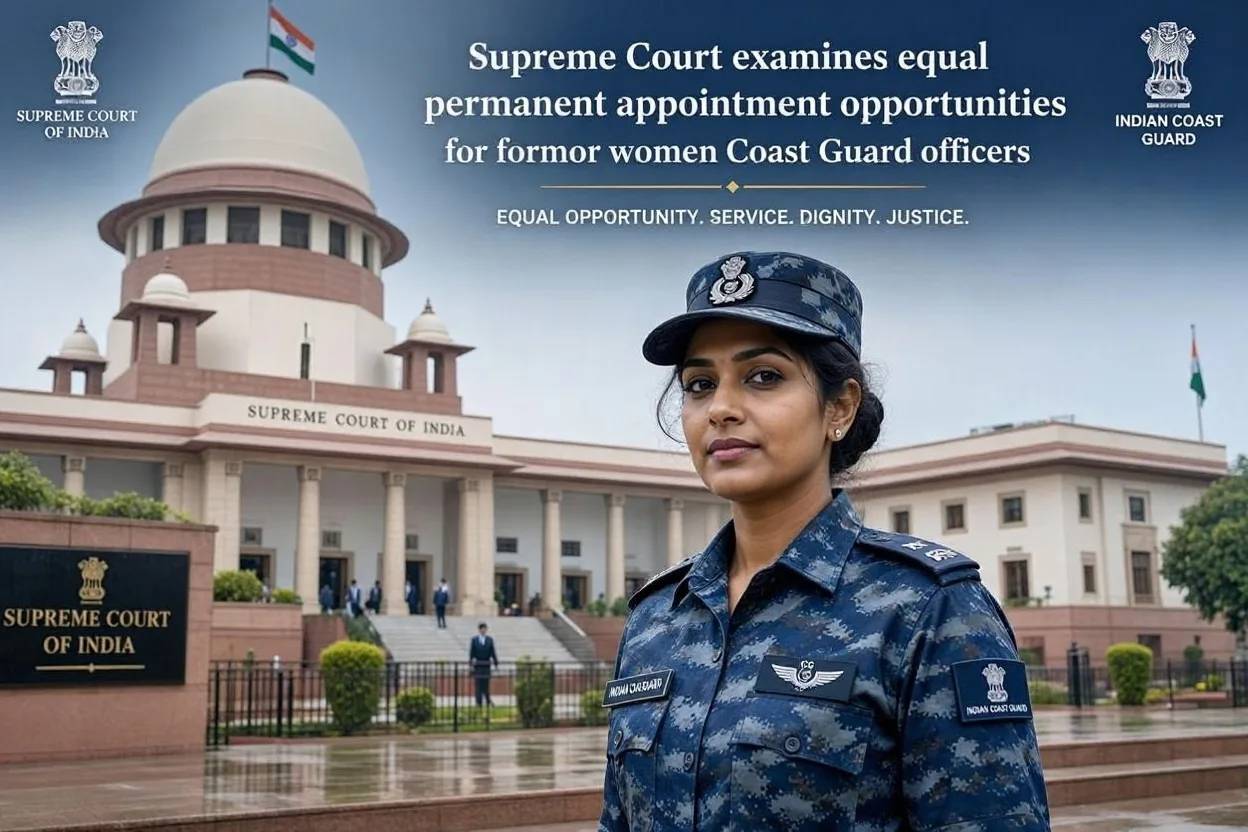
Supreme Court Examines Permanent Absorption Rights of Released Women Coast Guard Officers
The Supreme Court of India has issued notice on a petition challenging the exclusion of former women officers of the Indian Coast Guard from consideration for permanent appointment under a newly introduced policy. The petition raises important questions concerning gender equality, equal opportunity in public employment and the fairness of service-related policies.
The petition has been filed by a former Commandant (Junior Grade), identified as Priyanka, who served in the Indian Coast Guard as a Short Service Appointment (SSA) officer in the General Duty branch for approximately 14 years before being released from service in December 2023.
Challenge to the Permanent Appointment Policy
The petitioner has challenged policy letters dated August 18, 2026, which reportedly introduced an opportunity for women SSA officers of the General Duty branch to opt for permanent appointment. However, the policy restricts eligibility to officers who are in service on the date of its implementation.
According to the petitioner, this eligibility condition unfairly excludes officers who completed their maximum 14-year service tenure and were released before the policy was introduced, despite having comparable service records and qualifications.
The petitioner reportedly joined the Indian Coast Guard on December 30, 2009, as part of its pioneer SSA General Duty course. She had sought permanent absorption in March 2023, and her request was recommended at different levels of the chain of command. However, no final decision was communicated before her release from service.
Allegation of Arbitrary Classification
A significant argument raised in the petition concerns the differential treatment of similarly situated officers. The petitioner has pointed out that some officers from her batch, including officers who had also completed 14 years of service, were reportedly covered by the new policy.
She argues that the distinction based solely on whether an officer remained formally on the service rolls when the policy was introduced is arbitrary and unfair.
The petition invokes constitutional principles of equality and non-discrimination, drawing support from earlier Supreme Court decisions concerning permanent commissions for women officers in the Indian Army, Navy and Air Force.
Reliefs Sought by the Petitioner
The petitioner has sought reinstatement and consideration for permanent appointment on parity with eligible serving women officers. Alternatively, she has sought pensionary benefits comparable to those available to similarly placed women officers in the other armed services, subject to the reliefs claimed in her petition.
The matter also raises the question of whether service policies can exclude former employees from consideration solely because they were released before the introduction of a new beneficial policy.
Supreme Court Proceedings
A Bench comprising Chief Justice of India Surya Kant, Justice Joymalya Bagchi and Justice V. Mohana has taken up the matter. The Supreme Court issued notice to the Union of India and the Director General of the Indian Coast Guard, seeking their response to the challenge.
The proceedings are significant in the broader context of women's equality in uniformed services. However, the Court has not yet delivered a final ruling on the validity of the policy or the petitioner's entitlement to permanent appointment.
Legal Significance
The case raises important questions concerning Article 14 and Article 16 of the Constitution of India, particularly the principles of equality before the law, non-arbitrary state action and equal opportunity in public employment.
Its eventual outcome may clarify whether a service policy introducing new opportunities for women officers can lawfully exclude those who completed their service tenure before its implementation, despite allegedly being similarly situated to officers covered by the policy.
The Union government's response and the Supreme Court's subsequent consideration of the matter will be important in determining the scope of equal treatment for women officers in the Indian Coast Guard.