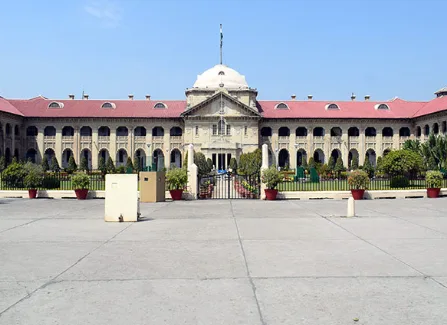
Open Court Does Not Mean Free Recording: Allahabad High Court Acts Against Unauthorised Filming
The Allahabad High Court has emphasised that the principle of open justice does not grant individuals an unrestricted right to record or broadcast judicial proceedings. Taking serious note of unauthorised filming inside a courtroom, the Court ordered action against a man found recording a hearing on his mobile phone without permission and introduced restrictions on litigants carrying mobile phones into courtrooms.
A Single Judge Bench of Justice Vikram D. Chauhan passed the directions on November 19, 2026, while hearing a petition under Article 227 of the Constitution of India in Kuldeep Batra v. State of Uttar Pradesh and Another.
Man Caught Recording Court Proceedings
During the hearing, Additional Government Advocate P.K. Singh informed the Court that an individual was recording the proceedings on his mobile phone without obtaining the Court's permission.
The individual identified himself as Raj Kulshrestha and admitted that he had recorded the proceedings. However, he could not satisfactorily explain the purpose behind the recording. Upon examination of his mobile phone, the Bench Secretary found three videos of the court proceedings.
The Court also noted that the individual did not have a matter listed before the Bench and possessed a pass that permitted access only to the advocates' chambers, not the courtroom.
Open Justice Does Not Authorise Unrestricted Broadcasting
Addressing the legal distinction between public access to judicial proceedings and unauthorised recording, the Court observed that open justice allows members of the public to attend court hearings, but does not permit individuals to freely record or broadcast proceedings without the Court's permission.
The Bench expressed concern that unauthorised recordings and their publication on social media could create a parallel social media trial even before a judicial determination. Such circulation could prejudice litigants, compromise their personal information and expose victims to social stigma.
The Court particularly highlighted the sensitive nature of matters involving personal liberty, child sexual abuse, the Central Bureau of Investigation (CBI), the Enforcement Directorate (ED), and cases involving Members of Parliament and Members of Legislative Assemblies.
Mobile Phones Restricted for Litigants Inside Courtrooms
Considering courtroom security and the need to protect the interests of litigants, the High Court directed that litigants would not be permitted to enter courtrooms carrying mobile phones.
The Court further stated that if a litigant is found carrying a mobile phone inside a courtroom, the concerned advocate would be held responsible. The Registrar General was directed to display a notice regarding the restriction at the High Court's pass counter. The Registrar (Protocol) was also instructed to ensure proper verification of entry passes and incorporate the mobile phone restriction into the relevant passes.
Custody and Further Directions
The Court directed that Raj Kulshrestha be taken into custody and produced before the Chief Judicial Magistrate, Prayagraj, after a medical examination. The order also provided for his release on bail upon furnishing the required personal bond and two sureties, subject to the condition that he appear before the High Court on November 20, 2026, at 10:00 AM.
His mobile phone was directed to be kept in a sealed cover and produced before the Court. The individual was also required to explain through an affidavit why he had entered the courtroom without an appropriate pass and recorded proceedings without permission, and why his conduct should not be treated as interference with the administration of justice.
The Court also directed the concerned advocates to appear and explain why proceedings should not be initiated against them in connection with the incident.
Why the Order Matters
The development highlights an important distinction between transparency in judicial proceedings and the unauthorised dissemination of courtroom content. While public access remains an important aspect of open justice, it does not override judicial control over courtroom proceedings, litigant privacy and the administration of justice.
The order reinforces the importance of maintaining courtroom discipline and ensuring that sensitive judicial proceedings are not converted into content for unrestricted circulation on digital platforms.
Source: Allahabad High Court order dated November 19, 2026; reporting by The Indian Express, LiveLaw and other legal news publications.