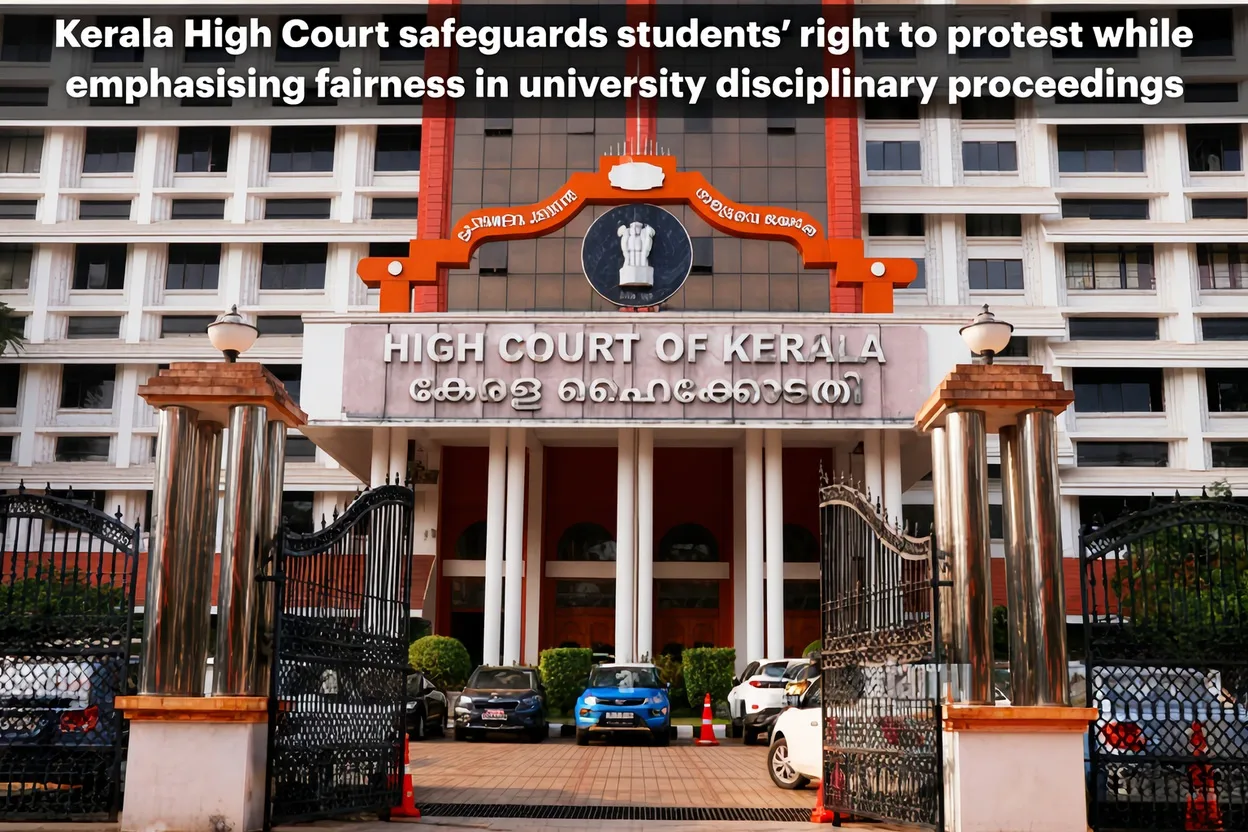
Kerala High Court Protects Students' Right to Protest, Warns Against Punishments That Destroy Academic Careers
The Kerala High Court has observed that universities cannot suppress students' right to protest through disciplinary punishments that threaten their academic futures, even when the institution disagrees with the cause of their agitation. The Court emphasised that freedom of expression and the right to dissent must be respected, while clarifying that violence has no place on university campuses.
Justice P.V. Kunhikrishnan made these observations while disposing of a writ petition filed by 16 students of Sree Sankaracharya University of Sanskrit, Kalady, challenging their suspension and subsequent disciplinary proceedings.
Background of the Case
The dispute arose following a student protest at the university concerning various institutional grievances, including vacant teaching positions, inadequate infrastructure, delays in issuing printed certificates and the disbursement of fellowship amounts.
Following an alleged confrontation during the protest, criminal cases were registered and the university suspended the students on September 1, 2026. The students challenged the disciplinary action, contending that the proceedings violated the principles of natural justice.
High Court Identifies Violations of Natural Justice
The Court found serious procedural irregularities in the university's disciplinary proceedings. The students had not been properly served with specific charges, relevant witness statements and materials relied upon during the inquiry were not furnished to them, and they were not given an adequate opportunity to rebut the evidence or cross-examine witnesses.
The Court also questioned the independence of the inquiry committee and the absence of a properly reasoned inquiry report. Referring to the Supreme Court's decision in Anil Kumar v. Presiding Officer (1985), the Court reiterated that disciplinary findings must demonstrate proper application of mind and cannot rest on a unilateral inquiry.
Right to Protest and the Voltairean Principle
While acknowledging the university's authority to take action against violence, the Court stressed that disagreement with the cause of a protest cannot justify suppressing the students' right to express their views.
Invoking the Voltairean principle of freedom of expression, the Court observed:
"I disapprove of what you say, but I will defend to the death your right to say it."
The Court noted that the students had already remained under suspension for approximately 84 days, which itself constituted a substantial punishment. It questioned whether such a prolonged suspension was sufficient and cautioned against imposing further consequences that could destroy their academic careers.
Court Refers to Examples of Forgiveness and Democratic Tolerance
To underline the importance of responding to student protests with restraint, the Court referred to instances involving former Prime Minister Manmohan Singh, Prime Minister Narendra Modi and former Kerala Chief Minister E.M.S. Namboodiripad, who were cited as examples of leniency towards student protesters.
The Court observed that forgiveness should not be regarded as weakness, stating that "Forgiveness is not a sin; it is an affirmation of human dignity."
Directions Issued by the Court
The High Court set aside the impugned suspension orders, the order constituting the inquiry committee, the inquiry report and the consequential disciplinary decision.
The Court permitted the university to initiate fresh disciplinary proceedings in accordance with law. However, the students cannot be suspended again pending such proceedings. If any punishment is imposed following a fresh inquiry, the university must take into account the 84 days already spent under suspension.
Additionally, the university was directed to arrange separate examinations for the 10 students who had missed their examinations because of the suspension. These examinations must be conducted as expeditiously as possible and within six weeks of receiving a certified copy of the judgment. A fresh inquiry cannot be used as a reason to deny them this opportunity.
Legal Significance
The decision reinforces the importance of procedural fairness, proportionality and freedom of expression in university disciplinary matters. It also highlights that educational institutions must balance campus discipline with students' academic interests and democratic rights.
Importantly, the judgment does not prevent universities from taking lawful action against violence or genuine misconduct. Instead, it makes clear that disciplinary powers must be exercised fairly and in accordance with the principles of natural justice.
Case: Archana P.S. and Others v. Sree Sankaracharya University of Sanskrit, Kalady and Others
Case Number: W.P.(C) No. 35256 of 2026
Decision Date: 23 November 2026
Judge: Justice P.V. Kunhikrishnan