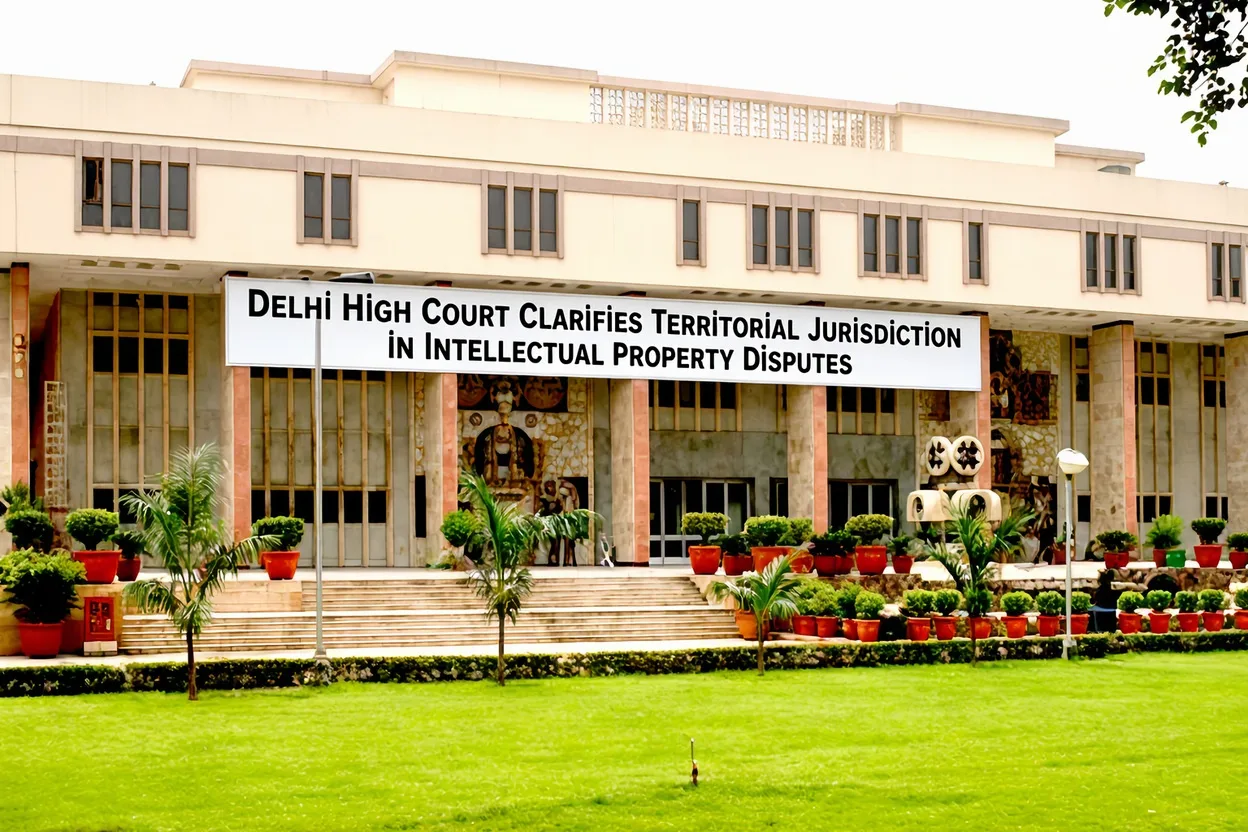
Delhi High Court Returns Ten Intellectual Property Suits Over Lack of Territorial Jurisdiction
The Delhi High Court has returned ten intellectual property (IP) infringement suits after finding that the disputes lacked a sufficient territorial connection with Delhi. Justice Purushaindra Kumar Kaurav held that a minor or artificially created link with the national capital cannot automatically confer jurisdiction when the substantial part of the dispute is centred in another State.
The common judgment was delivered on November 19, 2026, in Sotkon SP SLU v. Western Imaginary Transcon Pvt. Ltd. & Ors. and connected matters. The Court applied the principles laid down in its earlier November 3 ruling in ABD Maestro Private Limited v. Great Galleon Ventures Ltd., which involved the return of plaints in 17 commercial intellectual property disputes.
Why Were the Suits Returned?
The ten suits involved allegations relating to patent, design, trademark and copyright infringement. The plaintiffs attempted to establish Delhi's territorial jurisdiction through factors such as website accessibility, online marketplace listings, alleged sales, investigator-led purchases and other limited transactions connected with the city.
However, the Court examined the actual substance of each dispute, including the location of manufacturing activities, the parties' business operations, contractual relationships and the nature of the injunctions sought. It concluded that the material, integral and essential parts of the disputes were more closely connected with other jurisdictions.
Important Disputes Examined by the Court
Among the matters was a patent infringement suit filed by Novartis concerning the cancer drug Dabrafenib. Although the Court acknowledged that an allegedly infringing version of the drug had been sold in Delhi, it found that Mumbai had a stronger connection with the dispute because Novartis' Indian affiliate holding the relevant marketing and import licence was based there.
In another patent dispute, German company Gebr Schmid challenged the alleged infringement of its patent by Waaree Energies. The Court observed that the products were manufactured in Surat, Gujarat, and that the relief sought extended beyond an isolated transaction in Delhi to the alleged manufacturing activities.
The Court also examined a design infringement dispute involving Nyra Chocolates. The plaintiff relied on a transaction involving a dealer in Bihar and delivery to Badarpur, Delhi. However, the Court questioned the evidentiary value of the transaction and considered the freight arrangements and contractual jurisdiction clause while determining the appropriate forum.
Other disputes involved companies including Sotkon, Mold-Tek Packaging, HLE Glascoat, Plusplus Lifesciences, Global Music Junction and Dr. Reddy's Laboratories.
Role of Forum Conveniens
An important aspect of the ruling was the application of the doctrine of forum conveniens. The Court emphasised that even where a limited part of the cause of action may arise within a particular jurisdiction, the Court can examine whether another forum has a substantially stronger connection with the dispute.
The Court observed that a slender connection with Delhi should not deprive another court of its rightful and appropriate jurisdiction. Therefore, the plaintiff's choice of forum cannot be treated as unrestricted when the essential elements of the dispute lie elsewhere.
Legal Provisions and Directions
The Court considered territorial jurisdiction under Section 20 of the Code of Civil Procedure, 1908, alongside the relevant provisions of the Trade Marks Act, 1999 and the Copyright Act, 1957, wherever applicable.
All ten plaints were returned under Order VII Rule 10 read with Section 151 of the CPC, allowing the plaintiffs to present them before the courts having appropriate territorial jurisdiction. The plaintiffs were also granted liberty to seek appropriate directions under Order VII Rule 10A of the CPC.
Why the Judgment Matters
The ruling reinforces that intellectual property owners cannot establish territorial jurisdiction merely by pointing to an accessible website, an isolated online transaction or an investigator-arranged purchase. Courts will examine the real geographical connection of the alleged infringement and the substance of the relief sought.
The decision is particularly significant for businesses and IP litigators who choose forums for infringement proceedings. However, the broader legal position remains subject to the outcome of the larger Bench proceedings in the Delhi High Court on the same jurisdictional issue.
Case: Sotkon SP SLU v. Western Imaginary Transcon Pvt. Ltd. & Ors. and connected matters
Neutral Citation: 2026:DHC:10260
Decision Date: November 19, 2026
Judge: Justice Purushaindra Kumar Kaurav
Court: Delhi High Court