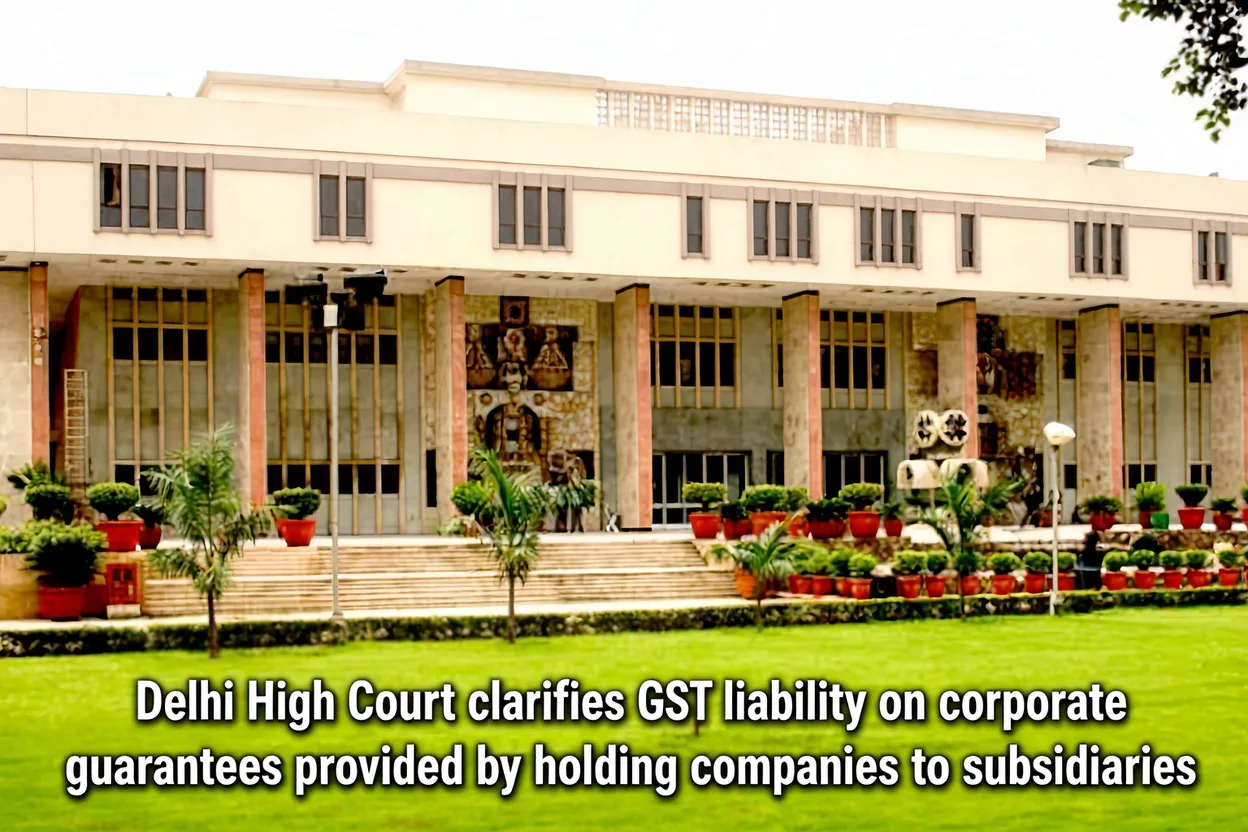
Delhi High Court Holds Corporate Guarantees for Subsidiary Loans Taxable Under GST Even Without Consideration
The Delhi High Court has held that corporate guarantees furnished by holding or group companies to banks or financial institutions for loans obtained by related entities constitute a taxable supply of services under the Central Goods and Services Tax Act, 2017, even where no guarantee commission or other consideration is charged.
In Sterlite Power Transmission Limited & Ors. v. Union of India & Ors., a Division Bench comprising Justices Anil Kshetarpal and Bharat Parashar ruled that providing a corporate guarantee involves assuming the risk of the subsidiary's default and extending the guarantor's creditworthiness to the borrowing entity. Accordingly, the subsidiary is the recipient of the service.
Corporate Guarantees Constitute a Supply of Services
The Court examined Section 7(1)(c), read with Entry 2 of Schedule I of the CGST Act, 2017. These provisions recognise certain transactions between related persons as supplies even when no consideration is involved, provided they are made in the course or furtherance of business.
The Bench held that a corporate guarantee is not excluded from GST merely because the holding company receives no separate payment. The benefit lies in the financial support and creditworthiness extended to the subsidiary, enabling it to obtain loans from financial institutions.
One Per Cent Valuation Benchmark Is Not an Absolute Minimum
The Court also examined Rule 28(2) of the CGST Rules, which prescribes a deemed valuation mechanism for corporate guarantees between related persons.
While upholding the rule-making framework, the Court read down the provision to the extent that it treated the deemed value of 1% of the guaranteed amount per annum as an inflexible minimum. It held that such a mandatory floor would be arbitrary and violative of Article 14 of the Constitution.
Consequently, taxpayers may establish a lower open-market value through cogent and verifiable evidence. However, the mere absence of consideration or an agreement to charge a lower amount will not, by itself, establish a lower taxable value.
When Does GST Liability Arise?
The Court clarified that the supply takes place when the corporate guarantee is furnished. GST does not become a fresh supply every year merely because the guarantee continues to remain in force. The tax is computed at the time of supply for the entire tenure of the guarantee, although collection may be made in annual instalments.
Renewal, extension or enhancement of a guarantee may constitute a fresh supply. Invocation of the guarantee by the lender, however, does not independently trigger another GST liability.
Different Treatment Based on the Date of the Guarantee
- Before 1 July 2017: Guarantees are not taxable under GST unless subsequently renewed, extended or enhanced after the GST regime commenced.
- 1 July 2017 to 25 October 2023: Guarantees may attract GST under the valuation provisions applicable during that period, without applying the later 1% benchmark retrospectively.
- On or after 26 October 2023: Rule 28(2) applies to guarantees executed, renewed, extended or enhanced during this period, subject to the Court's interpretation permitting a substantiated lower open-market value.
Earlier Bombay High Court View Distinguished
The Delhi High Court declined to follow the contrary approach adopted by the Bombay High Court in D.P. Jain & Co. Infrastructure Pvt. Ltd. The Bench observed that the earlier decision relied on a Supreme Court ruling under the erstwhile service tax regime and did not adequately examine the effect of Section 7(1)(c) read with Schedule I of the CGST Act.
The Court's approach is consistent with the Gujarat High Court's decision in Torrent Power Ltd. on the fundamental question of taxability of corporate guarantees between related persons.
Relief to Petitioners and Implications for Businesses
The Court set aside the challenged notices, orders and demands to the extent that they were inconsistent with its findings. It directed the tax authorities to determine the companies' liabilities afresh, after providing them an adequate opportunity of hearing.
The ruling has significant implications for corporate groups, particularly those in the power, infrastructure, renewable energy and financial sectors. Companies will need to review their guarantee arrangements, maintain supporting valuation documentation and assess their GST exposure in light of the judgment.
The decision is particularly important because it distinguishes the taxability of a corporate guarantee from the valuation of that service, clarifying that the absence of consideration does not automatically eliminate GST liability.