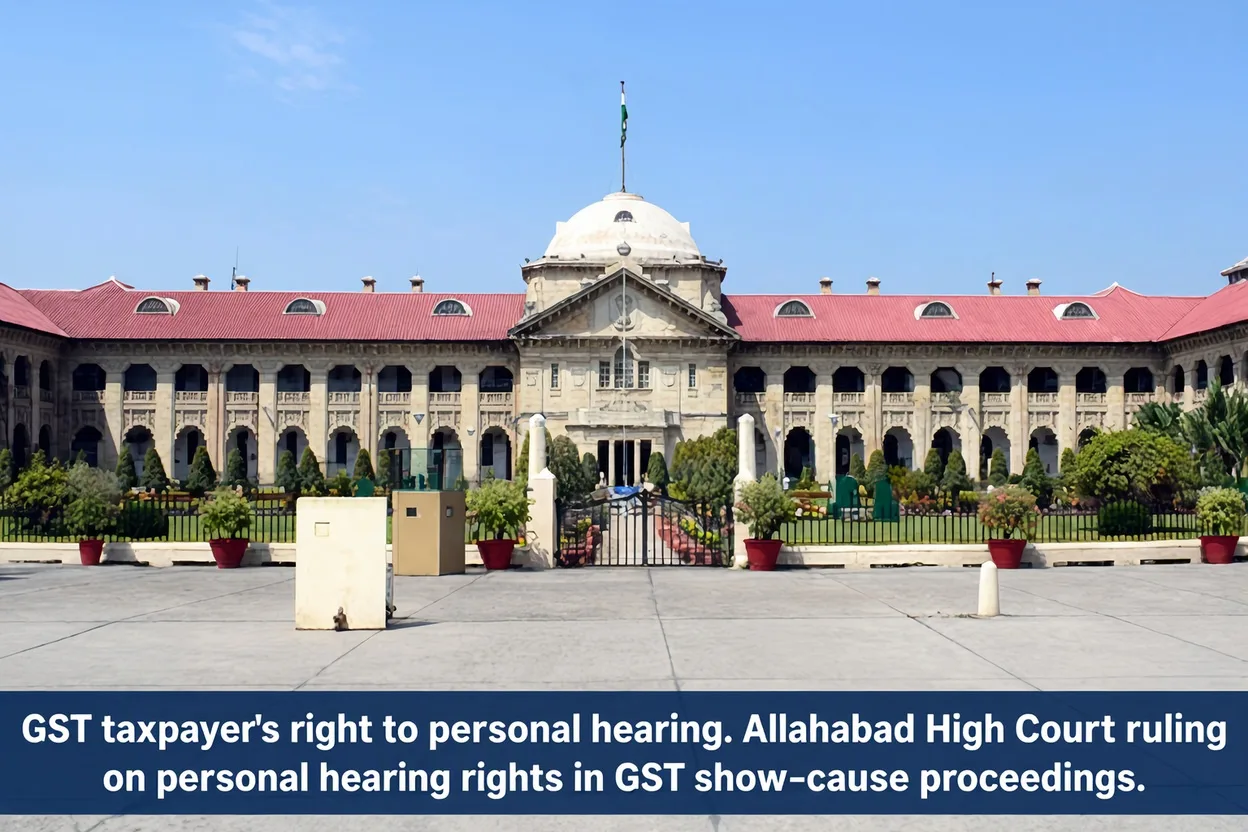
Allahabad High Court: Taxpayer's Right to Personal Hearing Cannot Be Denied Even If No Reply Is Filed to GST Show-Cause Notice
The Allahabad High Court has held that a taxpayer's failure to submit a written reply to a Goods and Services Tax (GST) show-cause notice does not automatically extinguish the right to an opportunity of personal hearing. The Court emphasised that the adjudicating authority must specify the date, time and venue of the hearing to enable the taxpayer to present their case orally.
Justice Vikas Budhwar delivered the ruling while deciding a writ petition filed by M/s Shri Ganpati Carrying Corporation v. State of Uttar Pradesh and Others (Writ Tax No. 4352 of 2026), concerning GST proceedings for the financial year 2018–19.
Background of the Case
The petitioner, a partnership firm engaged in the transportation of goods by road and based in Saharanpur, had filed its GST returns, including GSTR-1, GSTR-3B, GSTR-9 and GSTR-9C, for the relevant financial year.
Following discrepancies allegedly identified in its returns, the tax authorities issued a notice under Section 61 of the applicable GST legislation on July 15, 2023. According to the department, the taxpayer neither submitted a reply nor sought an adjournment.
Subsequently, on December 23, 2023, a show-cause notice in Form GST DRC-01 was issued, requiring the petitioner to submit its reply by January 23, 2024. However, the columns relating to the date, time and venue of personal hearing were marked as "N.A." (Not Applicable).
The Assistant Commissioner, State Tax, passed an adjudication order under Section 73 on April 23, 2024, without providing an opportunity for personal hearing. The petitioner's subsequent appeal was rejected on August 4, 2025, due to a delay of 70 days.
What Did the Petitioner Argue?
Before the High Court, the petitioner challenged both the original adjudication order and the appellate order. It argued that once a show-cause notice had been issued, the original authority was required to provide an opportunity of personal hearing by specifying the date, time and venue.
The State's counsel argued that the taxpayer had failed to respond to both the scrutiny notice and the show-cause notice. However, the State could not dispute that the hearing particulars had never been fixed.
High Court's Observations
Justice Vikas Budhwar rejected the contention that non-submission of a written reply could justify denying an opportunity of personal hearing.
The Court observed that once a show-cause notice is issued, the assessee may choose whether or not to submit a written reply. However, even where no reply is submitted, the original authority is expected to fix the date, time and venue of the personal hearing so that the assessee can present their position orally.
The Court further observed that the failure to provide these essential hearing particulars affected the proceedings at their very foundation.
"Since the very foundation itself is weak eliminating the substratum, thus the entire proceeding stands vitiated."
What Did the Court Order?
The High Court set aside the original GST adjudication order dated April 23, 2024, as well as the appellate order dated August 4, 2025.
The matter was remitted to the Assistant Commissioner, State Tax, Saharanpur, for fresh proceedings from the stage following service of the show-cause notice.
The Court directed the petitioner to submit its reply by November 13, 2026. The authority was instructed to provide a personal hearing during the week commencing November 23, 2026, after giving at least five days' prior intimation through the specified communication channels.
A fresh order was directed to be passed by December 24, 2026. The Court also restricted adjournments to exceptional circumstances beyond the taxpayer's control, with no adjournment extending beyond three days at a stretch.
Legal Significance
The decision reinforces the importance of procedural fairness and natural justice in GST adjudication. It highlights that the opportunity to submit a written response and the opportunity to present one's case through a personal hearing are distinct procedural safeguards.
However, the Court did not decide the underlying tax liability on merits. Instead, it directed the authorities to reconsider the matter after providing the taxpayer an appropriate opportunity to respond and be heard.
Case: M/s Shri Ganpati Carrying Corporation v. State of Uttar Pradesh and Others
Court: Allahabad High Court
Bench: Justice Vikas Budhwar
Case Number: Writ Tax No. 4352 of 2026
Neutral Citation: 2026:AHC:226636
Decision Date: November 2, 2026