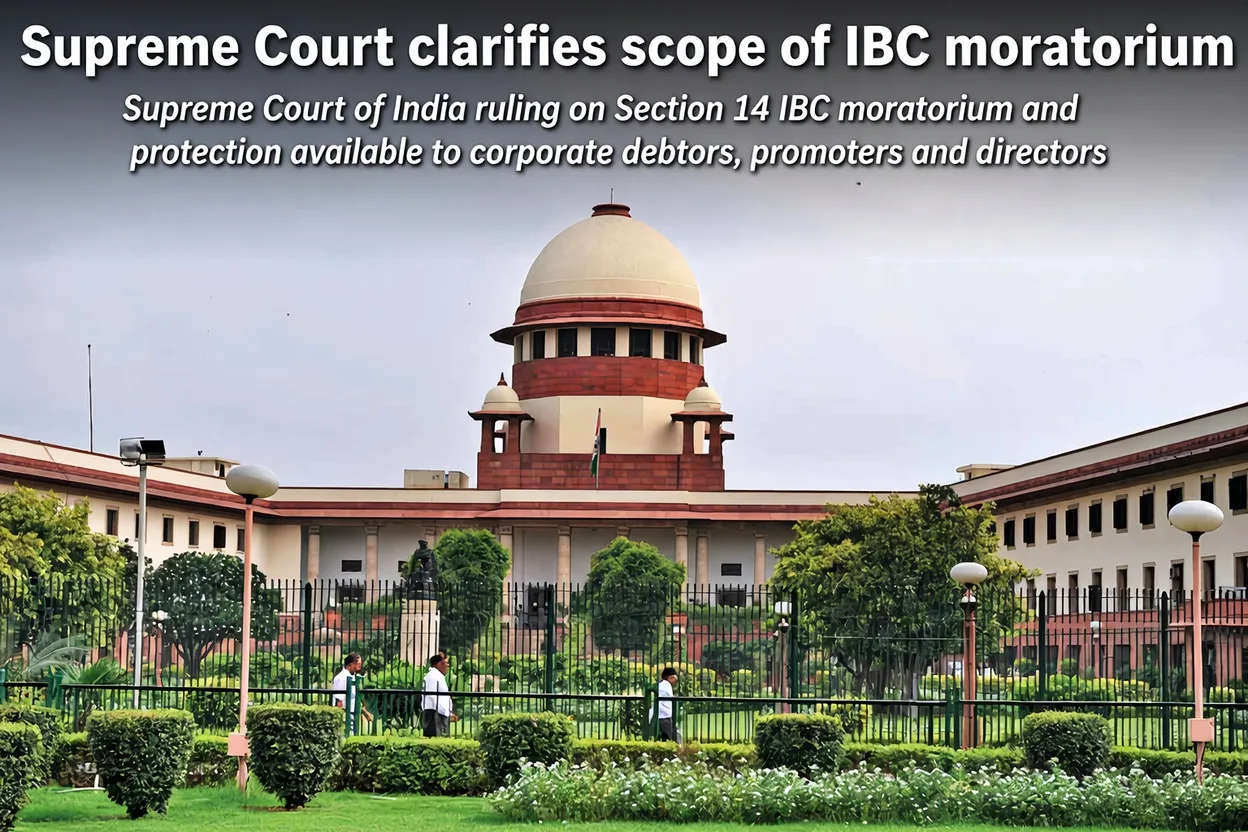
Supreme Court Clarifies IBC Moratorium Does Not Extend to Promoters or Directors
The Supreme Court of India has reiterated that the moratorium imposed under Section 14 of the Insolvency and Bankruptcy Code, 2016 (IBC) operates exclusively in relation to the corporate debtor and does not automatically extend protection to its promoters or directors.
A Bench comprising Justice Sanjay Kumar and Justice Sanjeev Sachdeva made the observation while deciding BSE Ltd. v. Spice Energy Pvt. Ltd. & Anr. (Civil Appeal No. 7038 of 2025). The Court set aside an order passed by the Securities Appellate Tribunal (SAT), Mumbai, and remanded the matter for fresh consideration on merits.
Background of the Dispute
The dispute arose after the Bombay Stock Exchange (BSE) sought recovery of outstanding Annual Listing Fee (ALF) dues owed by Cals Refineries Limited from its erstwhile promoter, Spice Energy Private Limited (SEPL).
The National Securities Depository Limited (NSDL) had frozen SEPL's demat account following the outstanding dues. Subsequently, BSE's Review Committee rejected SEPL's request for de-freezing the account on April 26, 2023.
Aggrieved by the decision, SEPL approached the Securities Appellate Tribunal. On April 30, 2025, SAT allowed the appeal, quashed BSE's decision, directed a refund of the amount recovered towards the outstanding listing fees along with interest, and ordered immediate de-freezing of SEPL's demat account. It also imposed costs of ₹1 lakh.
SAT reasoned that Cals Refineries was undergoing the Corporate Insolvency Resolution Process (CIRP) after admission of an insolvency petition under Section 9 of the IBC on October 17, 2017. It consequently relied on the moratorium under Section 14, read with the overriding effect of Section 238 of the Code, to prevent recovery from the erstwhile promoter.
Supreme Court's Observations
Disagreeing with SAT's interpretation, the Supreme Court observed that the moratorium under Section 14 operates only in the context of the corporate debtor and not its promoters or directors.
The Bench stated:
"The moratorium that operates under that provision would only be in the context of the corporate debtor and not its promoters or directors."
The Court observed that SAT had relied primarily on Section 14 and applied Section 238 without adequately examining the other legal and factual issues raised in SEPL's appeal.
It particularly highlighted the need to examine the interpretation and application of circulars issued by the Securities and Exchange Board of India (SEBI) under the SEBI (Listing Obligations and Disclosure Requirements) Regulations, 2015.
The Court also noted that SAT had failed to examine SEPL's status in relation to Cals Refineries, despite a specific ground being raised on this issue.
Supreme Court's Decision
Finding that SAT had disposed of the appeal without properly examining the relevant questions of fact and law, the Supreme Court set aside its order dated April 30, 2025, and remanded the matter to SAT for fresh consideration on merits and in accordance with law.
The Court further recorded that SEPL had deposited ₹58,04,505 with BSE, without prejudice and under protest, pursuant to an interim order dated February 10, 2026, to secure the de-freezing of its demat account.
It clarified that the deposit would abide by the outcome of the proceedings before SAT. All issues, including SEPL's entitlement to a refund with interest if it succeeds, were left open for consideration.
Legal Significance
The decision reinforces the limited statutory scope of the moratorium under Section 14 of the IBC. It clarifies that insolvency proceedings against a corporate debtor do not, by themselves, provide equivalent moratorium protection to its promoters or directors.
However, the judgment does not conclusively determine SEPL's liability for the outstanding listing fees. That question has been left open for fresh adjudication by SAT.
Case: BSE Ltd. v. Spice Energy Pvt. Ltd. & Anr.
Case Number: Civil Appeal No. 7038 of 2025
Court: Supreme Court of India
Bench: Justice Sanjay Kumar and Justice Sanjeev Sachdeva
Decision Date: November 17, 2026
Relevant Provisions: Sections 14, 238 and 9 of the Insolvency and Bankruptcy Code, 2016.