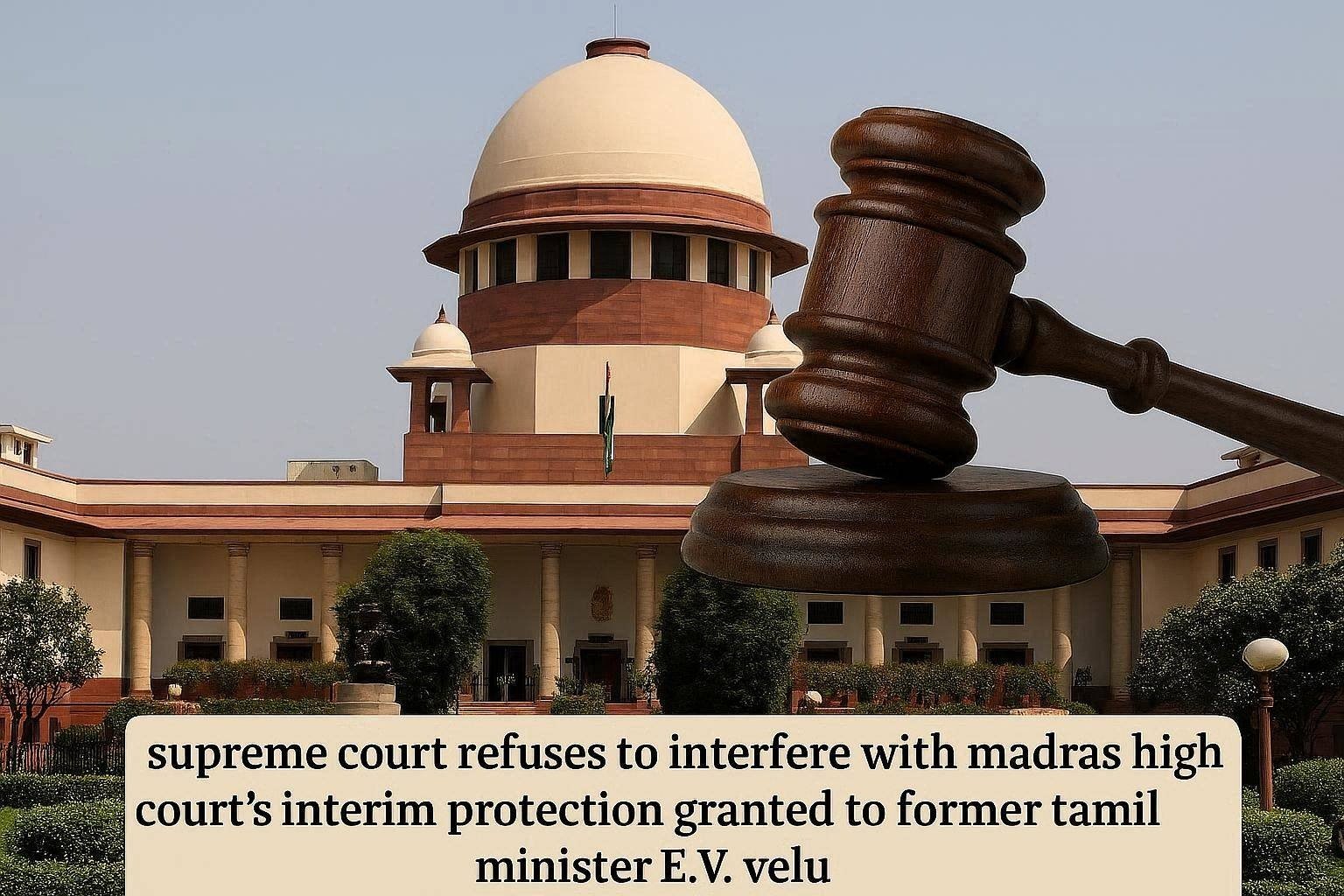
The Supreme Court of India has dismissed a petition filed by the Tamil Nadu government challenging an interim order of the Madras High Court that granted protection from coercive action to former Tamil Nadu minister and DMK leader E.V. Velu in an alleged corruption case.
A bench comprising Justice Vikram Nath and Justice Sandeep Mehta refused to interfere with the High Court's order, observing that the investigation was already underway and that Velu had been directed to cooperate with the authorities.
The matter arises from an investigation conducted by the Directorate of Vigilance and Anti-Corruption (DVAC) concerning alleged irregularities in road infrastructure projects executed during Velu's tenure as a minister. The probe focuses on allegations of financial misconduct and procedural violations in the implementation of public works contracts.
Earlier, the Madras High Court had granted interim protection to Velu by staying a Look-Out Circular issued against him and restraining coercive action until a specified date. The High Court had simultaneously directed him to appear before the investigating authorities and cooperate fully with the ongoing inquiry.
Challenging this order, the Tamil Nadu government argued before the Supreme Court that the interim protection effectively amounted to anticipatory bail despite no such relief being sought. The State contended that the High Court's order unduly restricted investigative powers.
However, the Supreme Court found no reason to interfere with the interim arrangement. The bench noted that Velu had already been directed to participate in the investigation and that the authorities retained the liberty to pursue appropriate legal remedies before the High Court if necessary.
With the dismissal of the State's plea, the Madras High Court's interim order remains operative, ensuring protection from coercive action while permitting the anti-corruption investigation to continue in accordance with law.
The ruling underscores the Supreme Court's cautious approach toward interfering with interim orders passed by constitutional courts, particularly where ongoing investigations and procedural safeguards are already subject to judicial oversight.