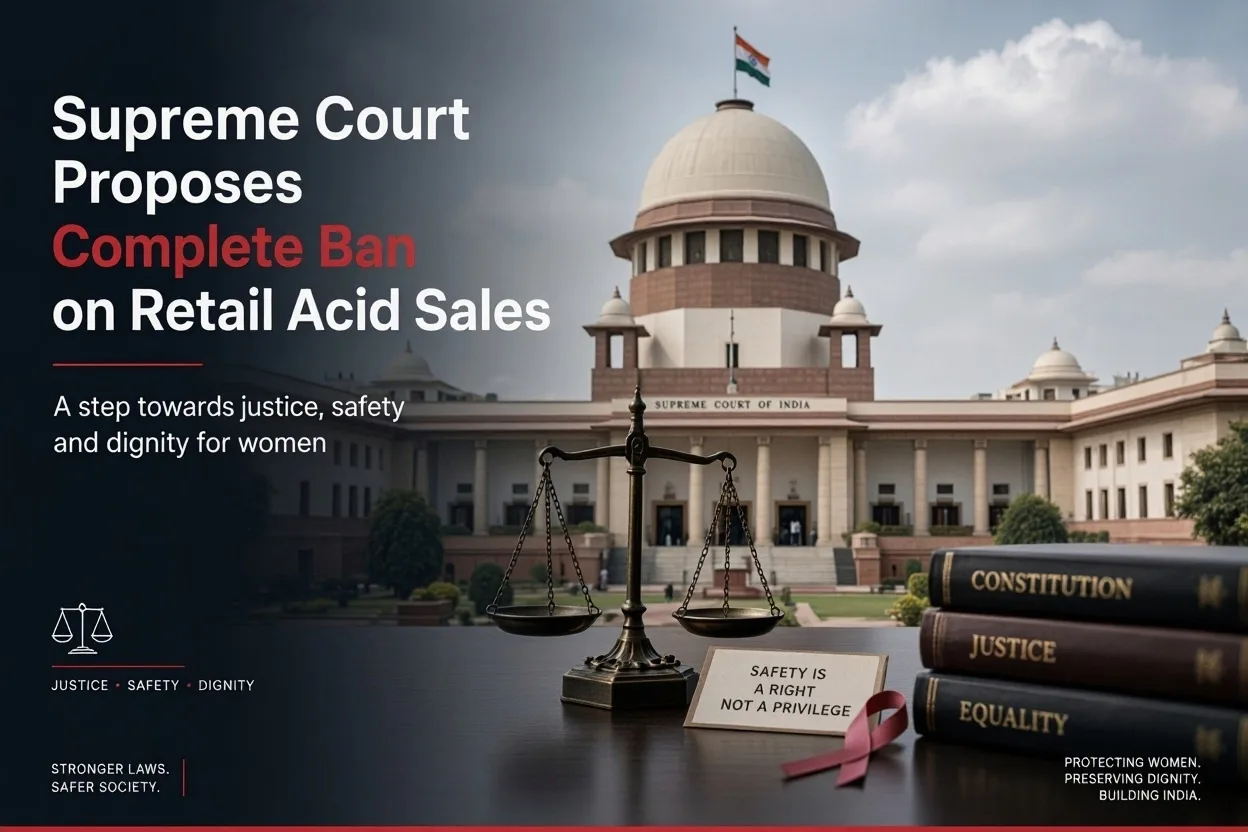
Supreme Court Proposes Complete Ban on Private Retail Sale of Acid to Curb Acid Attacks
The Supreme Court of India has urged the Union Government and State Governments to consider a complete prohibition on the retail sale of acid by private individuals, including through online platforms and door-delivery services, in a significant move aimed at preventing acid attacks across the country.
The directions were issued on November 23, 2026, in Shaheen Malik v. Union of India, Writ Petition (Civil) No. 1112 of 2025. A Bench comprising Chief Justice of India Surya Kant, Justice Joymalya Bagchi and Justice V. Mohana expressed serious concern over the continued easy and largely unregulated availability of acid in the open market.
Supreme Court Questions Continued Retail Availability of Acid
The Court observed that the safeguards introduced through its earlier directions dated July 18, 2013, in Laxmi v. Union of India had not been adequately implemented. Despite the regulatory framework, acid attacks continue, indicating serious gaps in enforcement.
The Bench emphasised the need for a comprehensive framework to regulate acid sales and prevent misuse, including through appropriate legislative or rule-making interventions.
Proposed Ban on Private Retail Sales
One of the significant measures proposed by the Court is a complete ban on the retail sale of acid by private persons, including sales through online platforms and door-delivery services.
However, the Court indicated that retail sales for medical purposes may be permitted through medical stores or pharmacies attached to Government hospitals, subject to prior written approval from the Chief Medical Officer or Civil Surgeon.
Strict Identification and Accountability of Buyers
The Court also proposed a prescribed documentation system for every permitted sale. The proposed form would record:
- The purchaser's Aadhaar number or other Government-issued photo identification.
- The quantity and stated purpose of the purchase.
- The purchaser's residential address and contact details.
- A declaration restricting use to the stated purpose.
The Bench further suggested that purchasers could be held accountable, in accordance with law, if the acid purchased by them is diverted or misused by another person, even where such misuse occurs without their knowledge.
It also suggested that details of the purchaser's immovable property may be recorded, with the possibility of attachment in accordance with law for meeting the treatment expenses or compensation of victims.
Survivor-Centric Policy and Educational Measures
Beyond regulating sales, the Supreme Court emphasised the importance of rehabilitation, emergency response and awareness. It entrusted the National Legal Services Authority (NALSA) with coordinating the dissemination and monitoring of a proposed survivor-centric policy framework and standard operating procedure.
The Court also directed the Union Government, through the Ministry of Education and the Ministry of Health and Family Welfare, to consider constituting an expert committee to develop educational modules on acid attack prevention, emergency medical response, survivors' legal rights and rehabilitation.
The proposed committee may involve institutions and stakeholders including NCERT, UGC, the National Medical Commission, NALSA, the National Commission for Women, State authorities, medical experts and survivor-led organisations.
Compliance and Further Hearing
Pending the formulation of a comprehensive policy, the Supreme Court directed the Union, States and Union Territories to strictly enforce its earlier directions in Laxmi v. Union of India and the applicable rules framed under the Poisons Act, 1919.
The Union Government has been directed to file an affidavit detailing the steps taken within two weeks. NALSA has also been directed to submit periodic compliance reports every three months.
The matter has been listed for further consideration on December 14, 2026.
Why the Order Matters
The proceedings mark an important development in India's legal response to acid attacks. By addressing the availability of acid at its source, the Court has called for stronger preventive regulation alongside victim rehabilitation, accountability and public awareness.
The proposed restrictions, however, require appropriate governmental action and should not be mistaken for an already enacted nationwide statutory prohibition.
Case: Shaheen Malik v. Union of India
Case Number: W.P. (C) No. 1112/2025
Court: Supreme Court of India
Order Date: November 23, 2026
Next Hearing: December 14, 2026