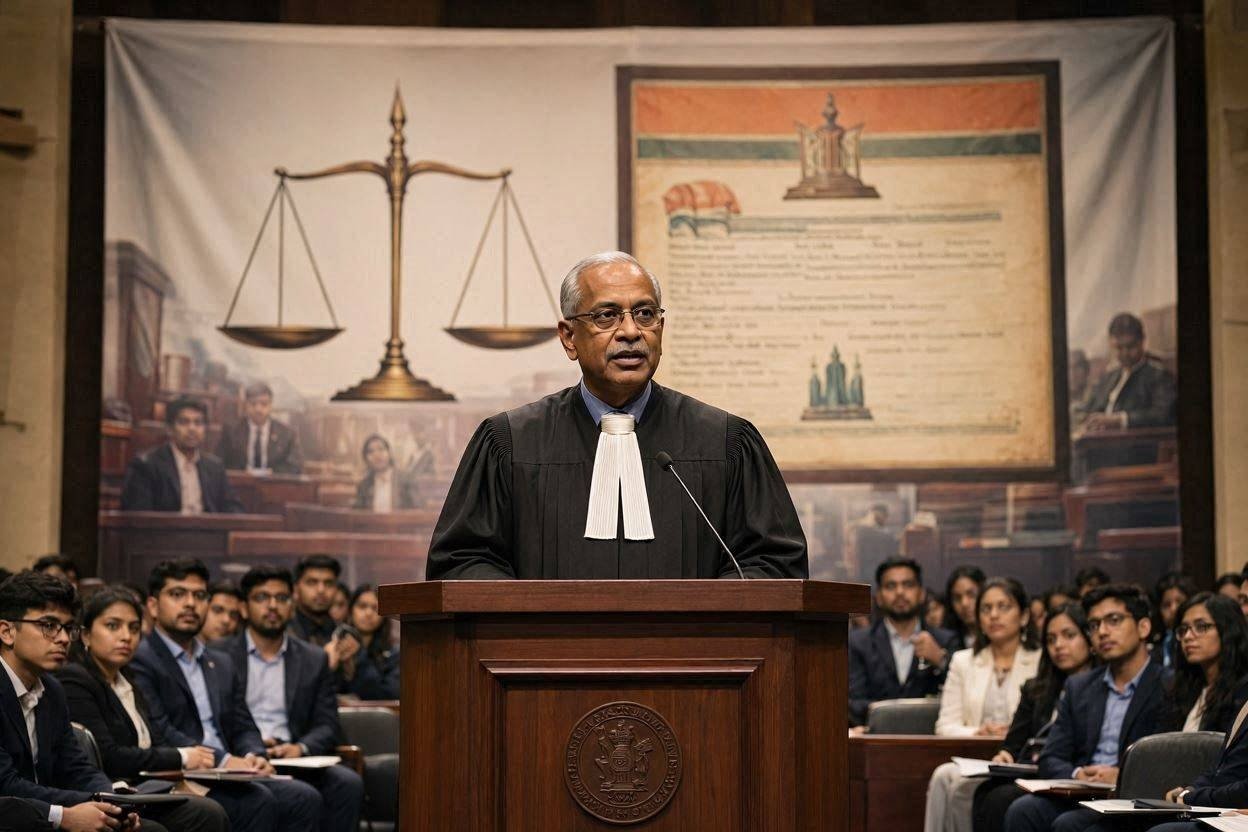
Justice Ujjal Bhuyan Raises Concerns Over Delayed Bail and Criminalisation of Ordinary Conduct
Supreme Court Judge Justice Ujjal Bhuyan has voiced strong concerns over the increasing criminalisation of ordinary activities and the delays in granting bail to individuals accused in cases involving protest, dissent, or alleged offences lacking clear legal foundations.
Speaking at a lecture hosted by the National Law Institute University (NLIU), Justice Bhuyan underscored the importance of personal liberty and cautioned against the tendency to subject citizens to prolonged incarceration before their cases are judicially examined.
Referring to a recent case involving individuals arrested after consuming non-vegetarian food during a gathering on the River Ganga, Justice Bhuyan observed that “there is no law prohibiting consumption of chicken over the Ganga river.” The remark was made to illustrate concerns about the criminalisation of conduct that may not constitute a clearly defined legal offence.
The Supreme Court judge highlighted how individuals are often subjected to lengthy detention periods before courts consider their applications for bail. According to him, such delays can undermine constitutional guarantees of liberty and due process.
Justice Bhuyan also expressed concern about judicial orders that impose restrictive conditions on the exercise of democratic rights, including peaceful assembly and protest. He referred to judicial scrutiny of decisions affecting public demonstrations and emphasized that courts must remain vigilant in protecting constitutional freedoms.
His remarks come amid broader national discussions regarding the role of bail in safeguarding individual liberty. Courts have repeatedly emphasized that bail should not be denied as a form of punishment before trial and that the criminal justice system must balance public order with fundamental rights.
The lecture has attracted significant attention within legal circles as it reflects ongoing judicial concerns regarding access to justice, procedural fairness, and the constitutional commitment to protecting civil liberties.
Justice Bhuyan's observations are likely to contribute to continuing debates on bail reform, judicial accountability, and the treatment of protest-related prosecutions within India's criminal justice system.