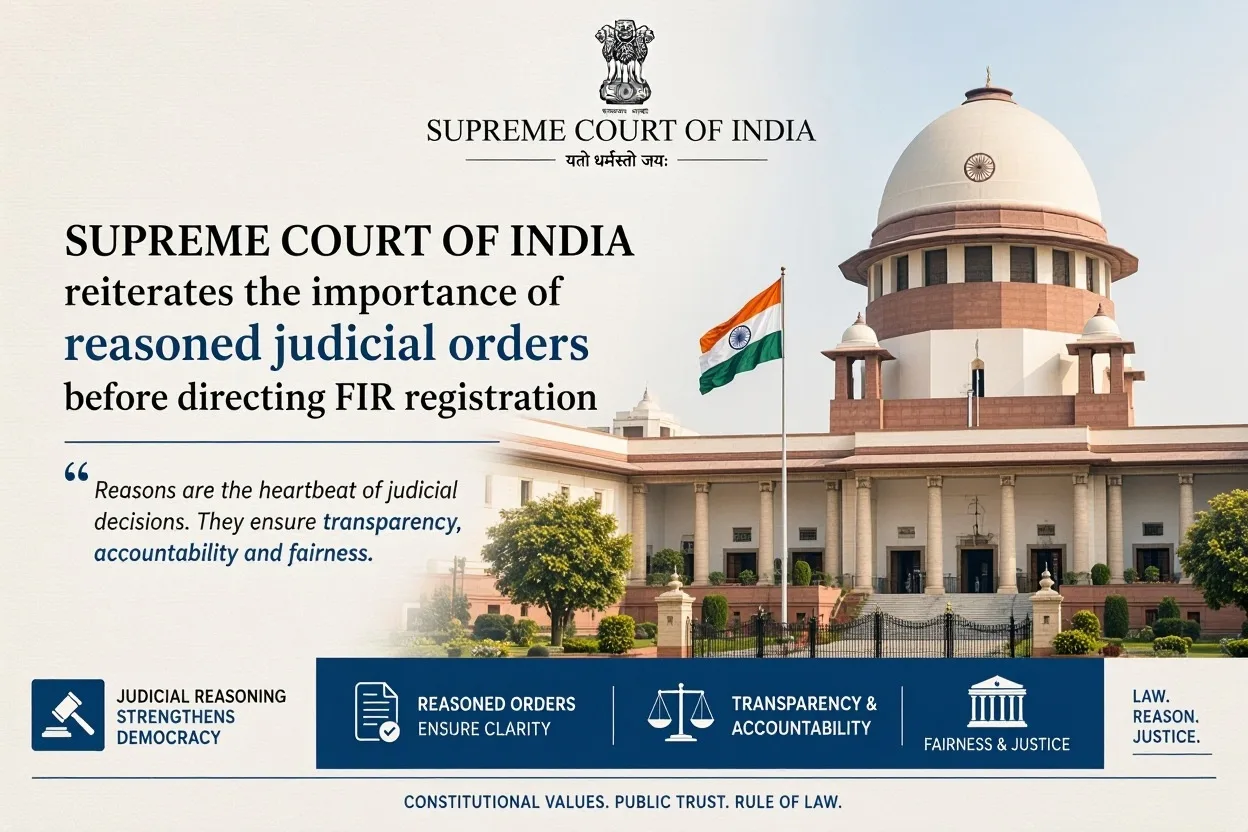
Supreme Court: Magistrates Must Record Reasons Before Ordering FIR Against Negative Police Report
New Delhi, November 21, 2026: The Supreme Court of India has held that a Magistrate must provide reasons when directing the registration of a First Information Report (FIR) despite an Action Taken Report (ATR) from the police concluding that no cognizable offence has been disclosed.
The judgment was delivered by a Bench comprising Justice Vikram Nath and Justice Sandeep Mehta in Edelweiss Asset Reconstruction Company Limited v. State of NCT of Delhi & Ors., Criminal Appeal Nos. 4622–4623 of 2026, decided on September 29, 2026.
Background of the Case
The dispute arose from commercial transactions involving landowners, a real estate developer and financial institutions, including L&T Finance Limited and Edelweiss Asset Reconstruction Company Limited (EARC). The landowners alleged cheating, criminal breach of trust and criminal conspiracy in connection with financing arrangements, mortgages and the utilisation of land and project assets.
Following a preliminary enquiry, the Economic Offences Wing (EOW) of Delhi Police concluded that no cognizable offence was made out and closed the complaint. Subsequently, the complainants approached a Magistrate under Section 156(3) of the Code of Criminal Procedure, 1973 (CrPC).
The Magistrate obtained an Action Taken Report from the police, which reiterated the conclusion that no cognizable offence had been disclosed. Nevertheless, the Magistrate directed the registration of an FIR. The Delhi High Court declined to quash the proceedings, prompting L&T Finance and EARC to approach the Supreme Court.
Supreme Court's Observations
The Supreme Court clarified that an Action Taken Report does not bind the Magistrate. However, where the Magistrate has specifically called for such a report, it constitutes relevant material that must be judicially considered.
The Bench emphasised that a Magistrate disagreeing with the police's conclusion must explain the reasons for doing so. The reasons need not be elaborate, but they must exist and relate to the material available on record.
The Court observed that an order rejecting the police's conclusion without providing reasons cannot be meaningfully examined by a superior court and effectively reflects a lack of application of judicial mind.
It further clarified that the power under Section 156(3) CrPC is discretionary rather than automatic. Magistrates must exercise this power with due care, caution and judicial application of mind, particularly where financial institutions are involved.
Distinction Between Civil and Criminal Disputes
The Supreme Court also examined whether the allegations disclosed the essential ingredients of cheating, criminal breach of trust and criminal conspiracy against L&T Finance and EARC.
It found that the allegations, even when accepted at face value, did not establish the necessary ingredients of these offences against the two financial institutions. The dispute was predominantly commercial and contractual in nature, with the complainants already pursuing remedies before civil, arbitral, insolvency and statutory forums.
The Court clarified that the mere existence of civil proceedings does not automatically prevent criminal prosecution. However, criminal proceedings cannot continue where the allegations fail to disclose an independent element of criminality.
Final Decision
The Supreme Court allowed the appeals, set aside the Delhi High Court's judgment and quashed the FIR and consequential proceedings insofar as they concerned L&T Finance Limited, EARC, and their officers and employees.
The Court expressly clarified that its findings were confined to the appellants and would not affect the proceedings against the other accused persons, which could continue independently in accordance with law.
Legal Significance
The ruling reinforces the requirement of reasoned judicial orders when Magistrates exercise their powers to direct police investigation. It also highlights that criminal proceedings must not be used as an instrument to exert pressure in disputes that are essentially civil or commercial in nature.
The judgment strengthens judicial accountability, protects against arbitrary invocation of criminal process and reiterates the importance of applying judicial mind before directing FIR registration.
Case: Edelweiss Asset Reconstruction Company Limited v. State of NCT of Delhi & Ors.
Case Citation: 2026 LiveLaw (SC) 1178
Judgment Date: September 29, 2026
Bench: Justice Vikram Nath and Justice Sandeep Mehta