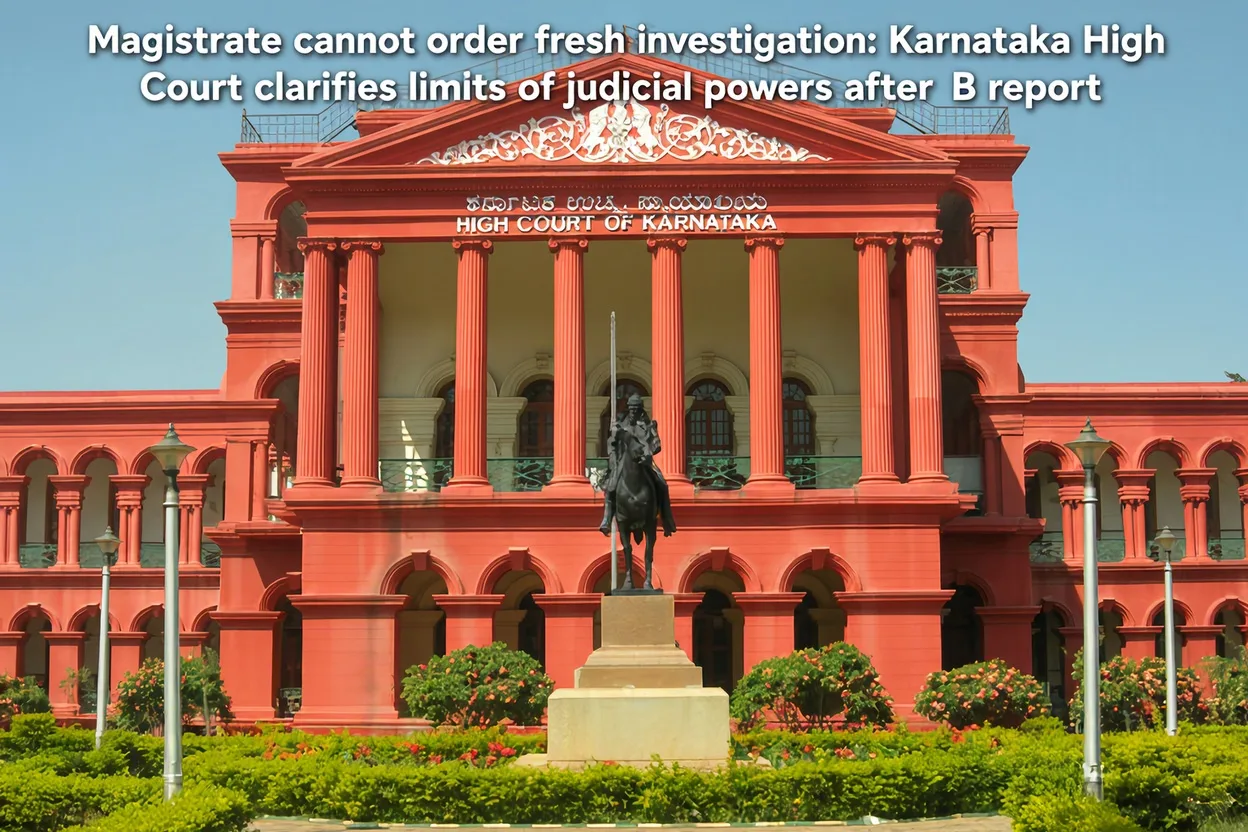
The Karnataka High Court has reiterated that a Magistrate does not have the jurisdiction to direct a fresh or de novo investigation after rejecting a police 'B' report (closure report). The Court clarified that the power to order fresh or reinvestigation rests with superior courts, while a Magistrate's authority to direct further investigation is distinct and limited.
Justice H.P. Sandesh delivered the ruling on November 21, 2026, while allowing two criminal petitions filed by Dr. T.D. Devegowda and Prof. Dr. K.S. Rangappa, former officials associated with Karnataka State Open University (KSOU).
Background of the Case
The dispute originated from Crime No. 42/2016 registered by Jayalakshmipuram Police in Mysuru following a complaint by the Finance Officer of KSOU. The complaint alleged financial irregularities involving the purchase of computers and furniture without following tender procedures, along with the payment of a mobilisation advance of approximately Rs. 1 crore to an agency under a Memorandum of Understanding.
The accused were booked under Sections 406, 409 and 149 of the Indian Penal Code, 1860. After investigation, the police filed a 'B' report, concluding that there was insufficient material to submit a charge sheet.
The complainant subsequently filed a protest petition and produced supporting documents. On March 31, 2022, the I Additional Senior Civil Judge and Chief Judicial Magistrate, Mysuru, rejected the 'B' report and directed the investigating officer to conduct a fresh investigation under Section 202 of the Code of Criminal Procedure, 1973, by obtaining original documents from the complainant university.
Aggrieved by this direction, Dr. T.D. Devegowda and Prof. Dr. K.S. Rangappa approached the Karnataka High Court seeking to set aside the Magistrate's order and quash the criminal proceedings.
Legal Issue Before the Court
The principal question was whether a Magistrate possesses the jurisdiction to order a fresh or de novo investigation after rejecting a police 'B' report, particularly by invoking Section 202 of the CrPC.
What Did the Karnataka High Court Hold?
The High Court held that a Magistrate cannot direct a fresh or de novo investigation. Referring to the Supreme Court's ruling in Vinay Tyagi v. Irshad Ali (2013) 5 SCC 762, the Court explained the distinction between further investigation and fresh investigation.
The Court observed that after a police report is submitted, the Magistrate may accept or reject the report in accordance with law. However, the Magistrate cannot direct a completely fresh investigation or reinvestigation, as such powers fall within the jurisdiction of superior courts exercising their authority under Section 482 of the CrPC or Article 226 of the Constitution of India.
The Court also relied upon Chandra Babu alias Moses v. State (2015) 8 SCC 774 and Vinubhai Haribhai Malaviya v. State of Gujarat (2019) 17 SCC 1 to explain the limits of the Magistrate's investigative powers.
Distinction Between Further Investigation and Fresh Investigation
The High Court emphasised that further investigation and fresh investigation are legally distinct. A Magistrate may direct further investigation within the scope of the law, including under Section 173(8) of the CrPC. However, ordering a fresh or de novo investigation after an investigation has already been completed is beyond the Magistrate's jurisdiction.
It further clarified that Section 202 of the CrPC is intended to assist a Magistrate in determining whether sufficient grounds exist to proceed with a complaint. It cannot be used as a mechanism to initiate a fresh police investigation on the basis of a rejected closure report.
Findings on the Merits of the Case
Apart from the jurisdictional issue, the Court examined the allegations against both petitioners.
Regarding Dr. T.D. Devegowda, the Court noted that the audit report did not establish irregularities in the purchase of computers, which formed the specific allegation against him.
Regarding Prof. Dr. K.S. Rangappa, the Court observed that he had served as Vice-Chancellor until January 2013, whereas the relevant payments under the MOU were made subsequently. The agreement was also signed by the Registrar, and the Court found no prima facie material establishing his criminal involvement.
Relying on State of Haryana v. Bhajan Lal and Pepsi Foods Ltd. v. Special Judicial Magistrate, the Court concluded that the criminal proceedings against the petitioners were not sustainable.
Final Decision
The Karnataka High Court allowed both criminal petitions, set aside the Magistrate's order dated March 31, 2022, accepted the police 'B' report and directed that the proceedings against the petitioners in Crime No. 42/2016 be dropped.
Why This Judgment Matters
The ruling reinforces the distinction between the investigative powers of Magistrates and superior courts. It highlights that judicial authorities must exercise their statutory powers within the limits prescribed by criminal procedure law.
For criminal practitioners, the judgment is particularly relevant when challenging orders directing fresh investigation following the submission of a closure report. It also reiterates the importance of distinguishing further investigation from fresh or de novo investigation.
Case Details:
- Case: Prof. Dr. K.S. Rangappa v. State of Karnataka and connected petition, including Dr. T.D. Devegowda v. State of Karnataka
- Case Numbers: Criminal Petition Nos. 6286 of 2022 and 7111 of 2022
- Court: High Court of Karnataka, Bengaluru
- Judge: Justice H.P. Sandesh
- Decision Date: November 21, 2026
- Relevant Provisions: Sections 156(3), 173(8), 202 and 482 of the CrPC; Article 226 of the Constitution of India