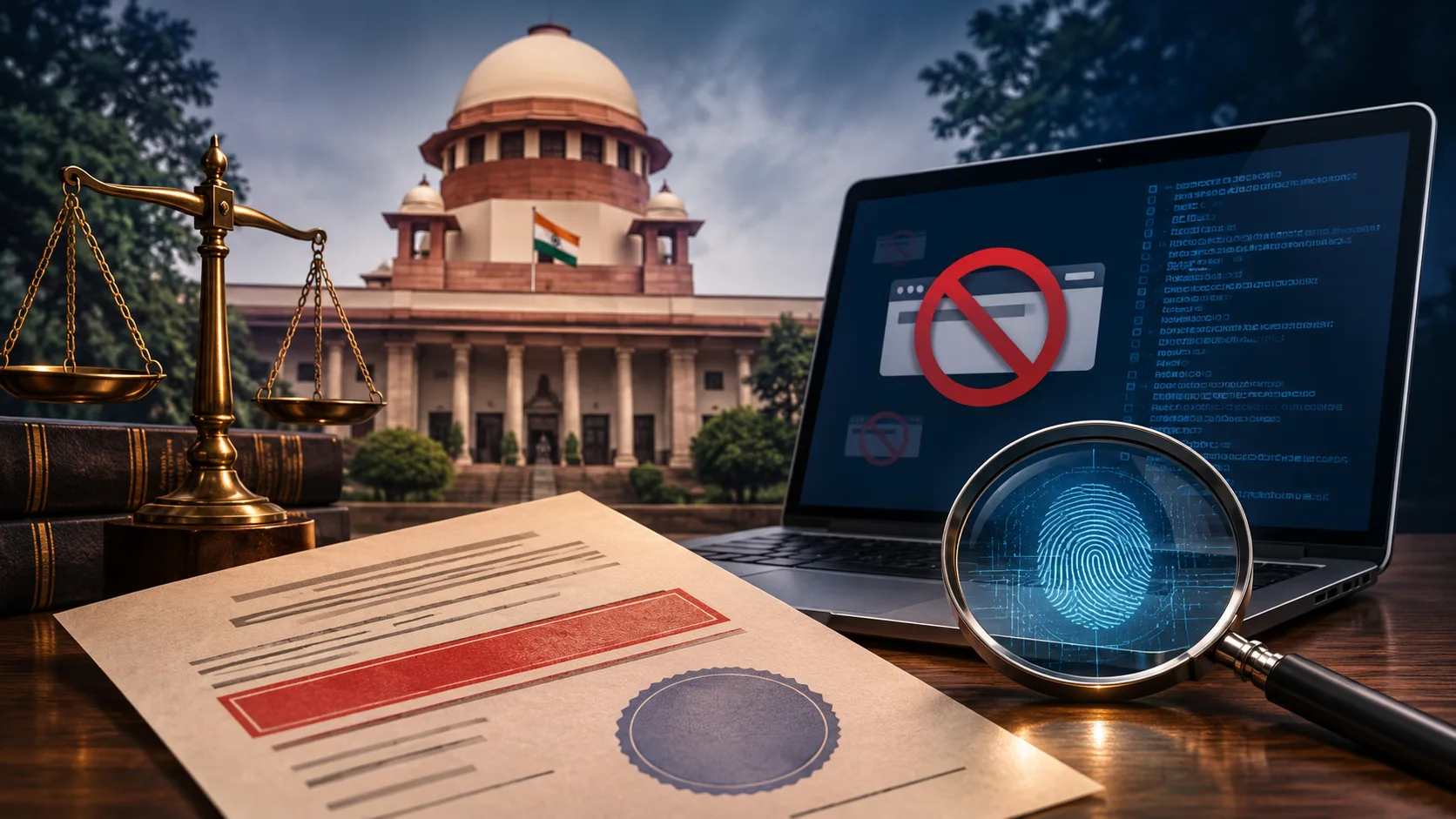
India Investigates Website Blocking Based on Forged High Court Orders
India has launched a government inquiry and a criminal investigation after discovering that 129 websites were blocked on the basis of forged court orders allegedly issued in the names of the Rajasthan High Court and the Allahabad High Court. The development has raised serious concerns regarding judicial document forgery, cybercrime and the verification mechanisms governing website-blocking directions.
How the Forgery Came to Light
According to a Reuters investigation, the Department of Telecommunications (DoT) issued website-blocking directions on July 21 and September 2, 2026, relying on purported judicial orders received through email. The documents allegedly directed authorities to restrict access to websites associated with illegal betting activities.
Subsequent verification revealed that the purported orders had not been issued or registered by the respective High Courts. The forged documents reportedly contained fabricated court seals, official-looking signatures and other features intended to make them appear authentic.
Allahabad High Court Initiates Police Action
The Allahabad High Court's verification process established that the purported order issued in the name of Justice Garima Prashad was not genuine. The document reportedly referred to a case that did not exist in the court's official records.
Following the discovery, the High Court administration initiated police action. An FIR was registered against unidentified persons at Prayagraj on November 6, 2026, following a complaint by the court administration.
The case reportedly involves provisions of the Bharatiya Nyaya Sanhita, 2023, relating to cheating, forgery and the use of forged documents as genuine, along with relevant provisions of the Information Technology Act, 2000.
Police Seek Digital Logs and Ministry Records
Uttar Pradesh cybercrime officials have sought information from the Department of Telecommunications, including details of its content management system, website administration and digital logs. Investigators have reportedly sent a questionnaire containing 24 questions to understand how the forged documents were received, processed and acted upon.
The investigation is expected to examine the origin of the communications, possible misuse of official credentials, access to government systems and the identities of those responsible for submitting the fabricated documents.
Government Reviews Website-Blocking Safeguards
The telecom ministry has initiated an internal inquiry to examine its procedures for implementing website-blocking directions based on judicial orders. Officials have indicated that additional verification mechanisms may be introduced before action is taken on documents presented as court orders.
The ministry is also considering revoking the blocking directions issued on the basis of the forged documents and removing the related material from its website.
Legal Significance
The incident highlights the serious consequences of relying on unverified judicial documents in administrative decision-making. It raises questions about the authenticity of electronic communications, the security of official government systems and the need for independent verification of court orders before restricting online access.
It also reinforces the importance of protecting the integrity of judicial institutions against forged documents and digital impersonation. The investigation remains ongoing, and responsibility for the alleged fraud has yet to be established.
Source: Reuters, reporting dated November 12, 2026.