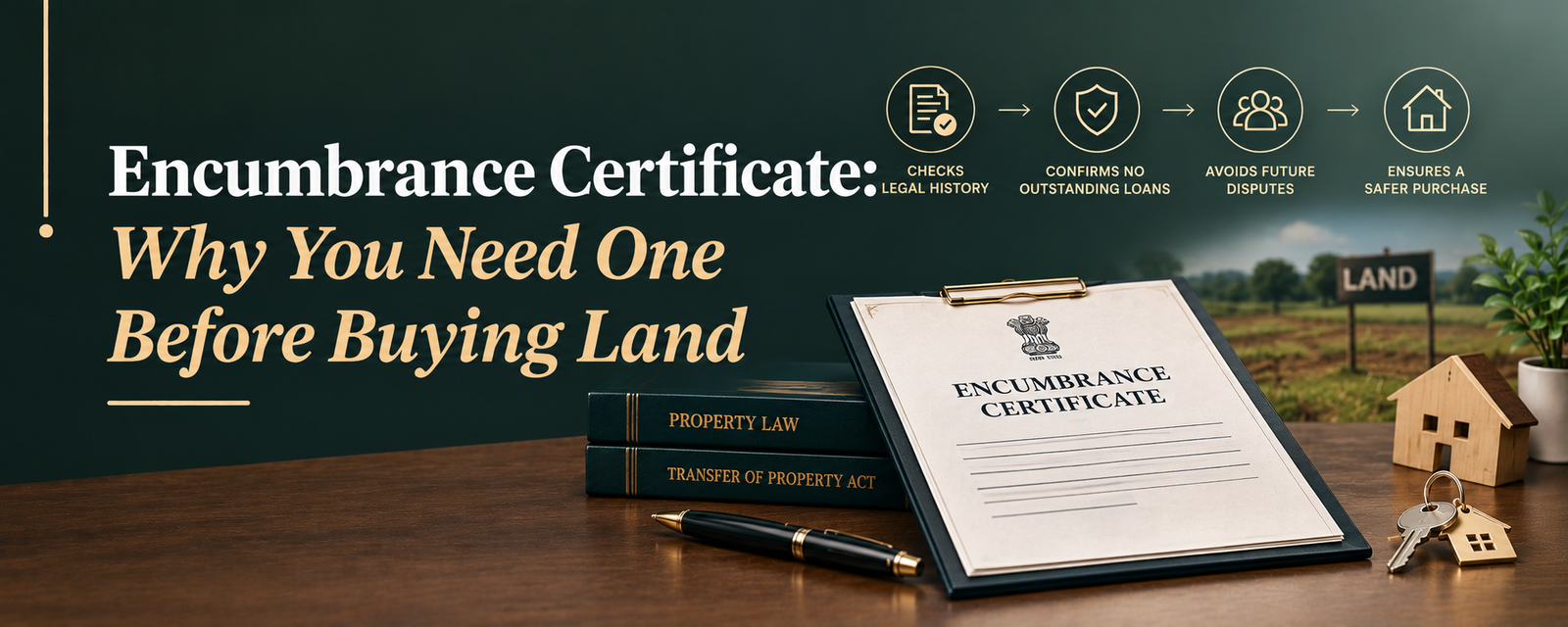
Buying land is often considered a major financial decision, whether it is purchased for building a house, making an investment, or securing an asset for the future. However, the process involves much more than deciding the location, negotiating the price, and completing the registration formalities. A property may appear suitable on the surface yet carry legal or financial liabilities that may affect the buyer after the transaction is completed.
One document that helps a prospective buyer examine a property's transaction history is the Encumbrance Certificate (EC). It provides information about registered transactions affecting the property for a specified period and can help identify mortgages and other dealings that require further investigation.
But is obtaining an Encumbrance Certificate enough to establish that a property is legally safe to purchase? Not necessarily. Although the certificate is an important part of property verification, it has limitations that every buyer should understand.
In India, where land ownership may involve several previous transfers, inheritance claims, mortgages and disputes, proper verification of property documents is particularly important. An EC can assist in this process, but it must be examined alongside other relevant records.
What Is an Encumbrance Certificate?
An Encumbrance Certificate is an official record issued by the concerned registration authority, generally through the jurisdictional Sub-Registrar's Office, showing registered transactions relating to a specified property during the period for which a search is requested.
The term encumbrance generally refers to a legal or financial burden affecting property. A mortgage is a common example, as the property may be subject to a lender's rights until the secured debt is properly discharged. However, an EC is not restricted to mortgages. It may also contain details of registered sale deeds, gift deeds, releases and other instruments affecting the property.
Section 57 of the Registration Act, 1908 provides for inspection of specified registration books and indexes, subject to prescribed fees, and for obtaining copies of relevant entries in accordance with the statutory conditions. It does not itself establish a uniform procedure for issuing an Encumbrance Certificate throughout India. The application procedure, format and related requirements depend upon the applicable State registration rules. In practice, an EC is prepared from the relevant registration records for the period and property covered by the search.
For instance, if a seller claims to be the sole owner of a piece of land, but the EC reveals a registered mortgage or an earlier transaction involving the same property, the buyer has a reason to investigate further. The entry does not automatically establish that the proposed sale is invalid, but it may reveal an obligation or competing interest that cannot safely be ignored.
A certificate showing no relevant entries for the requested period is commonly called a Nil Encumbrance Certificate. It means that no relevant entries were found in the records searched for that period. It does not independently prove ownership or establish that the property has never been subject to any liability or competing claim.
Why Do You Need an EC Before Buying Land?
1. To identify registered mortgages and other liabilities
One of the primary reasons for obtaining an EC is to identify registered transactions that may affect the property. A seller may offer land for sale without clearly explaining its existing legal or financial position. Examining the certificate can help reveal a registered mortgage or another transaction that requires clarification.
Consider a situation where a landowner mortgages a plot to a bank to obtain a loan and later decides to sell it. The EC reveals the registered mortgage, but the seller claims that the loan has already been repaid. The safer approach is to verify the loan position, obtain appropriate evidence of repayment and mortgage discharge, and confirm whether further formalities are necessary before completing the purchase.
If the mortgage remains in force, the buyer should not proceed as though the property were free from the lender's rights. The transaction may require the lender's involvement and a properly documented arrangement for discharging the mortgage.
However, not every mortgage will necessarily appear in an EC. Under Section 58(f) of the Transfer of Property Act, 1882, a mortgage may be created by depositing title deeds in the circumstances specified by that provision. Section 59 generally requires a registered instrument for mortgages other than a mortgage by deposit of title deeds, subject to the statutory framework. A mortgage created by deposit of title deeds may therefore not appear in the same manner as a registered mortgage instrument. The position depends upon how the mortgage was created and the applicable legal requirements. This is why the buyer should also examine the title documents and relevant loan records rather than relying exclusively on the EC.
2. To examine the property's transaction history
Land may pass through several hands before reaching its present owner. Each transfer can affect the legal position of the property, particularly where there are questions concerning ownership, the extent of the land transferred, or the authority of the person executing the deed.
An EC helps a buyer examine registered dealings during the relevant period and compare them with the documents produced by the seller. If the seller claims to have acquired the land through a registered sale deed, the buyer can check whether the relevant transaction appears in the certificate.
This is particularly useful where the property has undergone multiple transfers. A discrepancy between the seller's explanation and the registered records should be investigated rather than overlooked merely because the present seller possesses a sale deed.
3. To identify transactions requiring further verification
The value of an EC is not restricted to discovering an existing mortgage. It can also draw attention to previous transactions that may require legal examination.
For example, a certificate may reveal a registered gift deed, release deed or earlier sale involving the property. The buyer may then need to determine whether the present seller acquired the entire property, whether any interest was retained by another person, and whether the proposed transaction is consistent with the earlier documents.
Such entries do not necessarily indicate wrongdoing. A registered transaction may be entirely valid and form part of a lawful chain of ownership. The purpose of verification is to understand the nature and legal effect of the transaction before proceeding.
4. To reduce the risk of future disputes
Property disputes can arise years after a purchase, sometimes involving earlier owners, family members, lenders or persons claiming an interest in the land. Resolving such disputes may require substantial time, money and legal proceedings.
An EC cannot prevent every dispute, but it can help identify certain risks before the transaction is completed. It also allows the buyer to compare the seller's claims with official registration records and investigate discrepancies before committing to the purchase.
How to Obtain and Verify an Encumbrance Certificate
The procedure for obtaining an EC differs from State to State. In general, an application may be submitted through the relevant registration department's online portal or at the jurisdictional Sub-Registrar's Office, subject to the facilities available in that State.
The applicant is generally required to provide details identifying the property, such as its survey number, plot number, village and other prescribed particulars. The period for which the search is required must also be specified. After the prescribed procedure and fee requirements are completed, the authority issues the certificate based on the relevant registration records.
However, obtaining the certificate is only the first step. The buyer should carefully examine the following:
- Property description: Check whether the survey number, plot number, area, boundaries and other identifying particulars match the land being purchased.
- Search period: Ensure that the search covers an appropriate period of the property's transaction history. A limited search may leave earlier dealings unexamined.
- Registered transactions: Examine each relevant entry and obtain copies of the underlying documents wherever necessary.
- Outstanding liabilities: If a mortgage or other charge appears, verify whether it has been discharged and whether further action is required before purchase.
An error in the property's description may affect the usefulness of the search. Therefore, the details supplied while applying for the EC should be accurate and sufficiently complete to identify the land.
Legal Position and Limitations of an EC
The Karnataka High Court examined the legal nature of an Encumbrance Certificate in M. Ramakrishna Reddy v. Sub-Registrar, Rajajinagar, AIR 2000 Kant 46, decided on 5 April 1999. The Court explained that an EC is not a document of title and does not itself create or affect title. Rather, it provides references to registered documents and transactions recorded in the relevant registration indexes.
The judgment also clarified that an EC is not limited to mortgages or other encumbrances in the strict legal sense. It may record other registered dealings affecting the property, including sales and releases. Therefore, an entry in an EC must be understood in the context of the underlying document; its appearance in the certificate does not, by itself, determine the legal validity or effect of that transaction.
This distinction is crucial. A person may possess a registered sale deed, but that does not automatically establish that the person had a valid title to transfer. Similarly, an EC showing no entries cannot, by itself, prove that the seller is the lawful owner.
There are practical limitations as well. An EC primarily reflects transactions recorded in the relevant registration records for the period searched. Unregistered claims, certain legal disputes, errors in indexing and transactions that are not properly reflected in those records may not be apparent from the certificate. A pending civil suit, for example, cannot be assumed to appear in the EC merely because it concerns the property.
A Nil EC must therefore be read within its limits: it indicates that no relevant entries were found in the records searched for the specified period. It does not independently establish ownership or rule out every mortgage, liability or competing claim. Further examination of the title deeds and other relevant records remains necessary.
Other Documents That Should Be Checked
An EC should form part of a broader examination of the property's legal position. Depending on the nature and location of the land, the buyer should also examine the following documents:
- Title deeds: Previous sale deeds and other relevant documents should be examined to establish how ownership passed from earlier holders to the present seller.
- Revenue records: Records such as the Record of Rights and mutation entries may help verify recorded possession and revenue particulars. However, revenue entries do not independently establish title.
- Mortgage and loan records: Where the property has been mortgaged, the buyer should verify the outstanding liability and obtain appropriate evidence of discharge or release.
- Litigation and legal claims: Relevant court proceedings, attachment orders and claims affecting the property should be investigated where necessary.
- Land-use and statutory approvals: Depending on the property, it may be necessary to verify its permitted use, conversion status, layout approvals and compliance with applicable local laws.
The precise documents required will depend upon whether the property is agricultural land, a residential plot or land forming part of a larger development. A legal review of the title documents can help identify missing links or inconsistencies that an EC alone cannot resolve.
Conclusion
An Encumbrance Certificate is an important document to obtain before buying land because it helps a prospective buyer examine the property's registered transaction history and identify certain liabilities or dealings that may affect the proposed purchase. It provides a useful starting point for checking whether the seller's claims are consistent with the available registration records.
However, a clear certificate is not the same as a clear title. The buyer must still establish whether the seller has the legal right to transfer the property and whether any existing rights, liabilities or competing claims may affect the purchase.
The purpose of obtaining an EC is not merely to complete another formality before registration. It is to identify potential problems while there is still an opportunity to investigate them. Before buying land, the safer approach is to examine the EC alongside the title deeds and other relevant records, so that the decision rests on a proper understanding of the property's legal position rather than on the certificate alone.