Buying a home is one of the biggest financial decisions a person may make. For a first-time homebuyer, the process can often feel like a choice between attractive brochures, model flats, payment plans and assurances from sales representatives. The legal documents may come later, when a substantial part of the decision has already been made.
This is where the Real Estate (Regulation and Development) Act, 2016 (RERA) becomes important. The Act was introduced to regulate the real estate sector, improve transparency, protect the interests of homebuyers, and provide a mechanism for addressing disputes between promoters and allottees.
But what should a buyer actually check before booking a flat? Is checking the RERA registration number enough?
Not really. RERA gives homebuyers important statutory protections, but buying a property still requires independent due diligence. The registration status, title documents, sanctioned plans, carpet area, agreement for sale, possession date and project disclosures all deserve attention before money is committed.
What Does RERA Do for Homebuyers?
Section 3 of RERA generally requires a promoter to register a real estate project with the Real Estate Regulatory Authority before advertising, marketing, booking, selling or offering it for sale. The section also provides specific exemptions, including certain projects below the prescribed threshold, projects that had received completion certificates before commencement of the Act, and certain repair or redevelopment projects where there is no marketing, advertising, selling or new allotment. The applicable State or Union Territory rules and the facts of the project therefore matter when determining whether registration is required.
Once a project is registered, Section 4 requires the promoter to submit several details and documents. These include information concerning the land, approvals, commencement certificate, sanctioned plans, layout plans, specifications, development works, proposed facilities, apartments and their carpet areas, and the promoter's declaration regarding title and encumbrances. The promoter must also declare the proposed period for completion of the project.
This makes RERA registration useful as a starting point for due diligence. A prospective buyer can compare the information on the relevant regulatory portal with what is being represented by the promoter.
However, registration itself should not be treated as a certification that the property is completely safe to purchase. It does not by itself establish that the buyer has a perfect title, that construction will be free from defects, that the promoter will remain financially capable of completing the project, or that possession will necessarily be delivered on time.
Check the RERA Registration and Project Details
The first practical step is to locate the project on the website of the relevant State or Union Territory RERA Authority.
The buyer should verify the exact project name, promoter's name, registration number, location, phase or building covered by the registration, declared completion date and the information uploaded by the promoter.
This is particularly important for large projects developed in phases. A buyer should not assume that registration of one phase automatically covers every building or future phase of the development.
Section 11 requires the promoter to maintain a webpage for the registered project on the Authority's website and to enter specified project information for public viewing. This includes registration details, details of apartments or plots booked, approvals obtained and the status of the project, among other prescribed information. Promoters are also required to quote the Authority's website address and registration number in their advertisements or prospectuses.
The exact disclosure requirements and practices may be supplemented by State RERA rules and regulations. In Maharashtra, for example, MahaRERA has its own regulatory framework, circulars and directions dealing with project disclosures and related matters. These should not automatically be treated as applicable across India.
Verify Title and Encumbrances
The land on which a project is being developed is just as important as the flat itself.
Section 4 requires the promoter to provide a declaration concerning its legal title to the land and documents supporting that title. It also requires disclosure of encumbrances, if any. An encumbrance may broadly refer to a legal burden, claim or interest affecting the property.
A buyer should therefore examine the title-related documents disclosed for the project and understand whether the promoter owns the land or is developing it under another legal arrangement, such as through development rights.
Where the transaction involves a substantial investment, an independent title search or legal opinion may also be appropriate. The nature and extent of such due diligence will depend on the property and the documents available.
This is relevant to Section 18 as well. The provision recognises compensation where an allottee suffers loss due to defective title of the land. The existence of such a statutory remedy, however, does not make checking title before purchase unnecessary.
Check the Sanctioned Plan, Approvals and Amenities
A buyer should compare the sales brochure and model flat with the documents relating to the approved project.
Section 4 requires disclosure of sanctioned plans, layout plans and specifications. Section 11 also requires the promoter to make sanctioned plans, layout plans and specifications available to the allottee at the time of booking and issuance of the allotment letter, along with the stage-wise schedule of completion.
Section 14 requires the promoter to adhere to the sanctioned plans and project specifications. Once the sanctioned plans and specifications have been disclosed to an allottee, the promoter cannot make additions or alterations except as permitted by the section.
Minor additions or alterations may be made in accordance with the statutory provision. For other alterations or additions to the sanctioned plans, layout plans and specifications of the buildings or common areas, prior written consent of at least two-thirds of the allottees, other than the promoter, who have agreed to take apartments in that building is required.
The two-thirds consent rule therefore should not be understood to mean that every change to a project requires consent from two-thirds of allottees. The Act itself distinguishes between minor alterations and other alterations covered by the consent requirement.
Before booking, the buyer should therefore check the sanctioned plan, relevant approvals and the project specifications available through the RERA records and other competent authorities. Promised amenities should also be checked against the project documents and agreement rather than relying only on a brochure or verbal assurance.
Understand the Carpet Area
The area of a flat can be surprisingly confusing. A brochure may mention carpet area, built-up area or super built-up area, and these figures should not be treated as the same.
RERA defines carpet area as the net usable floor area of an apartment, excluding areas covered by external walls, areas under service shafts, exclusive balcony or verandah areas and exclusive open terrace areas, while including the area covered by internal partition walls.
Section 4 requires the promoter to disclose the number, type and carpet area of apartments offered for sale, along with exclusive balcony, verandah or open terrace areas, where applicable.
A buyer should therefore ask for the carpet area in writing and compare the property on that basis. If additional areas are separately described, the buyer should understand what they represent and whether they form part of the agreed consideration.
Do Not Skip the Agreement for Sale
One of the most important provisions before making a substantial payment is Section 13.
A promoter cannot accept more than ten per cent of the cost of the apartment, plot or building as an advance payment or application fee without first entering into a written agreement for sale with the person and registering that agreement for sale under the applicable law.
This provision should not be read as generally permitting a promoter to collect ten per cent before entering into an agreement. The statutory restriction is specifically against accepting more than ten per cent without first entering into and registering the agreement for sale.
The agreement itself should be read carefully. Section 13 requires it to contain particulars relating to the development and specifications, payment schedule, possession date and rates of interest payable in cases of default, along with other prescribed details. The applicable State rules may prescribe the form or additional particulars of the agreement.
The buyer should check the total consideration, payment schedule, possession date, specifications, default and cancellation provisions, and other charges before signing.
Check What Has Been Promised in Advertisements
Sales material can strongly influence a homebuyer's decision. RERA therefore places a specific obligation on promoters regarding the accuracy of representations made through advertisements and prospectuses.
Section 12 provides that where a person makes an advance or deposit on the basis of information contained in an advertisement or prospectus and suffers loss or damage because of an incorrect or false statement, the promoter is liable to compensate the person in the manner provided under the Act.
If the person wishes to withdraw from the project because of such incorrect or false information, the promoter is liable to return the entire investment with the applicable interest and provide compensation as provided under the Act.
This makes it useful to preserve brochures, advertisements, emails, booking forms and other written communications that influenced the purchase decision.
A promised amenity or feature should ideally be traceable to the sanctioned project documents, specifications or agreement for sale rather than remaining only a verbal assurance.
What If Possession Is Delayed?
Possession date is one of the most important details in the agreement for sale.
Section 18 applies where the promoter fails to complete or is unable to give possession in accordance with the terms of the agreement for sale or by the date specified therein, subject to the conditions and provisions of the Act. The Act also contains provisions concerning extension of registration in circumstances covered by Section 6.
Where the statutory conditions under Section 18 are satisfied and the allottee wishes to withdraw, the promoter is required to return the amount received with interest and compensation in the manner provided under the Act. If the allottee does not withdraw, the promoter is liable to pay interest for every month of delay until possession, subject to the Act and the applicable prescribed rate.
The remedy should therefore not be understood as an automatic refund or compensation in every dispute involving delay. The agreement, the facts causing the delay, applicable statutory provisions and the allottee's choice of remedy all matter.
The buyer should therefore identify the possession date recorded in the agreement for sale and compare it with the project's RERA disclosures and progress updates.
What Protection Exists Against Construction Defects?
RERA also provides a specific protection after possession.
Under Section 14(3), where a structural defect or any other defect in workmanship, quality or provision of services, or any other obligation of the promoter under the agreement for sale relating to such development, is brought to the promoter's notice within five years from the date of handing over possession, the promoter is required to rectify the defect without further charge within thirty days.
If the promoter fails to do so, the aggrieved allottee is entitled to appropriate compensation in the manner provided under the Act.
This provision is important, but it is not a general warranty covering every possible problem with a property. Whether a particular issue falls within Section 14(3) depends on the nature of the defect and the statutory requirements.
Know the Rights and Duties of an Allottee
Section 19 gives allottees the right to obtain information relating to sanctioned plans, layout plans and specifications approved by the competent authority, as well as other information available under the Act, applicable rules and regulations, or the agreement for sale.
An allottee is also entitled to know the stage-wise time schedule for completion, including agreed provisions relating to water, sanitation, electricity and other amenities and services.
Where the statutory conditions are met, Section 19 also recognises the allottee's right to claim possession and, in specified circumstances, refund, interest and compensation.
These rights come with responsibilities. Under Section 19, an allottee who has entered into an agreement for sale is required to make payments in accordance with the agreement and pay applicable charges such as registration charges, municipal taxes, water and electricity charges, maintenance charges and other charges, where applicable.
Delay in such payments may attract interest at the prescribed rate. The Act also contains duties concerning participation in the formation of the association of allottees, taking possession after the occupancy certificate in the circumstances specified by the Act, and registration of the conveyance deed.
What RERA Does Not Replace
RERA is an important regulatory framework, but it is not a substitute for ordinary property due diligence.
A buyer should still examine the title, relevant approvals, project documents, contractual terms and financial commitments. At the appropriate stage, the buyer should also check the applicable completion or occupancy certificate and other documents required before possession.
State-specific rules, regulations, orders and circulars also matter. RERA is the central legislation, but the manner in which project information is disclosed, applications are processed and regulatory requirements are implemented may depend on the relevant State or Union Territory framework.
A buyer should therefore check the website and current directions of the concerned RERA Authority instead of assuming that a procedure or disclosure practice followed in one State applies throughout India.
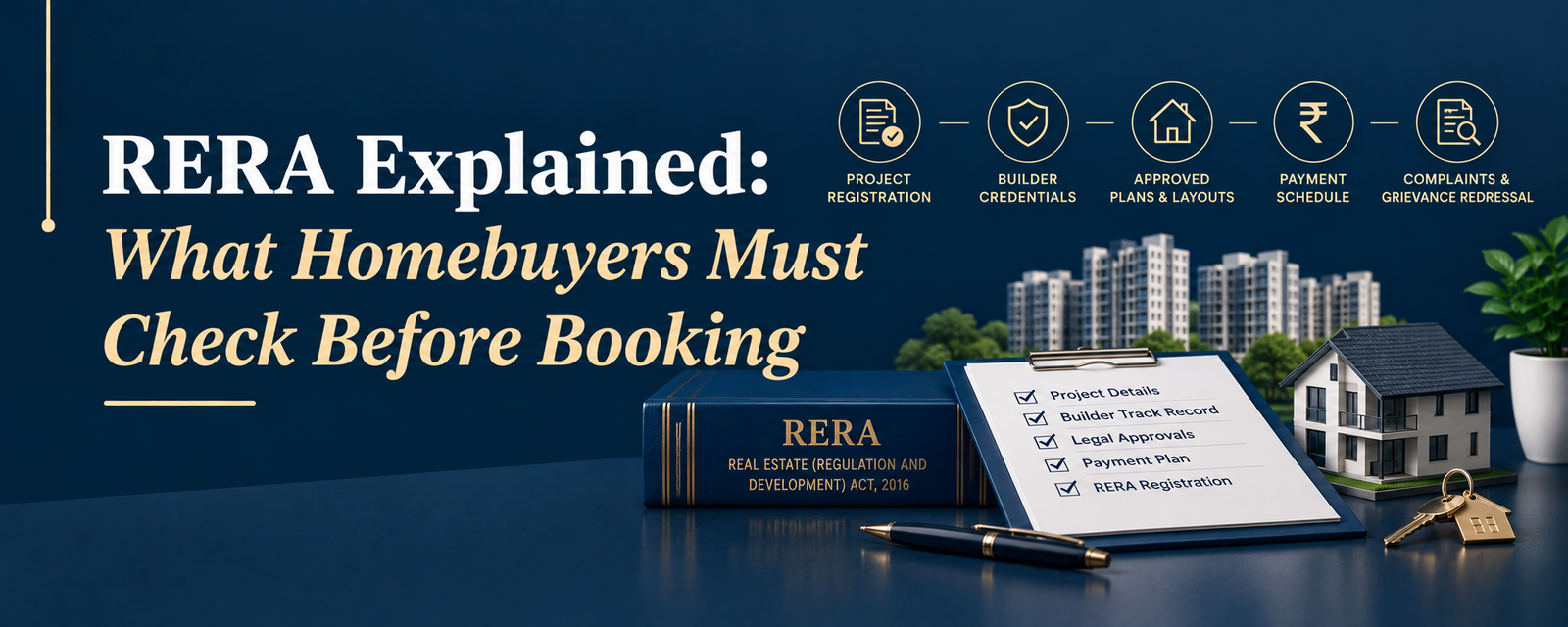
Before You Book: RERA Buyer Checklist
- Verify the RERA registration number and whether it covers the particular phase, building and project being purchased.
- Check the promoter details and the project's current status on the relevant RERA portal.
- Review the title documents and disclosed encumbrances relating to the land.
- Check the commencement certificate and other applicable approvals available in the project records.
- Compare the sanctioned plans, layout plans, specifications and promised amenities with the sales material.
- Confirm the carpet area of the apartment and separately identify any balcony, verandah or terrace areas.
- Check the possession and completion dates stated in the agreement for sale and relevant project records.
- Read the agreement for sale, including the payment schedule, specifications, possession terms, default provisions and applicable interest.
- Confirm the total consideration and additional charges mentioned in the contractual documents.
- Preserve advertisements, brochures and other written representations that influenced the booking decision.
- Check the relevant completion or occupancy certificate when the project reaches the stage at which it is required.
- Review the current rules, regulations, circulars and directions of the concerned State or Union Territory RERA Authority.
Conclusion
RERA has made the real estate sector more transparent by requiring project disclosures and creating statutory rights, duties and remedies for promoters and allottees.
For a homebuyer, however, the real benefit lies in using that information before making the purchase. Checking the project's registration, title, approvals, sanctioned plans, carpet area, agreement and possession terms can help a buyer understand what is actually documented before committing a substantial amount of money.
A home may be an emotional purchase, but the booking should still begin with a careful reading of the documents.