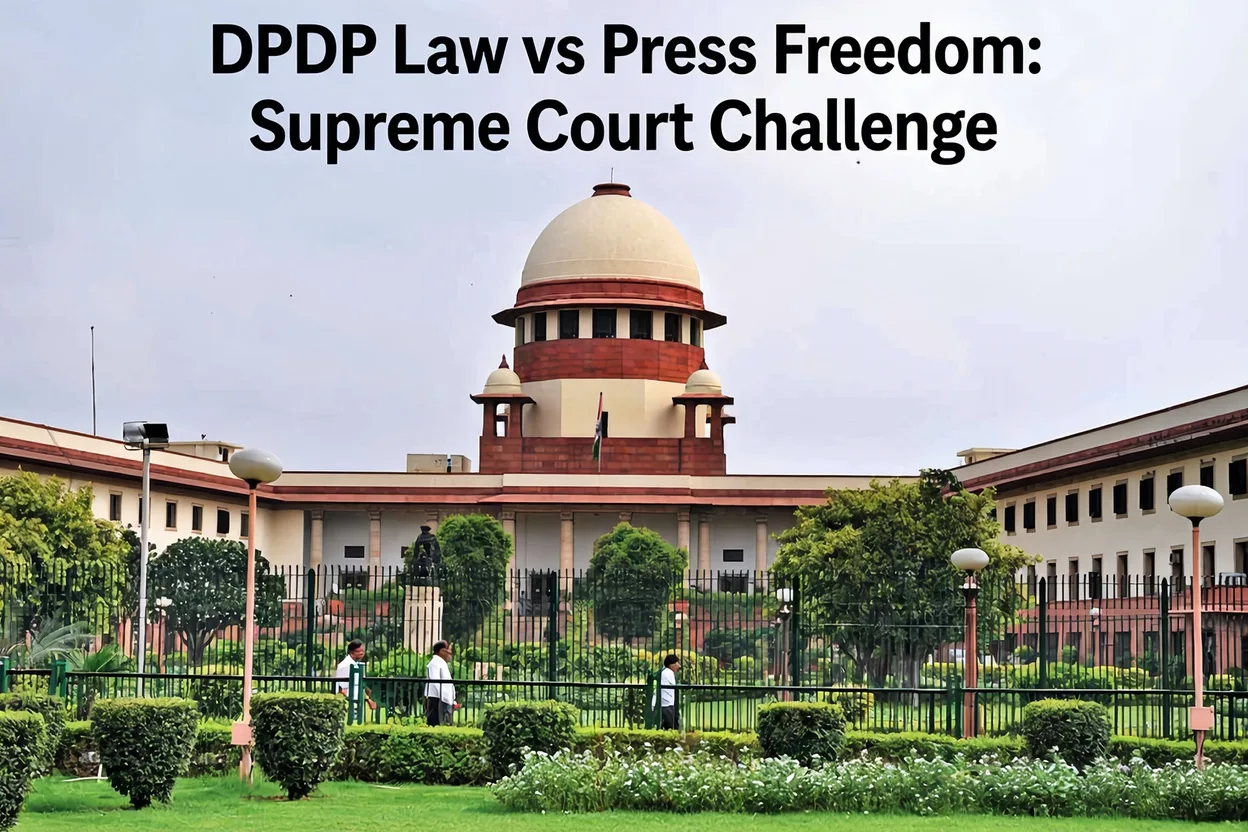
Supreme Court Examines Challenge to DPDP Law Over Missing Journalism Exemption
The Supreme Court of India is examining a significant constitutional challenge to the Digital Personal Data Protection (DPDP) Act, 2023, and the Digital Personal Data Protection Rules, 2025, over the absence of an explicit exemption for journalistic activities.
The challenge has been filed by the Digital News Publishers Association (DNPA), which represents 21 major news organisations, including The Indian Express, The Hindu, India Today, NDTV and Network18. The association has argued that the data protection framework could adversely affect investigative journalism, press freedom and the public's right to information.
Supreme Court Issues Notice to Centre
On October 27, 2026, a three-judge Bench comprising Chief Justice of India Surya Kant and Justices Joymalya Bagchi and V. Mohana issued notice to the Union Government on the petition and an application seeking interim relief.
Senior Advocate Madhavi Divan, appearing for the DNPA, argued that requiring journalists to obtain prior consent before collecting or processing personal information could make investigative and time-sensitive reporting extremely difficult.
The petitioners contended that such requirements could effectively introduce a form of pre-publication censorship, particularly when journalists investigate corruption, corporate misconduct or wrongdoing by public officials.
The Bench emphasised that a balance must be maintained between citizens' right to privacy and the media's freedom to investigate and report. The Court also asked the publishers to suggest safeguards against the potential misuse of personal information.
What Provisions Have Been Challenged?
The petition challenges Sections 7, 17(2), 18, 19, 27, 29, 36, 37 and 44(3) of the DPDP Act, 2023, along with Rules 16, 17 and 23 of the DPDP Rules, 2025.
According to the petitioners, the legislation does not recognise journalism as a distinct category of personal data processing entitled to an appropriate exemption. They argue that notice, consent and data-erasure requirements could interfere with the ordinary functioning of news organisations.
Another significant concern relates to Section 36 of the Act, read with Rule 23, which concerns the Central Government's power to require information from data fiduciaries and intermediaries. The petitioners argue that the provision could threaten the confidentiality of journalistic sources, including whistleblowers.
Impact on the Right to Information
The challenge also concerns Section 44(3) of the DPDP Act, which amended Section 8(1)(j) of the Right to Information Act, 2005.
The petitioners argue that the amendment substantially restricts access to personal information by removing the earlier express public-interest disclosure safeguard. According to them, this could affect investigative reporting and public scrutiny of government activities.
Constitutional Questions Before the Court
The petition raises important questions concerning Articles 14, 19(1)(a), 19(1)(g) and 21 of the Constitution of India. It also relies on the principles recognised in Justice K.S. Puttaswamy v. Union of India (2017), concerning the constitutional right to privacy.
At the centre of the dispute is the need to reconcile an individual's right to informational privacy with freedom of speech and expression and the public's right to know.
Latest Case Status
The Supreme Court has not declared the challenged provisions unconstitutional, nor has it granted an interim stay of the law. The matter, which was listed for November 17, 2026, was subsequently adjourned to December 9, 2026, according to reports on the proceedings.
The constitutional validity of the challenged provisions therefore remains undecided. The proceedings could have significant implications for India's data protection framework and the future of investigative journalism.
Case: Digital News Publishers Association & Anr. v. Union of India & Anr.
Proceeding: Writ Petition (Civil) Diary No. 45589/2026
Court: Supreme Court of India