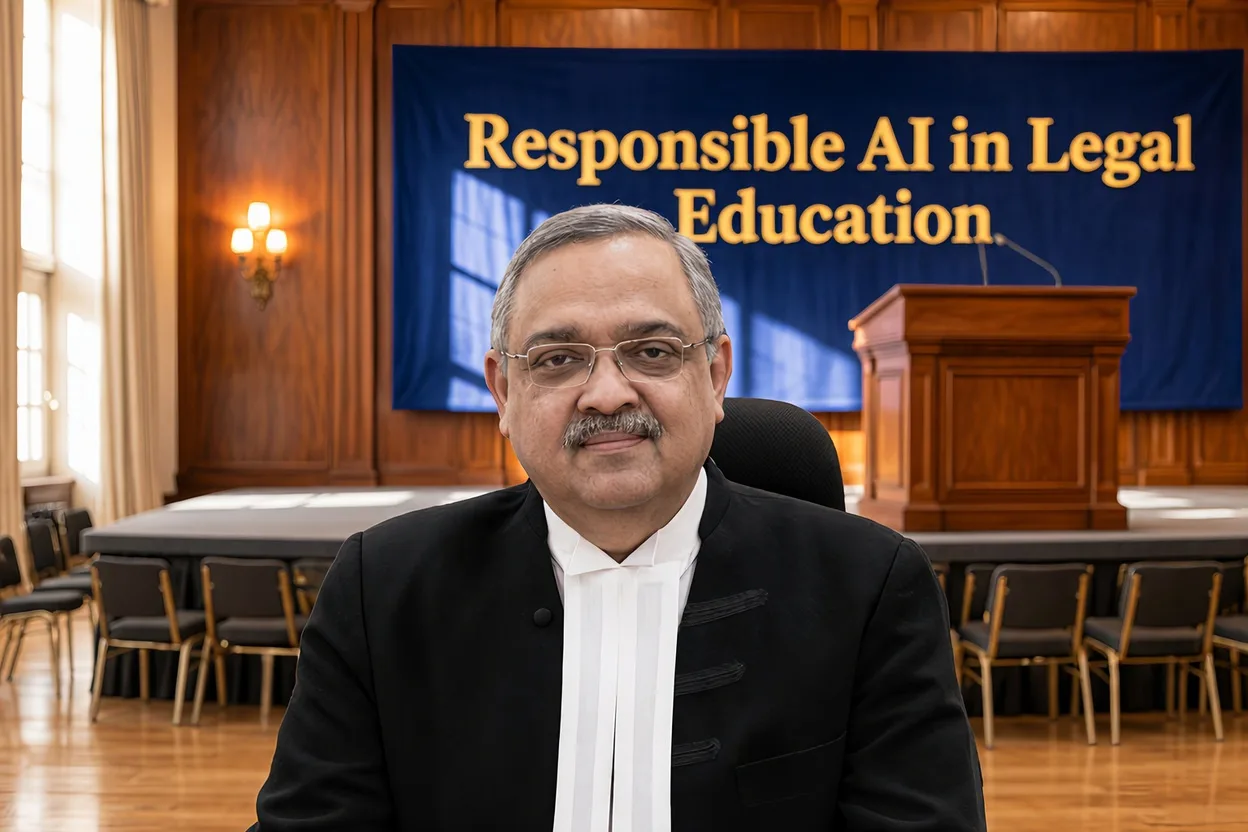
CJI Surya Kant Warns Law Schools Against Penalising Students Solely Through AI Detection Tools
New Delhi, November 21, 2026: Chief Justice of India (CJI) Surya Kant has cautioned law schools against treating artificial intelligence (AI) detection software as conclusive evidence of academic misconduct, emphasising that no student should be penalised solely on the basis of a machine-generated assessment.
Delivering the inaugural address at the Commonwealth Legal Education Association's (CLEA) First Annual International Conference on Legal Education, 2026, in Hyderabad, the CJI highlighted the limitations of AI-detection tools and the potential consequences of relying on them without independent verification.
AI Detection Tools May Wrongly Flag Students
Justice Surya Kant observed that several institutions increasingly rely on software claiming to identify whether academic assignments, essays or research papers have been generated using artificial intelligence. However, he warned that these tools are not sufficiently reliable to independently establish academic misconduct.
Referring to a 2023 study published in the journal Patterns, titled "GPT Detectors Are Biased Against Non-Native English Writers", he noted that seven widely used AI detectors incorrectly classified more than three out of every five essays written by non-native English speakers as AI-generated.
The CJI highlighted that students in Commonwealth countries frequently use English as a second or third language. Consequently, linguistic differences could result in genuine student work being incorrectly identified as machine-generated.
Emphasising the importance of fairness in academic proceedings, he stated that no student should be held guilty of misconduct solely on the word of a machine.
CJI Opposes a Blanket Ban on Artificial Intelligence
Addressing the broader impact of generative AI on legal education, Justice Surya Kant observed that artificial intelligence can now summarise judicial decisions, suggest legal arguments and produce polished academic responses within minutes.
However, he stressed that the central concern should be whether submitted academic work genuinely reflects a student's own reasoning, understanding and appreciation of the law.
He cautioned that completely prohibiting AI tools would neither be practical nor wise. Instead, law schools should establish clear institutional guidelines explaining which uses of AI are permitted, which require disclosure and which constitute an unacceptable substitution for independent academic work.
He also referred to the approach of the Supreme Court of Singapore, where users may employ generative AI tools but remain responsible for the materials they submit.
Law Schools Must Reform Assessment Methods
The CJI suggested that educational institutions should reconsider traditional assessment methods to ensure that students genuinely understand the work they submit.
He proposed supplementing written assignments with oral explanations, discussions defending the legal authorities relied upon and exercises requiring students to identify errors in AI-generated answers.
Such measures, he indicated, could help institutions distinguish genuine academic understanding from excessive dependence on automated tools.
Call for Guidelines on AI Disclosure in Legal Research
Justice Surya Kant also urged the Commonwealth Legal Education Association to develop model guidelines governing the disclosure of AI assistance in legal research. These guidelines could be adapted by law schools and academic journals across Commonwealth jurisdictions.
He emphasised that researchers must verify every legal authority against its primary source, disclose material assistance received from AI tools and remain accountable for their published work. He cautioned that AI-generated responses may contain fabricated judicial authorities or inaccurate legal propositions.
He further observed that an AI system cannot be credited as an author because it cannot assume responsibility for the work.
Broader Reforms in Legal Education
Beyond artificial intelligence, the CJI advocated a more practical approach to legal education. He suggested integrating clinical legal education into core subjects such as Evidence, Criminal Procedure, Family Law and Constitutional Law.
He also proposed making a minimum period of legal aid work compulsory for law students before graduation, with additional academic credits for students undertaking further service.
His address highlighted the importance of ensuring that legal education develops not merely theoretical knowledge but also practical skills, professional responsibility and access-to-justice awareness.
Why It Matters
The CJI's observations highlight an emerging challenge for legal education in the age of generative AI: balancing technological innovation with academic integrity and procedural fairness. For law schools, the message is to regulate AI use through transparent policies and meaningful assessments rather than relying exclusively on automated detection systems.
Although the address does not constitute a binding judicial ruling, it provides significant guidance for discussions on academic integrity, responsible AI use and the future of legal education in India and across the Commonwealth.