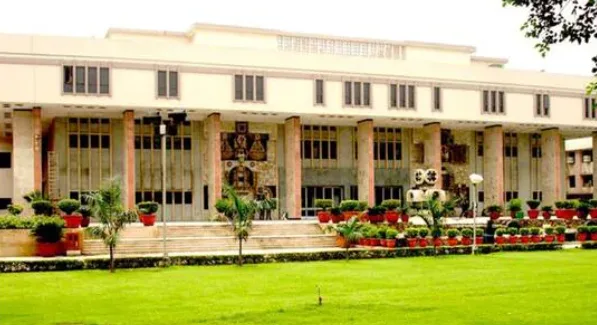
Delhi High Court: Aadhaar Card Alone Cannot Establish Date of Birth
The Delhi High Court has held that an Aadhaar card, by itself, cannot be treated as proof of a person's date of birth. The Court made this observation while dismissing a petition filed by M/s J.J. Electronics challenging a Labour Court award that granted full back wages and consequential benefits to a woman worker whose services had been illegally terminated.
In M/s J.J. Electronics v. Smt. Rosamma Joy, W.P.(C) 16476/2022, Justice Manoj Kumar Ohri observed that the employer could not rely solely on the date of birth mentioned in the employee's Aadhaar card when its own earlier Employees' State Insurance Corporation (ESIC) records reflected a different date of birth.
Background of the Case
The workwoman, Rosamma Joy, claimed that she had been employed as a finishing worker with the establishment since December 1981. She alleged that after the Delhi Government revised minimum wages for skilled workers in March 2017, the management refused to pay her the revised wages. Her services were terminated on 20 May 2017 after she demanded payment of her outstanding wages for April 2017.
The employer defended the termination by claiming that the employee had attained the age of superannuation of 58 years on 20 May 2017. It relied on her Aadhaar card, which recorded her date of birth as 20 May 1959. The management also claimed that she had voluntarily retired following cataract surgery and had received her dues.
However, the Labour Court found that the employer had itself recorded her date of birth as 20 May 1960 in the ESIC records when she was registered in June 2010. It also found that the management had failed to establish that she had resigned or voluntarily retired.
What Did the High Court Observe?
The High Court noted that the employer's case regarding the employee's retirement rested solely on the Aadhaar card. The Court observed that an Aadhaar card, by itself, is not proof of date of birth.
The Court also referred to the UIDAI Office Memorandum dated 20 December 2018 and relevant legal authorities clarifying that Aadhaar is primarily recognised as proof of identity and that the date of birth recorded on it is based on supporting documents or self-declaration furnished by the cardholder.
The Court considered the ESIC record particularly significant because it had been prepared in 2010, several years before the employment dispute arose. The employer itself had furnished the employee's date of birth as 20 May 1960 in those records.
The Court observed that the management could not subsequently rely on a different date of birth in the Aadhaar card to terminate her services a year earlier. It also noted that the Aadhaar card had been received by the management only in March 2017, shortly before the termination.
Illegal Termination and Section 25F of the Industrial Disputes Act
The Court found no reason to interfere with the Labour Court's factual findings. It reiterated that the jurisdiction exercised under Articles 226 and 227 of the Constitution is limited and that a writ court does not ordinarily interfere with a plausible finding of fact unless it suffers from perversity, jurisdictional error or a violation of natural justice.
Since the workwoman had not attained the age of superannuation and the management had failed to prove resignation or voluntary retirement, her termination without complying with Section 25F of the Industrial Disputes Act, 1947, was rightly held to be illegal.
Final Decision
The Delhi High Court dismissed the employer's writ petition and upheld the Labour Court's award granting the workwoman full back wages at the rate of ₹14,698 per month for the period from 20 May 2017 to 20 May 2018, along with consequential benefits and interest at 6% per annum from the date of publication of the award until realisation.
The Court further directed that the amount deposited with the Registrar General, along with accrued interest, be released to the workwoman. Any remaining amount payable was directed to be paid by the management within four weeks.
Legal Significance
The decision reinforces the distinction between proof of identity and proof of date of birth. It also highlights the importance of consistent employment and statutory records when determining an employee's age and retirement eligibility. Employers must establish the factual and legal basis of a claimed superannuation before terminating an employee on that ground.
Case: M/s J.J. Electronics v. Smt. Rosamma Joy
Case Number: W.P.(C) 16476/2022
Citation: 2026 SCC OnLine Del 8708
Decision Date: 13 November 2026
Judge: Justice Manoj Kumar Ohri
Court: Delhi High Court