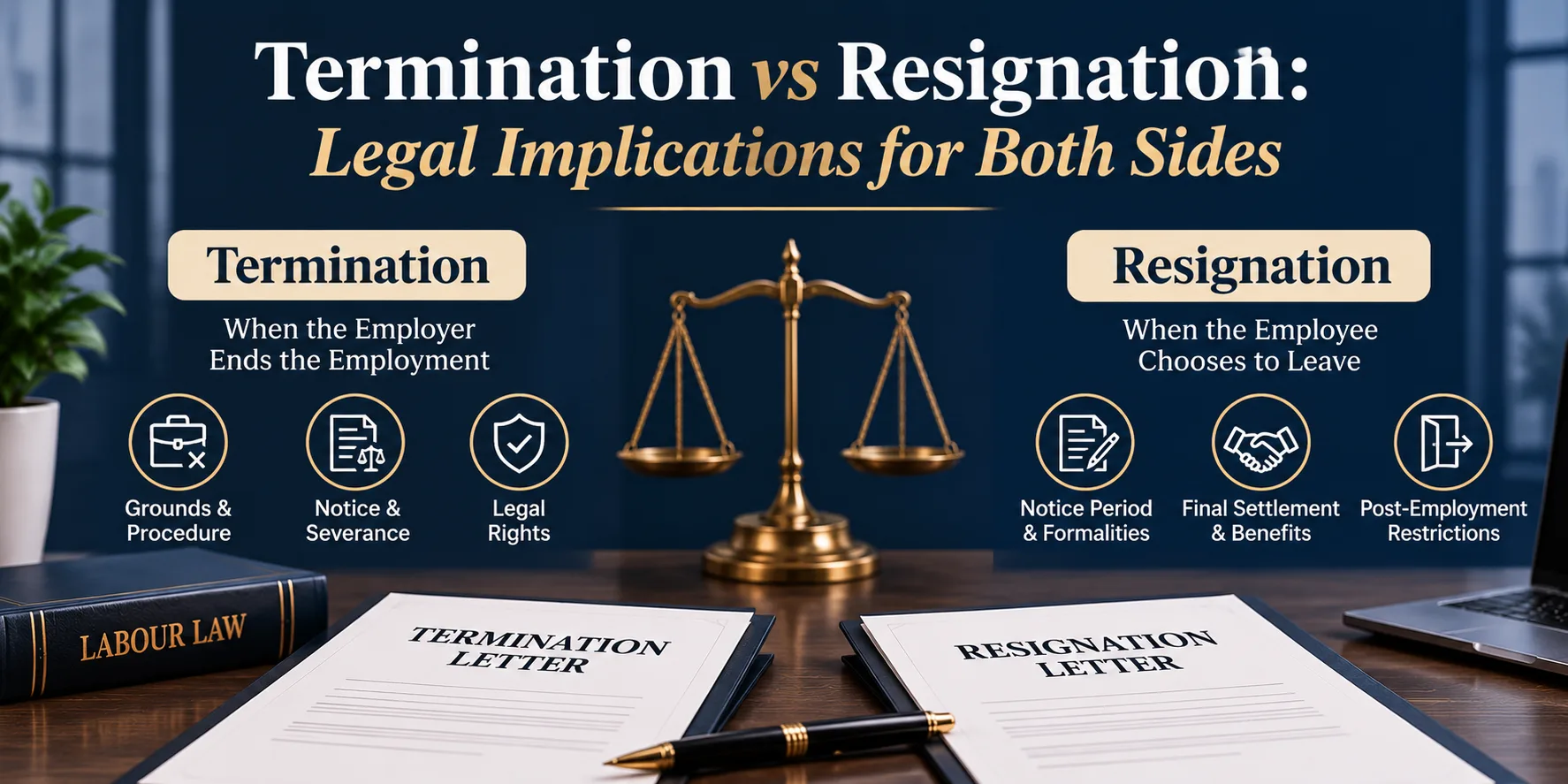
Employment is based upon a relationship of mutual responsibilities and obligations between an employer and an employee. While an employee is expected to perform the duties assigned to them, an employer is required to provide remuneration, maintain appropriate working conditions and comply with applicable employment laws. However, this relationship does not necessarily continue indefinitely. There may be situations where an employee decides to leave an organisation or where an employer chooses to discontinue an individual's services. This brings us to two commonly used terms in employment relationships: resignation and termination.
Although both result in the end of employment, they differ considerably in their legal meaning and consequences. Resignation generally refers to an employee's decision to leave voluntarily, whereas termination refers to the discontinuation of employment by the employer. The distinction becomes important when determining notice periods, outstanding wages, gratuity, compensation and the legal remedies available to the concerned parties.
In India, employment separation is governed by employment contracts, applicable service rules, state-specific Shops and Establishments legislation and labour laws. With the four Labour Codes becoming effective on 21 November 2025, the legal framework has also undergone significant changes. These include the Industrial Relations Code, 2020, the Code on Wages, 2019, the Code on Social Security, 2020 and the Occupational Safety, Health and Working Conditions Code, 2020.
Understanding this distinction is therefore important for both employees and employers, as an improperly handled separation may result in financial liabilities and legal disputes.
1. Understanding Resignation and Termination
Resignation is a decision made by an employee to discontinue their employment. It may arise due to personal reasons, better career opportunities, dissatisfaction with the workplace, relocation or other professional considerations. Generally, an employee submits a written resignation and serves the applicable notice period or makes payment in lieu of it, where permitted under the employment agreement.
Termination, on the other hand, refers to the discontinuation of employment initiated by the employer. It may occur because of misconduct, unsatisfactory performance, redundancy, restructuring, closure of an establishment or other reasons.
However, every termination cannot be treated alike. Disciplinary termination, retrenchment, discharge and expiry of a fixed-term contract have different legal consequences. In particular, retrenchment has a specific statutory meaning under the Industrial Relations Code, 2020. It generally covers termination by the employer for any reason other than disciplinary punishment, subject to specified exclusions, including voluntary retirement and certain cases of non-renewal or expiry of employment contracts.
Therefore, identifying the actual reason and nature of separation is essential before determining the applicable legal requirements.
2. Legal Implications of Resignation for Employees
An employee may ordinarily resign from employment, but the consequences depend upon the applicable contract, service rules and statutory requirements. Most employment agreements contain a notice period clause requiring an employee to provide advance notice before leaving. Alternatively, the employer may waive the remaining notice period or permit payment in lieu of it.
An employee who leaves without serving the agreed notice period may face a contractual claim for notice pay. However, the employer cannot automatically treat all outstanding salary or statutory benefits as forfeited. Any deduction or recovery must have a valid contractual and legal basis.
Another important issue concerns the withdrawal of resignation. Can an employee withdraw their resignation after submitting it? The answer depends upon the applicable service rules, the terms of employment, whether the resignation has been accepted and the date on which it becomes effective.
In Union of India v. Gopal Chandra Misra, (1978) 2 SCC 301, the Supreme Court considered whether a resignation expressed to take effect on a future date could be withdrawn before that date. The judgment recognised the importance of distinguishing between the submission of a resignation and its actual effectiveness. However, the case concerned a constitutional office-holder, and its principles should not be mechanically applied to every private employment relationship.
Employees should therefore communicate their resignation clearly and retain written records of its acceptance and the agreed relieving date.
3. Legal Implications of Termination for Employees
Unlike resignation, termination is generally initiated by the employer. Consequently, the employer must ensure that the decision complies with the employment agreement and applicable statutory protections.
Where termination is proposed on grounds of misconduct, the applicable standing orders, service rules and principles of natural justice become important. Depending upon the circumstances, the employee may be entitled to receive specific charges, an opportunity to respond and a fair domestic enquiry before disciplinary action is taken.
In D.K. Yadav v. J.M.A. Industries Ltd., (1993) 3 SCC 259, the Supreme Court emphasised that termination affecting an employee's livelihood must follow a just, fair and reasonable procedure. The judgment highlights that employment termination cannot always be treated as a purely contractual decision without considering procedural fairness. However, this does not mean that a domestic enquiry is mandatory for every form of termination.
A separate position applies where termination amounts to retrenchment. Section 70 of the Industrial Relations Code, 2020 requires an employer to provide a worker who has completed at least one year of continuous service with one month's written notice stating the reasons for retrenchment, or wages in lieu of notice. The employer must also pay retrenchment compensation equivalent to fifteen days' average pay for every completed year of continuous service, or part exceeding six months, and provide the prescribed notice to the appropriate Government.
Section 71 further provides the ordinary principle of last come, first go, subject to its exceptions.
Additionally, Section 79 introduces a prior-permission requirement for retrenchment in qualifying industrial establishments employing at least 300 workers on average per working day during the preceding twelve months, subject to the statutory conditions and applicable Government notifications.
These protections are particularly important because retrenchment cannot simply be treated as an ordinary contractual termination.
4. Financial Rights and Obligations of Both Parties
One of the most important aspects of resignation and termination concerns the financial settlement between the employer and employee.
Under Section 17(2) of the Code on Wages, 2019, wages payable to an employee who has been removed, dismissed, retrenched or has resigned must ordinarily be paid within two working days of the relevant event. This provision concerns wages payable and should not be confused with a rule requiring every component of full and final settlement to be paid within the same period.
Another important component is gratuity. Section 53 of the Code on Social Security, 2020 provides for gratuity upon termination of employment, including resignation, subject to the prescribed eligibility conditions. Generally, an employee must have completed five years of continuous service. However, this requirement is not applicable in specified circumstances, including death, disablement and expiry of fixed-term employment.
Employees may also be entitled to provident fund accumulations, leave encashment, bonus and other outstanding contractual or statutory dues. These benefits are governed by different provisions and eligibility conditions. For instance, provident fund accumulations may be transferred to a new account rather than withdrawn immediately, depending upon the circumstances and applicable rules.
Employers must therefore calculate each component separately and ensure that the employee receives the amounts legally due. Resignation or termination does not, by itself, eliminate these financial obligations.
5. Challenges
Although resignation and termination appear to be straightforward employment matters, several practical and legal challenges arise during their implementation.
Forced resignation: There may be situations where an employer pressures an employee to resign instead of formally terminating their services, potentially to avoid disciplinary procedures, retrenchment compensation or other obligations. In such circumstances, the question of whether the resignation was genuinely voluntary becomes important. The surrounding communications, circumstances and evidence may help establish whether the employee acted freely.
Notice periods and employment bonds: Employers may have legitimate interests in protecting their investment in training and maintaining continuity of work. However, contractual restrictions should not become unreasonable obstacles to an employee's professional freedom.
In Vijaya Bank v. Prashant B. Narnaware, 2025 INSC 691, the Supreme Court upheld a minimum-service condition accompanied by stipulated liquidated damages for premature resignation in the circumstances of that case. The decision demonstrates that such clauses are not automatically void under Section 27 of the Indian Contract Act, 1872. However, it does not make every employment bond enforceable. Its terms, proportionality and surrounding circumstances remain relevant.
Wrongful termination: Employees may be terminated without following the applicable procedure or in violation of statutory protections. However, not every termination disputed by an employee is automatically unlawful. Its validity depends upon the contractual arrangement, applicable legislation, grounds for termination and procedure followed.
For employers, maintaining proper documentation is equally important. Resignation letters, acceptance communications, termination notices, enquiry records and final settlement statements may become relevant in future disputes.
Lastly, the distinction between managerial employees and statutory workers creates further complexity. The Industrial Relations Code defines a worker by reference to the nature of duties performed and excludes certain managerial, administrative and supervisory categories. A supervisory employee drawing wages above the statutory threshold is also excluded. Consequently, designation alone does not determine whether a person qualifies for statutory protection. The actual responsibilities and applicable definitions must be examined.
Conclusion
Termination and resignation may lead to the same outcome, that is, the end of an employment relationship, but their legal implications are considerably different. Resignation is generally an employee's voluntary decision, whereas termination is initiated by the employer and may attract additional procedural and statutory requirements depending upon its nature.
For employees, understanding notice period requirements, financial entitlements, employment bond conditions and available legal remedies is essential. Similarly, employers must ensure that separation decisions comply with applicable contracts and legislation, and that statutory dues are settled correctly.
The implementation of the four Labour Codes has reorganised India's employment law framework. However, the protection available in an individual case will still depend upon the nature of employment, the applicable statutory definition and the circumstances in which the relationship ends.
Ultimately, an employment relationship does not end simply because one party decides to discontinue it. The manner in which it ends matters equally. Whether through resignation or termination, the process must respect the rights of the concerned parties and fulfil the legal obligations attached to it.
Disclaimer: This article is intended for general informational and educational purposes only and does not constitute legal advice. The applicable legal position may vary depending upon the nature of employment, the relevant State legislation, contractual terms and individual circumstances.