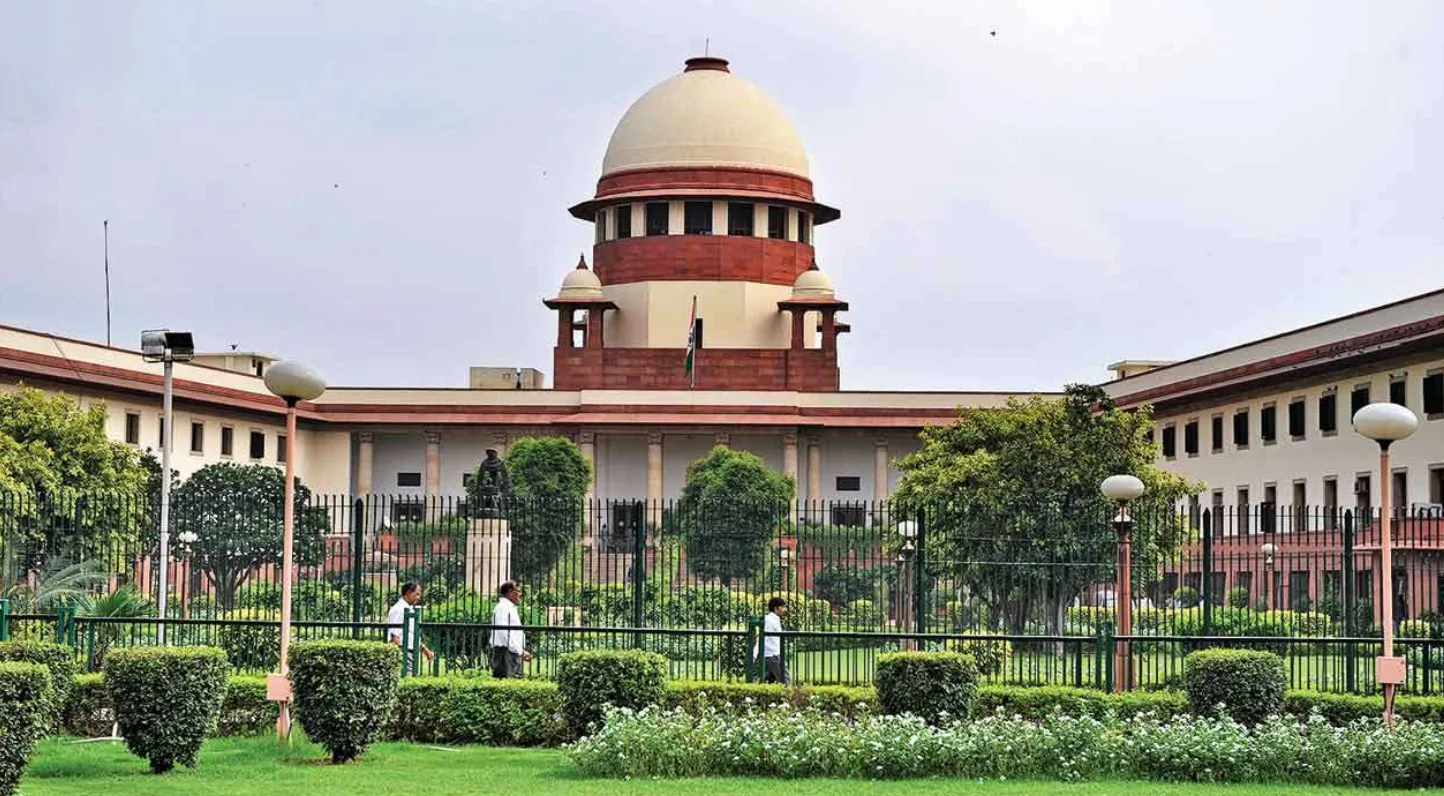
New Delhi, November 20, 2026: In a significant ruling concerning government employees' pension rights, the Supreme Court of India has struck down two Uttar Pradesh laws that excluded service rendered before regularisation from the computation of qualifying service for pensionary benefits.
A Bench comprising Justice Dipankar Datta and Justice Satish Chandra Sharma declared the Uttar Pradesh Qualifying Service for Pension and Validation Act, 2021 and the Uttar Pradesh Entitlement to Pension and Validation Act, 2025 unconstitutional.
The judgment, delivered on November 18, 2026, holds that employees initially engaged as work-charged, temporary, daily-wage or muster-roll workers cannot be denied pensionary benefits merely because of the nature of their initial appointment, once their services have been regularised under a duly formulated scheme.
Background of the Dispute
The controversy originated from the Supreme Court's 2019 decision in Prem Singh v. State of Uttar Pradesh, in which the Court held that qualifying service rendered in a work-charged establishment must be counted for pension purposes in the circumstances considered by the Court.
Following that judgment, Uttar Pradesh introduced legislation in 2021 and subsequently in 2025, attempting to redefine qualifying service and restrict pension eligibility through retrospective statutory provisions.
The employees challenged these enactments, arguing that the State had effectively reintroduced the very exclusion that the Supreme Court had previously found legally impermissible.
Why Did the Supreme Court Strike Down the Laws?
The Bench examined whether the subsequent legislation had actually removed the legal defect identified in the 2019 judgment or merely attempted to overcome the earlier ruling by changing statutory terminology.
The Court held that a legislature may enact retrospective legislation to remove the legal basis of a judicial decision. However, it cannot simply reintroduce an invalidated exclusion through a new definition or a validating provision without curing the underlying defect.
The 2021 Act redefined qualifying service by linking it to appointments against temporary or permanent posts under applicable service rules. The 2025 Act introduced the concept of a substantive appointee and further restricted pension eligibility.
According to the Court, these legislative measures failed to address the constitutional infirmity identified in Prem Singh and effectively attempted to preserve the same exclusion through a different statutory framework.
Regularisation Changes the Legal Position
The Supreme Court emphasised that regularisation under a duly formulated scheme marks an employee's integration into the regular establishment.
Once regularisation takes place, the initial character or source of appointment cannot subsequently be revived as a ground to deny service and retirement benefits otherwise available to the employee as a member of the regular establishment.
The Court therefore held that the retrospective exclusion of qualifying pre-regularisation service could not be sustained merely by introducing new statutory definitions or validating earlier pension denials.
Directions Issued by the Supreme Court
While declaring both enactments ultra vires the Constitution, the Court issued several directions:
- Eligible work-charged employees' pension claims must be considered in accordance with the principles laid down in Prem Singh v. State of Uttar Pradesh.
- Retired government employees covered by the judgment may approach the competent authority with complete particulars of their service.
- Authorities must examine and decide each claim within six months of receiving it.
- Where pensionary benefits are found due, the admissible amounts must be released.
- Any proposed rejection of a claim must be preceded by an opportunity of hearing and supported by a reasoned order.
- Authorities must provide a detailed statement of payments released under the respective heads.
- Monetary benefits will ordinarily be restricted to the three years preceding the institution of the writ petition in Prem Singh. A specified exception applies to eligible heirs or legal representatives of employees who retired and died before the 2019 judgment.
- Failure to release admissible payments within the prescribed timelines will attract simple interest at 9% per annum until payment.
The Court also granted the State a final six-month period to comply with its directions in the pending contempt proceedings, cautioning that further non-compliance could amount to aggravated contempt.
Significance of the Judgment
The ruling reinforces the constitutional limits on legislative power to override judicial decisions. It clarifies that retrospective validating legislation must genuinely remove the defect identified by a court rather than merely alter the language of the law.
For eligible government employees who served for years in work-charged, temporary, daily-wage or muster-roll capacities before regularisation, the judgment provides an important basis for claiming pensionary benefits in accordance with the applicable legal framework.
Case: Uttar Pradesh Ground Water Department Non Gazetted Employee Association (Regd.) & Anr. v. The Chief Secretary & Ors.
Court: Supreme Court of India
Bench: Justice Dipankar Datta and Justice Satish Chandra Sharma
Judgment Date: November 18, 2026
Legal Principle: Pre-regularisation service cannot be retrospectively excluded from qualifying service for pension merely by introducing validating legislation that fails to cure the underlying legal defect.