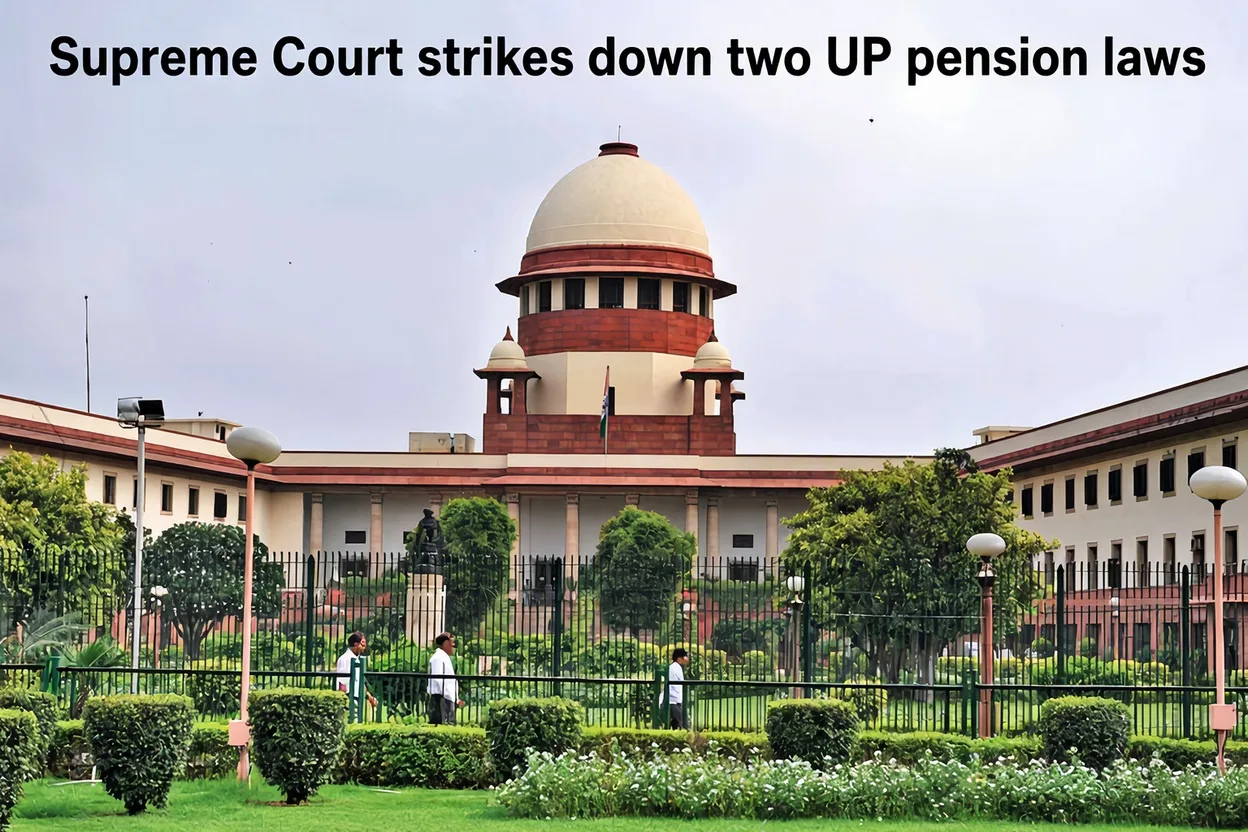
Supreme Court Strikes Down Two UP Laws Denying Pension Benefits for Pre-Regularisation Service
In a significant ruling concerning the pension rights of government employees, the Supreme Court of India has struck down two Uttar Pradesh laws that sought to exclude service rendered before regularisation from the computation of qualifying service for pensionary benefits.
A Bench comprising Justice Dipankar Datta and Justice Satish Chandra Sharma, in Uttar Pradesh Ground Water Department Non-Gazetted Employee Association (Regd.) & Anr. v. The Chief Secretary & Ors., declared the Uttar Pradesh Qualifying Service for Pension and Validation Act, 2021, and the Uttar Pradesh Entitlement to Pension and Validation Act, 2025, unconstitutional. The judgment was delivered on November 18, 2026.
Background of the Dispute
The dispute concerned government employees who had initially worked in work-charged, temporary, daily-wage or muster-roll capacities and were subsequently regularised into government service. The State's legislative measures sought to prevent their earlier service from being counted towards qualifying service for pension.
The controversy originated from the Supreme Court's 2019 decision in Prem Singh v. State of Uttar Pradesh, wherein the Court held that relevant work-charged service must be considered for pensionary benefits, particularly where employees were subsequently regularised.
Following that judgment, Uttar Pradesh enacted the 2021 and 2025 validation laws, retrospectively changing the statutory framework governing qualifying service and pension entitlement. The employees challenged these enactments, arguing that they effectively reinstated an exclusion that the Supreme Court had already disapproved.
Why Did the Supreme Court Strike Down the Laws?
The Supreme Court held that once an employee is regularised under a duly formulated scheme, the nature of their initial appointment cannot subsequently be used to deny pensionary benefits.
The Bench observed that regularisation obliterates the initial appointment's "birthmark" and integrates the employee into the regular establishment. Consequently, the State cannot revive the employee's earlier employment status to deprive them of vested retirement benefits.
The Court further explained that a legislature may enact retrospective validating legislation to overcome a judicial decision, but it must first remove the legal defect identified by the Court. Merely introducing new statutory definitions or changing the terminology of an exclusion does not cure the underlying constitutional infirmity.
Finding that both Uttar Pradesh enactments perpetuated the same exclusion without curing the defect identified in Prem Singh, the Court declared them ultra vires the Constitution.
Key Directions Issued by the Supreme Court
- Eligible employees' pension claims must be considered in accordance with the principles laid down in Prem Singh and the applicable law.
- Retired government employees covered by the judgment may approach the competent authority with complete particulars of their service.
- The competent authorities must determine the claims within six months of receiving them and extend pensionary benefits wherever due.
- Monetary benefits will ordinarily be calculated subject to the restriction concerning the three years preceding the institution of the writ petition in Prem Singh.
- This restriction will not apply to claims by heirs or legal representatives of employees who retired and died before the Prem Singh judgment, subject to satisfactory proof of their entitlement.
- Before rejecting a claim, authorities must provide an opportunity of hearing and pass a reasoned order.
- Authorities allowing claims must provide a detailed statement showing payments made under each head.
- If admissible payments are not released within the prescribed timeline, the State will be liable to pay simple interest at 9% per annum until payment.
Constitutional Significance
The judgment reinforces the constitutional protection of equality and fairness in public employment. The Court emphasised that retrospective legislation cannot be used merely to circumvent a binding judicial pronouncement while leaving the underlying legal defect untouched.
By striking down both enactments, the Supreme Court reaffirmed that employees who have been validly regularised cannot automatically be deprived of pensionary entitlements merely because their initial appointments were non-regular in nature.
Conclusion
The ruling is a significant development in Indian service jurisprudence, particularly concerning pension rights and the constitutional limits of retrospective validating legislation. It provides eligible retired employees in Uttar Pradesh with an opportunity to seek reconsideration of their pension claims and places a six-month deadline on the authorities to determine those claims.