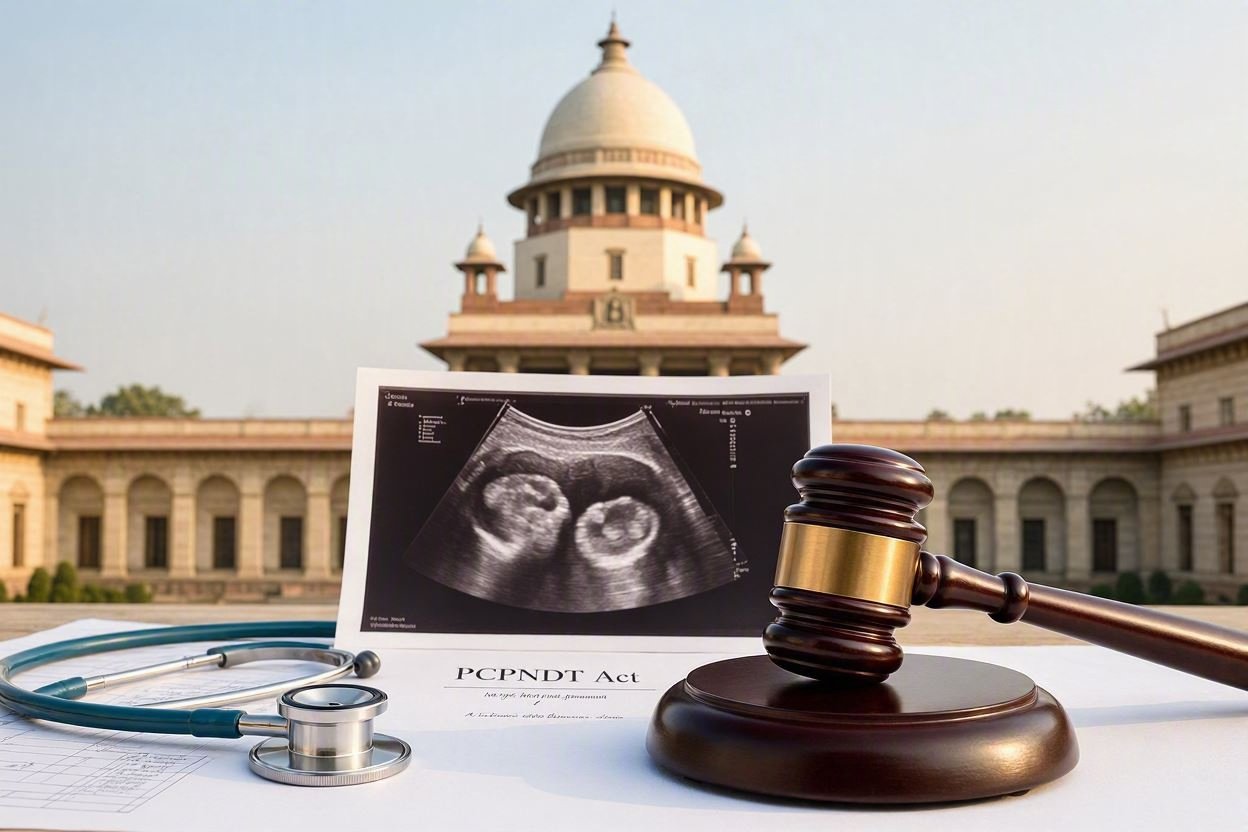
The Supreme Court of India has clarified that police authorities cannot ordinarily investigate offences under the Pre-Conception and Pre-Natal Diagnostic Techniques (Prohibition of Sex Selection) Act, 1994 (PCPNDT Act). The ruling was delivered by a Bench comprising Justice Sanjay Karol and Justice N. Kotiswar Singh.
The Court held that the Appropriate Authority (AA) constituted under the PCPNDT Act is the competent authority to initiate complaints, conduct investigations, and prosecute offences relating to prenatal sex determination and sex selection practices. While police authorities may assist when required, they cannot function as the principal investigating agency under the statute.
The judgment arose from a reference concerning whether police officers could register FIRs and conduct investigations merely because offences under the PCPNDT Act are classified as cognizable and non-bailable. Addressing conflicting views expressed by various High Courts, the Supreme Court emphasized that the special procedure established under the PCPNDT Act prevails over general criminal procedure.
The Bench observed that offences under the PCPNDT Act involve technical and medical issues requiring specialized expertise and sensitivity. Consequently, the legislature intentionally entrusted enforcement responsibilities to designated authorities possessing the necessary knowledge and administrative competence.
The Court further clarified that a Magistrate cannot take cognizance of offences under the Act based solely on a police chargesheet filed after an independent police investigation. Instead, prosecutions must be initiated through complaints filed by the Appropriate Authority or persons specifically authorized under the statute.
Importantly, the Supreme Court noted that the restriction applies only to offences under the PCPNDT Act and does not curtail police powers to investigate separate offences disclosed under general criminal law. Therefore, if independent offences under the Bharatiya Nyaya Sanhita or other penal laws emerge from the same facts, police retain authority to investigate those offences.
The ruling reinforces the legislative objective of the PCPNDT Act, which was enacted to curb female foeticide, prohibit sex selection practices, and regulate the use of prenatal diagnostic techniques. By affirming the central role of the Appropriate Authority, the Court has strengthened the specialized enforcement framework envisioned under the Act.
The judgment is expected to have significant implications for ongoing and future prosecutions under the PCPNDT Act, ensuring procedural uniformity across jurisdictions and clarifying the limits of police intervention in such cases.