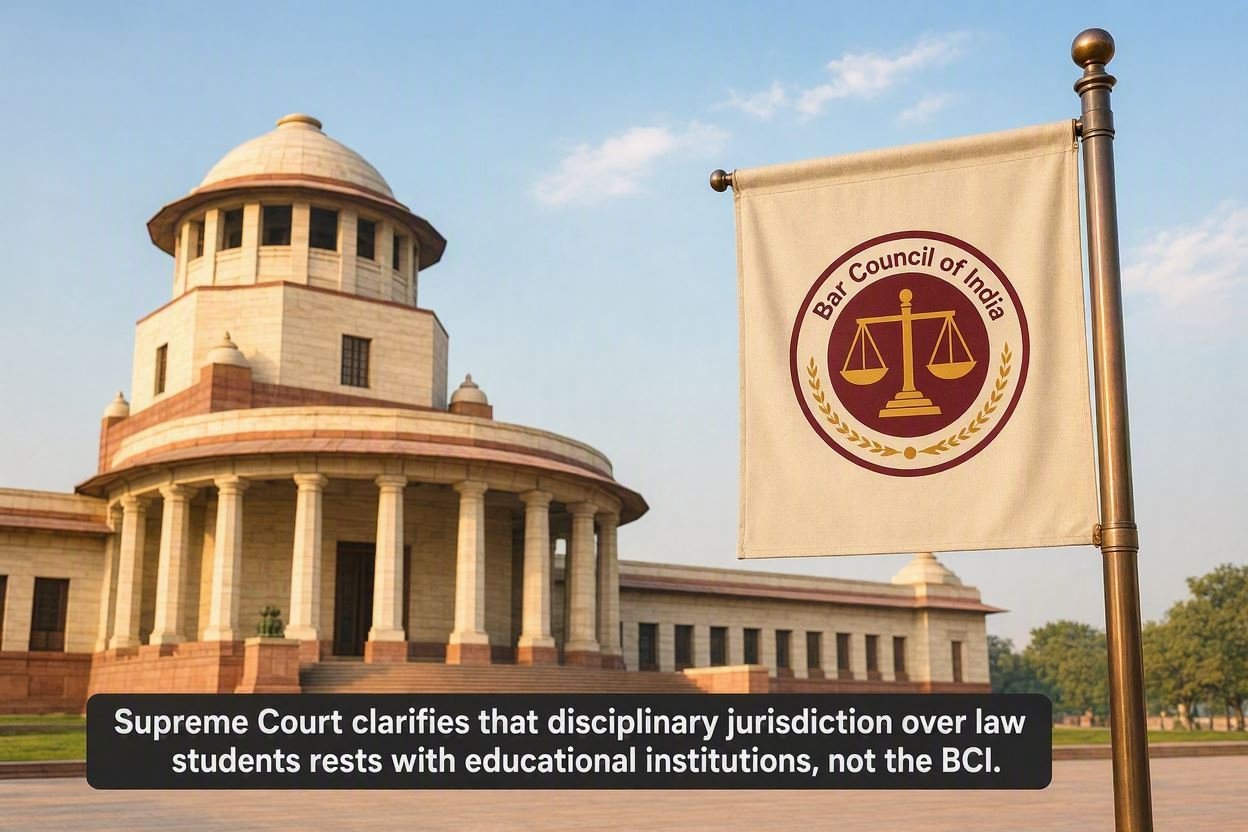
The Supreme Court of India has clarified that the Bar Council of India (BCI) and State Bar Councils do not possess any statutory power to initiate disciplinary proceedings against law students who have not yet been enrolled as advocates.
The ruling came in a case arising from the controversy surrounding NALSAR University of Law, Hyderabad, where the BCI had issued communications directing action against students and threatening consequences relating to their future enrolment as advocates. The communications were later withdrawn following criticism and legal challenges.
A bench comprising Chief Justice of India Surya Kant, Justice Joymalya Bagchi, and Justice V. Mohana observed that the Advocates Act, 1961 confers disciplinary powers upon Bar Councils only in relation to advocates enrolled under the Act. The Court emphasized that neither express nor implied authority exists under the statute to regulate or punish law students.
The Court further held that disciplinary jurisdiction over students remains with their parent educational institutions and the authorities designated under institutional regulations and by-laws. Consequently, any action relating to student conduct must be undertaken by universities or law schools and not by professional regulatory bodies.
Declaring the BCI's communications legally unsustainable, the Supreme Court reaffirmed the limits of regulatory authority under the Advocates Act and underscored the distinction between legal education governance and professional regulation of advocates.
The judgment is expected to have significant implications for legal education governance in India, clarifying the respective roles of universities and Bar Councils while reinforcing statutory limits on professional regulators.