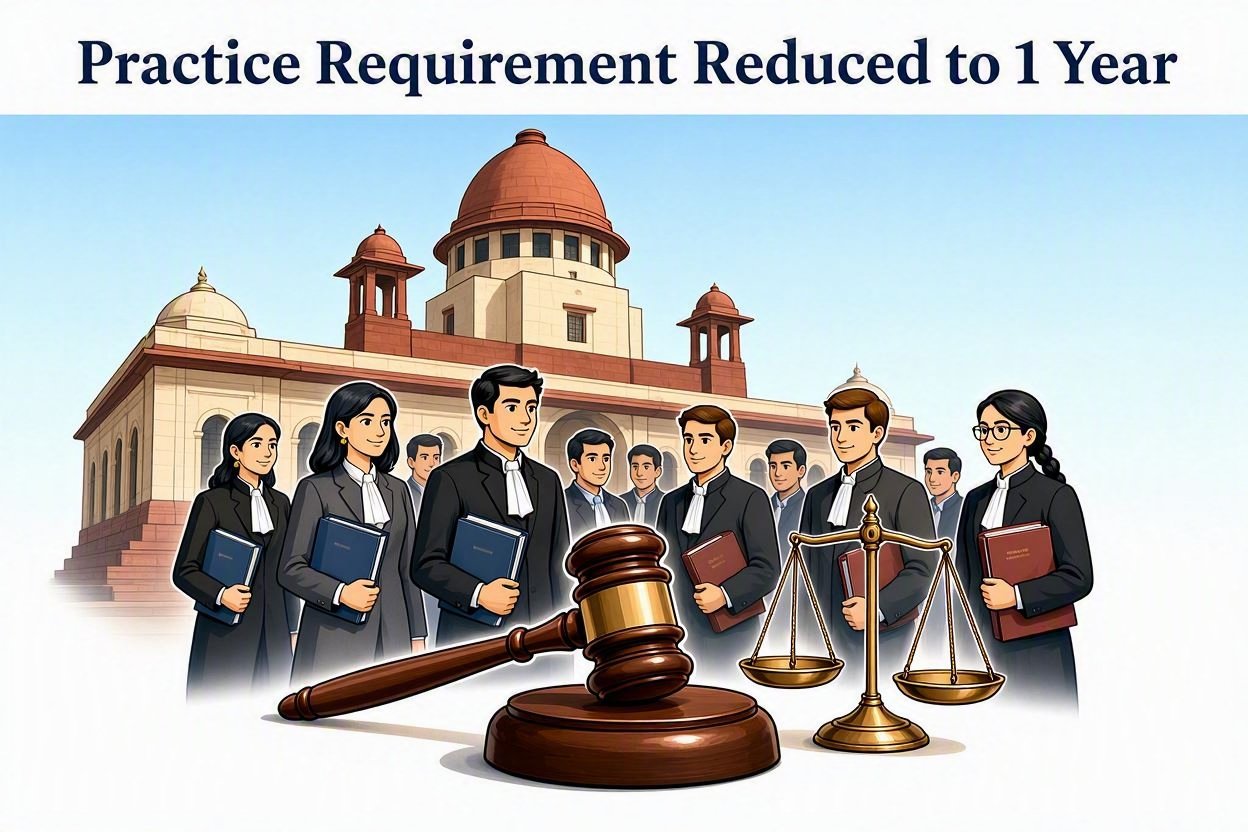
Supreme Court Reduces Judiciary Practice Requirement from 3 Years to 1 Year
In a landmark decision impacting thousands of judiciary aspirants across the country, the Supreme Court of India has reduced the mandatory legal practice requirement for entry-level judicial service recruitment from three years to one year.
The ruling revises the Court's earlier judgment delivered in May 2025, which had restored the requirement of three years of legal practice for candidates seeking appointment as Civil Judges (Junior Division). While reaffirming the importance of practical legal exposure before entering the judiciary, the Court concluded that a shorter practice period would strike a more balanced approach between competence and accessibility.
Under the revised framework, candidates will now be eligible to apply for judicial service examinations after completing one year of legal practice. However, the Court has simultaneously strengthened post-selection training requirements to ensure that newly recruited judicial officers gain sufficient practical exposure before assuming full judicial responsibilities.
Selected candidates will undergo one year of intensive judicial academy training followed by a structured one-year clerkship or courtroom attachment programme. During this period, candidates will receive practical exposure to judicial functioning, case management, courtroom procedures, and adjudicatory responsibilities.
The Supreme Court observed that while practical legal experience remains essential for judicial officers, the earlier three-year requirement may unnecessarily delay the entry of talented law graduates into judicial service. The revised model seeks to balance merit, accessibility, and professional preparedness.
The Court also provided transitional relief for law graduates and candidates participating in ongoing recruitment processes. High Courts and State Governments have been directed to suitably modify recruitment rules and extend application deadlines wherever necessary to accommodate eligible candidates under the revised criteria.
The decision is expected to widen the pool of eligible applicants for judicial service examinations while maintaining standards through enhanced training and supervised practical exposure. The Court has indicated that the effectiveness of the revised framework may be reviewed after a specified period based on its implementation and outcomes.
The ruling marks a significant development in judicial recruitment policy and is likely to influence future discussions on balancing practical experience requirements with access to judicial careers in India.