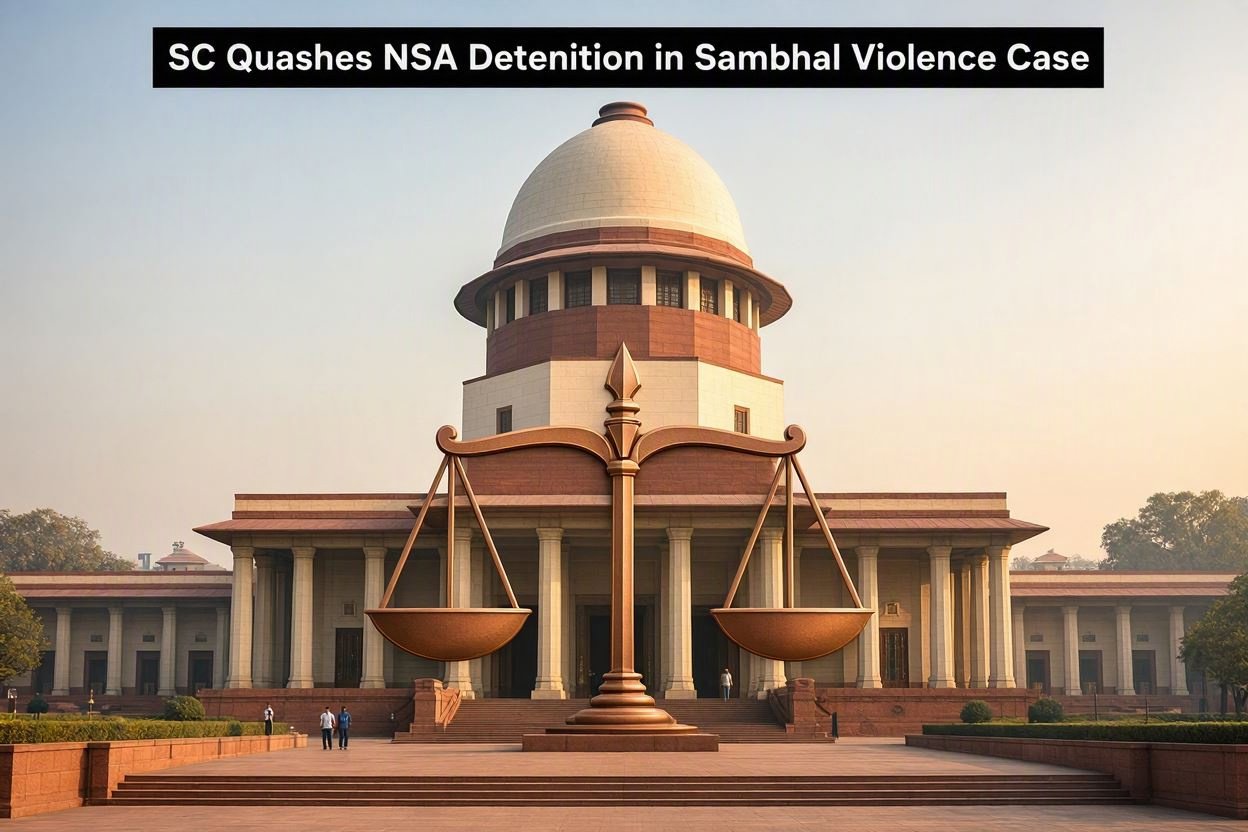
The Supreme Court of India has set aside the preventive detention of Mulla Afroz under the National Security Act (NSA), 1980, in connection with the 2024 Sambhal violence case, ruling that the detention was legally unsustainable.
A Bench comprising Justice Dipankar Datta and Justice Sheel Nagu overturned an earlier Allahabad High Court judgment that had upheld the detention order. The Court observed that the detention was primarily based on an alleged extra-judicial confession made while the accused was in police custody, which could not constitute a valid foundation for preventive detention under the NSA.
Mulla Afroz was arrested in January 2025 following the violence that erupted in Sambhal during a court-ordered survey of the Jama Masjid. The incident resulted in multiple fatalities and significant public unrest. While Afroz remained in judicial custody, a detention order under the NSA was issued against him in October 2025.
Before the Supreme Court, the petitioner argued that the detention order lacked a legally sustainable basis and relied heavily on custodial statements. The Court accepted this contention and held that preventive detention cannot be justified solely on the basis of such material.
Finding the detention unlawful, the Supreme Court quashed the NSA order and directed the Uttar Pradesh government to pay ₹10 lakh as costs. The ruling reiterates the judiciary's scrutiny of preventive detention measures and emphasizes that personal liberty cannot be curtailed without strict adherence to constitutional and statutory safeguards.
The judgment is expected to have significant implications for future preventive detention cases, particularly those involving reliance on custodial confessions and public-order allegations.