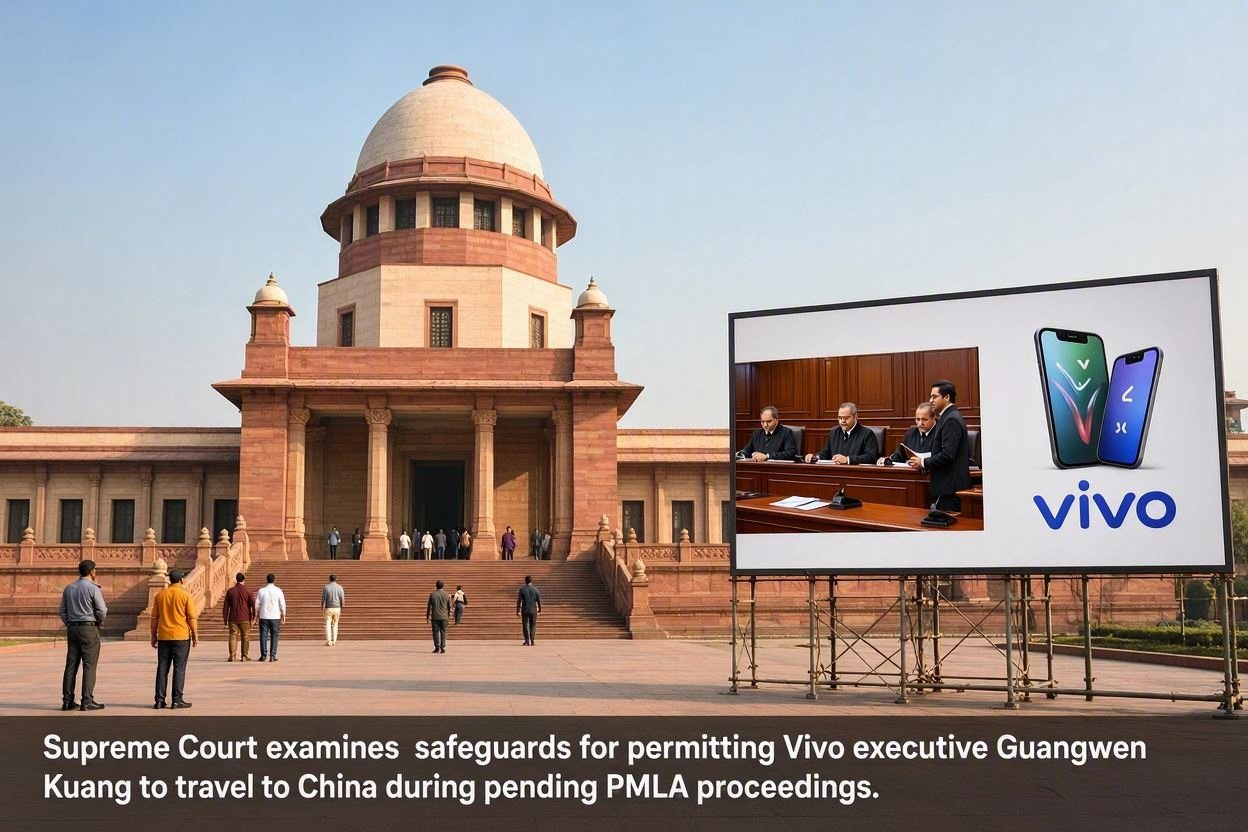
The Supreme Court of India on September 7, 2026, considered a plea filed by Guangwen Kuang, an executive of Vivo Mobile Communications, seeking permission to travel to Guangzhou, China, to visit his 82-year-old ailing father.
Kuang is facing prosecution under the Prevention of Money Laundering Act (PMLA) in connection with the Enforcement Directorate's investigation into alleged financial irregularities involving Vivo. His request to travel abroad had previously been rejected by the Delhi High Court.
A Bench comprising Justice Sanjay Kumar and Justice Sanjeev Sachdeva observed that the primary concern was ensuring the executive's return to India after his visit. During the hearing, the Court suggested that Kuang approach the Chinese Consulate and obtain a formal guarantee supporting his return to India upon completion of the visit.
The Bench granted him one month to explore the possibility of securing such a guarantee. The Court indicated that appropriate safeguards would be necessary before granting permission, particularly in light of the absence of an extradition treaty or Mutual Legal Assistance Treaty (MLAT) between India and China.
The Delhi High Court had earlier refused permission on the grounds of the seriousness of the allegations, the substantial amount of alleged proceeds of crime involved, Kuang's status as a Chinese national, and concerns regarding the enforceability of his return if allowed to leave India.
The matter highlights the judiciary's balancing of humanitarian considerations with the need to ensure the effective administration of criminal justice in cross-border financial crime investigations. The Supreme Court's observations also underscore the legal challenges that arise when accused foreign nationals seek overseas travel during the pendency of criminal proceedings.
Further consideration of the matter is expected after the petitioner informs the Court about the possibility of obtaining the requested diplomatic assurance.