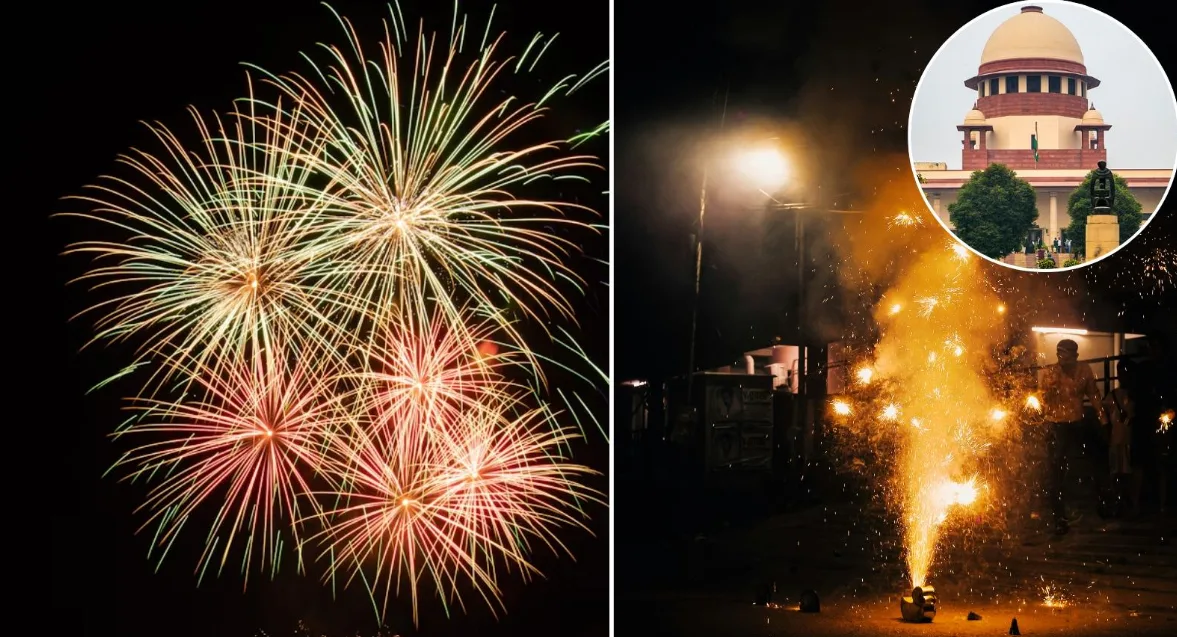
The Supreme Court of India has permitted the temporary manufacture, sale and use of certified green firecrackers in Delhi-NCR during Diwali 2026, while directing that the complete ban on firecrackers be restored from November 9, 2026. The directions were issued on October 29, 2026, in Arjun Gopal & Ors. v. Union of India & Ors., by a Bench comprising Justice M.M. Sundresh and Justice Prasanna B. Varale.
Limited Permission for Diwali
The Court permitted the bursting of approved green firecrackers only between 6:00 AM and 7:00 AM and between 8:00 PM and 10:00 PM on November 7 and 8, 2026. The relaxation is temporary and subject to strict compliance with the Court's directions.
Firecrackers are prohibited within a 300-metre radius of hospitals, nursing homes, primary and district health centres, old-age homes, educational institutions and notified silence zones. These areas must be declared and publicised as No-Cracker Zones.
Strict Conditions for Manufacturers and Traders
Only manufacturers holding valid certification from the Council of Scientific and Industrial Research–National Environmental Engineering Research Institute (CSIR-NEERI) and licences from the Petroleum and Explosives Safety Organisation (PESO) may manufacture approved green crackers during the permitted period. The relevant approved products must be listed on the CSIR-NEERI website between November 2 and 6, 2026.
Every package must be completely sealed and carry a product-specific and batch-specific QR code containing details of the manufacturer, NEERI registration, licence, formulation and test certificate. The manufacture and sale of firecrackers joined in series, commonly known as 'ladis', and garlands are prohibited. Firecrackers containing barium and products not approved by CSIR-NEERI are also prohibited.
The Court temporarily restored cancelled licences of traders from November 4 to 6 to facilitate the sale of approved green crackers. However, any violation may result in immediate cancellation of the licence.
Restrictions on Sale and Enforcement
The Court directed the authorities to designate specific locations for the sale of green crackers. Online sales and sales at unauthorised locations are prohibited. Manufacturers and traders must furnish monetary security, which may be forfeited in the event of violations.
Police and district administration teams have been directed to inspect designated sales locations, verify QR codes, confiscate illegal or conventional firecrackers and initiate prosecution against offending manufacturers and traders. Authorities must also check vehicles entering Delhi-NCR to prevent the transportation of prohibited firecrackers.
Environmental Monitoring and Constitutional Considerations
The Court observed that a blanket prohibition appeared to be an ideal solution, but adequate data was unavailable to determine whether the complete ban had effectively reduced pollution. It also expressed concern that conventional firecrackers continued to be sold illegally under the guise of green crackers despite existing restrictions.
While acknowledging the religious and cultural significance of Diwali, the Bench emphasised that the right to practise religion under Article 25(1) of the Constitution is subject to public health and other constitutional limitations. It reiterated that the right to life under Article 21 includes the right to a healthy, safe and pollution-free environment.
The Central Pollution Control Board and relevant State Pollution Control Boards have been directed to monitor air quality and submit reports covering the pre-Diwali, Diwali and post-Diwali periods. Authorities must also collect information concerning hospital admissions associated with firecracker pollution.
Complete Ban to Resume from November 9
The Supreme Court clarified that the complete ban on firecrackers in Delhi-NCR would be restored with effect from November 9, 2026. The concerned authorities must submit compliance reports and affidavits by December 14, 2026. The matter has been listed for further compliance on December 16, 2026.
The order highlights the Court's attempt to balance religious and cultural practices, environmental protection, public health and the regulation of illegal firecracker sales through a temporary, closely monitored relaxation.