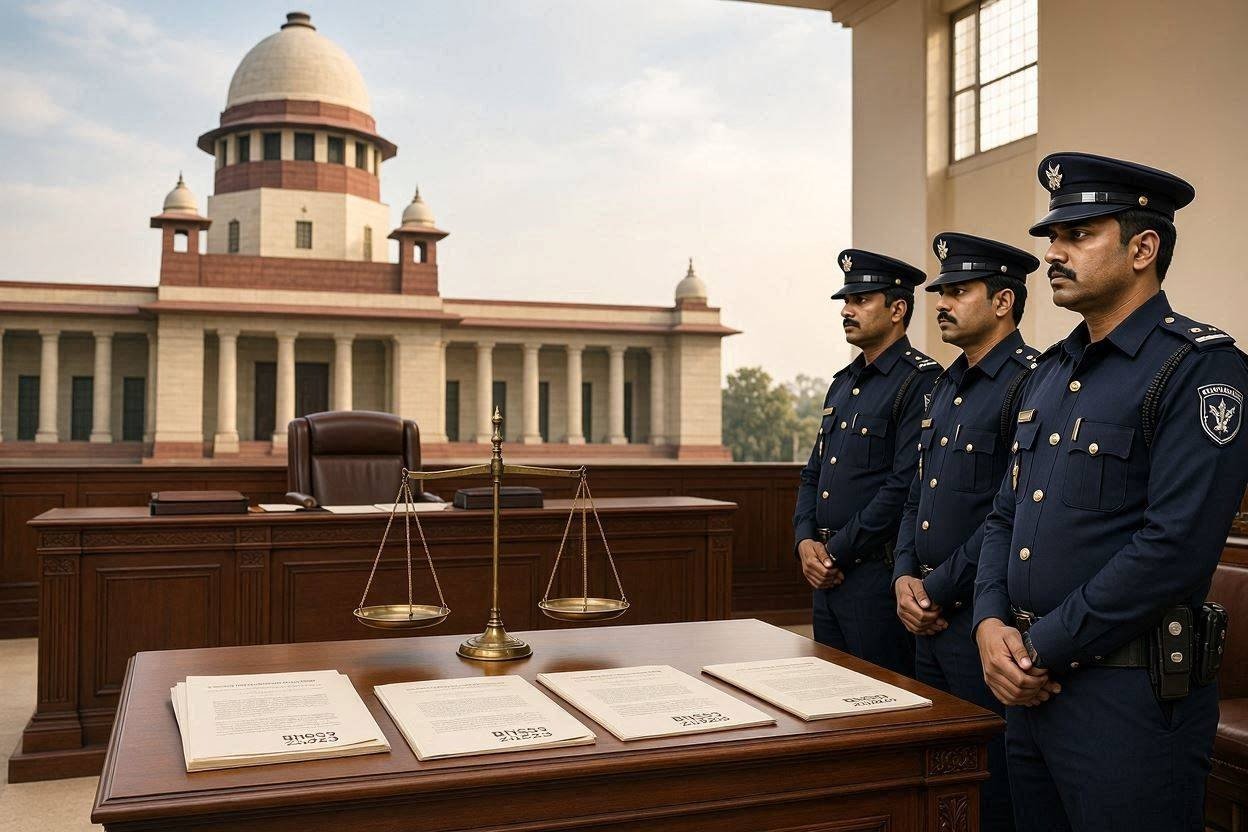
The Supreme Court has clarified the interpretation of police custody provisions under Section 187 of the Bharatiya Nagarik Suraksha Sanhita (BNSS), 2023, addressing concerns raised since the new criminal laws came into force.
The Court observed that while the BNSS permits police custody to be sought in phases rather than as a single continuous period, the aggregate duration of police custody cannot exceed 15 days. This represents a significant procedural clarification for investigating agencies and criminal courts across the country.
Section 187 of the BNSS replaced Section 167 of the Code of Criminal Procedure (CrPC). Unlike the earlier provision, the new law allows police custody to be granted in parts during the initial statutory remand period. However, the Court emphasized that this flexibility does not authorize unlimited or prolonged police custody.
The ruling seeks to reconcile investigative requirements with constitutional safeguards protecting personal liberty. The Court noted that remand orders must be scrutinized carefully by magistrates and should not be granted mechanically.
Legal experts have described the judgment as an important clarification of one of the most debated provisions of the BNSS. The decision is expected to guide magistrates, police authorities, prosecutors, and defence counsel in determining the permissible scope of police remand under the new criminal law framework.
The judgment reinforces that the total period of police custody remains capped at 15 days, even if such custody is granted intermittently within the statutory detention window provided under Section 187 BNSS.
The clarification is likely to have a significant impact on criminal investigations, especially in complex cases involving economic offences, organized crime, cybercrime, and other matters requiring extended investigation.