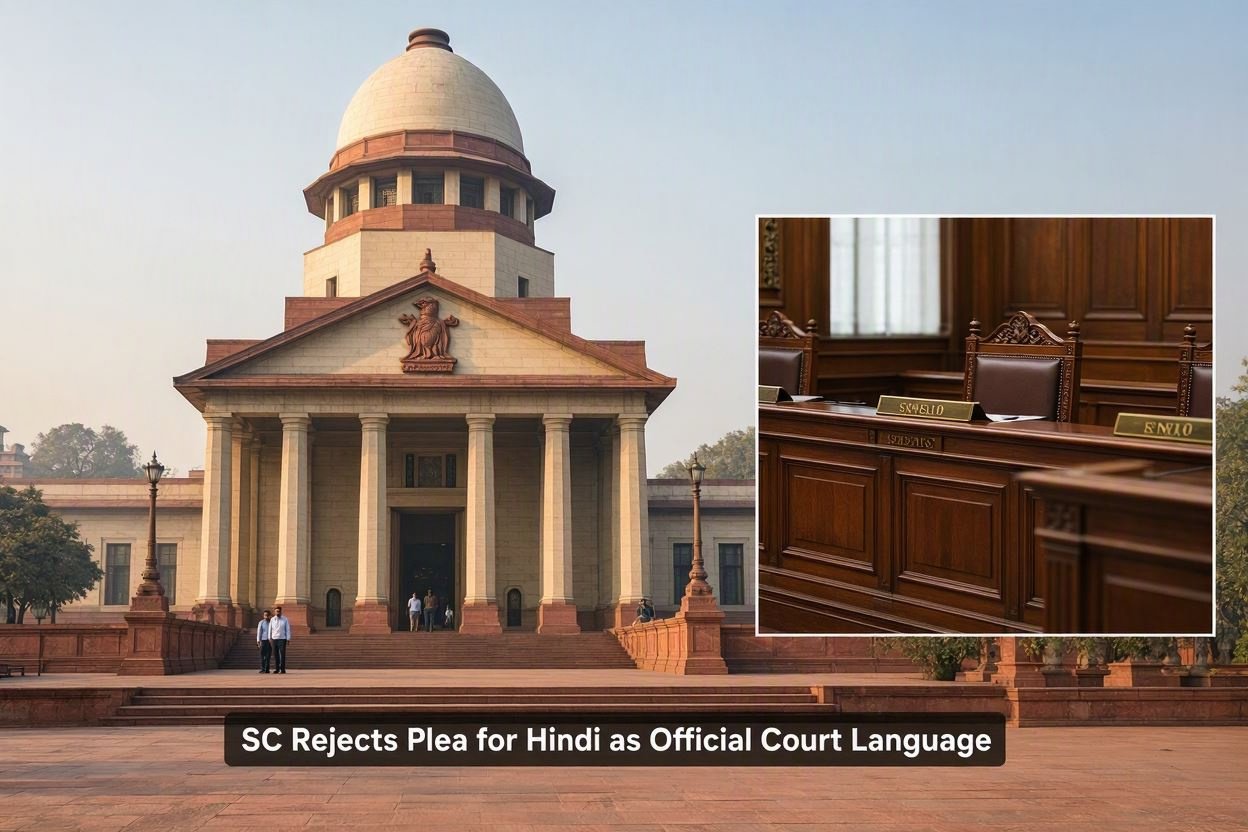
The Supreme Court of India has declined a plea seeking the adoption of Hindi as its official language, reaffirming the existing legal and constitutional framework under which proceedings before the apex court are conducted in English.
The petition sought directions for the Supreme Court to recognize Hindi as its official language for judicial proceedings and administrative purposes. However, the Court was not inclined to entertain the request, noting that the issue is governed by constitutional provisions, statutory enactments, and established judicial practice.
Under the current framework, English remains the language of proceedings before the Supreme Court. While several High Courts have received permission to use regional languages in specific circumstances, the Supreme Court continues to function in English to ensure uniformity, consistency, and accessibility in a national court that hears matters from every state and union territory.
The issue of language has historically been a sensitive constitutional question in India. Article 343 of the Constitution recognizes Hindi in Devanagari script as the official language of the Union, while English continues to be used for official purposes under the Official Languages Act and related constitutional arrangements.
The Court's refusal to entertain the plea underscores the distinction between the official language of the Union and the language of judicial proceedings before constitutional courts. The decision also reflects the practical challenges associated with transitioning the apex court's functioning to a single language in a multilingual country.
The development is significant in the broader debate surrounding language policy, access to justice, and judicial administration. It reiterates the judiciary's preference for maintaining a common working language for legal interpretation, precedent, and nationwide adjudication.