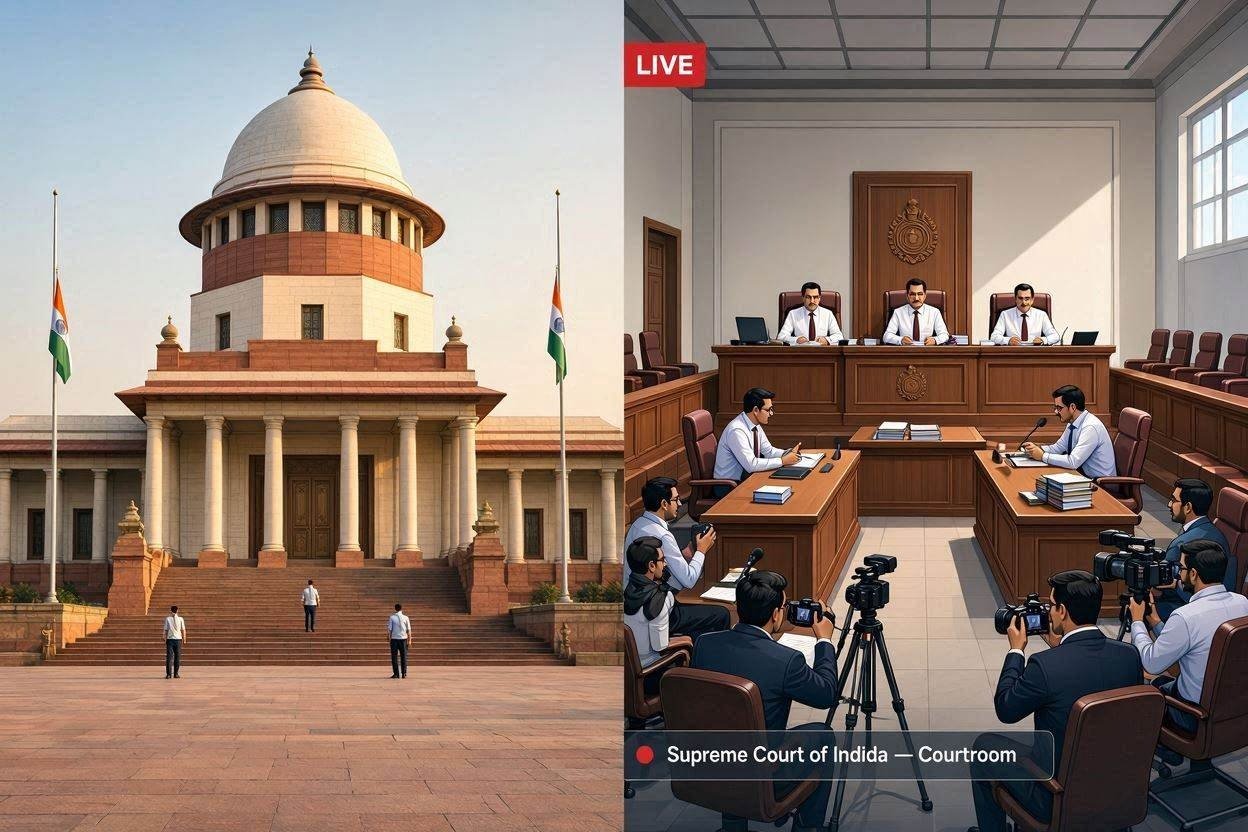
The Supreme Court of India has clarified that its recent interim order restricting the sharing and uploading of audio-video recordings of court proceedings does not impose a blanket prohibition on media reporting of judicial hearings.
The clarification came after concerns emerged regarding the interpretation of the Court's July 24, 2026 order, which barred the unauthorized recording, circulation, and publication of audio and video clips of courtroom proceedings on social media and digital platforms.
A Bench led by Chief Justice of India Surya Kant observed that recognized news organizations remain free to report on judicial proceedings and legal developments. However, such reporting cannot include the use of audio or video clips extracted from court proceedings unless prior authorization is obtained from the Court.
The Court emphasized that the restriction is limited to the use and dissemination of audio-visual recordings and should not be construed as a restriction on journalistic reporting. The clarification aims to preserve the balance between judicial transparency, open court principles, and the integrity of court proceedings.
The matter arose in the context of concerns regarding selective clipping, editing, decontextualized circulation, and commercial exploitation of courtroom proceedings on social media platforms. The Court noted that such practices may distort judicial proceedings and undermine public confidence in the administration of justice.
While maintaining restrictions on the use of courtroom recordings, the Supreme Court reiterated its commitment to transparency and public access to justice. The Court is expected to further consider issues relating to live-streaming regulations and the use of court recordings in future hearings.
The clarification is significant for media organizations, legal journalists, and digital publishers as it confirms that reporting on court proceedings remains permissible, subject to restrictions on the use of official audio-video content.