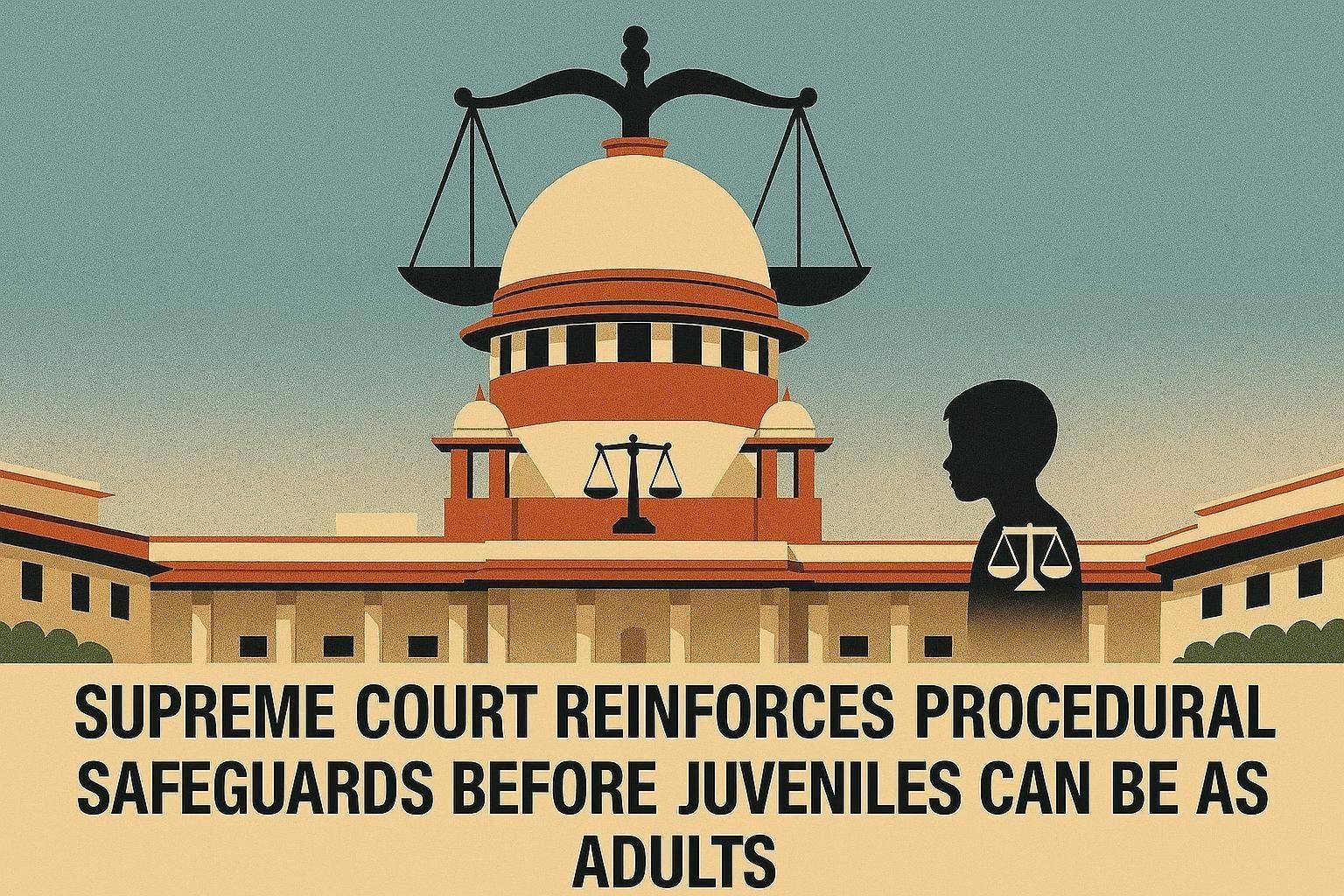
The Supreme Court has clarified that a Children's Court cannot automatically proceed with the trial of a child in conflict with law as an adult merely because the Juvenile Justice Board (JJB) has recommended such a course. In a significant ruling interpreting the Juvenile Justice (Care and Protection of Children) Act, 2015, the Court held that the Children's Court must independently apply its mind and pass a reasoned order under Section 19(1) before deciding whether the child should face trial as an adult.
The judgment arose from a case in which a juvenile had been convicted after being tried as an adult. The Supreme Court found that the Children's Court had failed to comply with the mandatory statutory requirement of independently determining whether an adult trial was warranted. Instead, it proceeded on the basis of the JJB's recommendation without conducting its own assessment.
Emphasizing the protective framework of juvenile justice legislation, the Court observed that Section 19 places a distinct responsibility on the Children's Court. The Court noted that the consequences of trying a child as an adult are far-reaching and therefore require an independent judicial determination rather than a mechanical acceptance of the Board's findings.
The Bench held that the requirement under Section 19(1) is mandatory. Even where the JJB has conducted a preliminary assessment under Section 15 and recommended an adult trial, the Children's Court must still evaluate the circumstances and record reasons supporting its decision.
The Supreme Court further ruled that the absence of such a reasoned determination vitiates the entire trial process. Consequently, the conviction in the present case was set aside, reaffirming the importance of procedural safeguards for children in conflict with law.
The judgment strengthens due process protections under the Juvenile Justice Act and provides important guidance to Children's Courts across the country. It reinforces that judicial discretion under Section 19 must be exercised independently and transparently whenever the possibility of an adult trial is being considered.
The ruling is expected to have a significant impact on pending and future cases involving juveniles accused of heinous offences, ensuring strict compliance with the procedural safeguards envisaged under the Juvenile Justice framework.