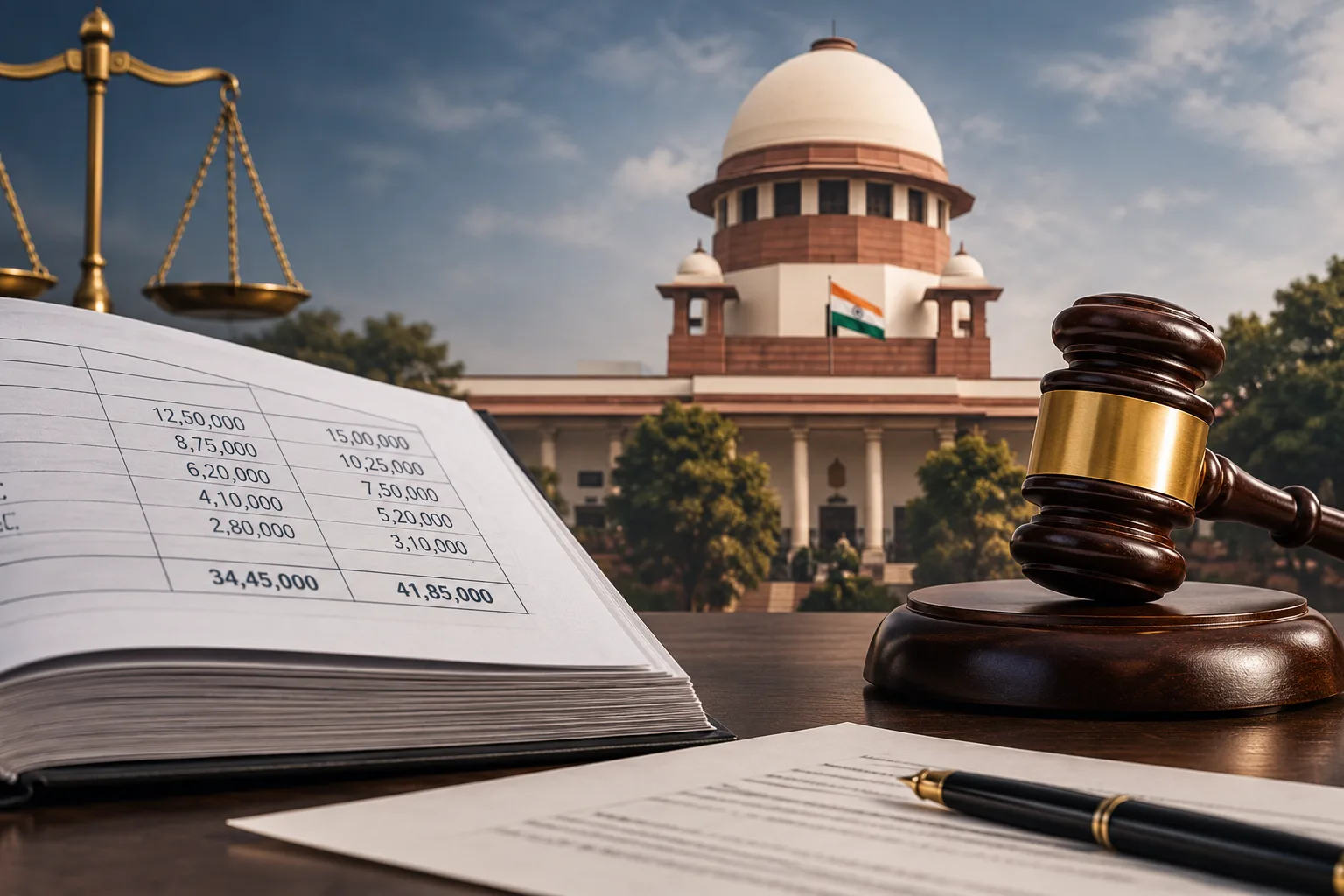
Supreme Court: Balance-Sheet Entries Can Acknowledge Debt and Extend Limitation Period
New Delhi, November 10, 2026: The Supreme Court of India has held that entries in a debtor's balance sheets, when read alongside surrounding transactions and supporting financial records, can constitute an acknowledgement of liability under Section 18 of the Limitation Act, 1963, giving rise to a fresh period of limitation.
A three-judge Bench comprising Justice Vikram Nath, Justice Augustine George Masih and Justice Sandeep Mehta delivered the ruling in Yusuf v. Vigyapan Loke Delhi Advertising CGHS Ltd. (2026 INSC 1207), decided on November 6, 2026.
Background of the Case
The dispute arose from a civil works contract dated February 10, 2000, concerning the construction of a multi-storey building in Mayur Vihar, Delhi. The original plaintiff, Wazir Hussain, had instituted a recovery suit in 2014, claiming ₹11,16,000 along with ₹11,04,840 as interest.
The plaintiff relied on running bills raised between 2000 and 2003, dishonoured cheques and entries in the defendant-society's financial statements. The outstanding amounts were allegedly carried forward in the society's balance sheets from 2004–05 through 2012–13.
The defendant sought rejection of the plaint under Order VII Rule 11 of the Code of Civil Procedure, 1908, arguing that the suit was barred by limitation. Although the trial court rejected this application in 2020, the Delhi High Court subsequently allowed the defendant's revision petition in 2024 and rejected the plaint as time-barred.
Supreme Court's Observations
Examining Section 18 of the Limitation Act, 1963, the Supreme Court reiterated that a written acknowledgement of an existing liability, made before expiry of the prescribed limitation period, triggers a fresh limitation period from the date of acknowledgement.
Referring to Asset Reconstruction Company (India) Ltd. v. Bishal Jaiswal and Axis Bank Ltd. v. Naren Sheth, the Bench reaffirmed that entries in books of account, including balance sheets, may amount to acknowledgement of liability. However, the entries must be examined in the context of the complete financial statement, including accompanying notes and auditor's qualifications.
The Court clarified that an acknowledgement does not necessarily have to identify the creditor by name or follow a prescribed format. What matters is whether the acknowledgement, considered alongside the surrounding circumstances, establishes a subsisting legal relationship between the parties.
In the present case, bank reconciliation statements recorded three cheques issued in favour of Wazir Hussain Contractor, while subsequent balance sheets continued carrying forward the relevant amounts until 2013. Taken together, these circumstances supported the existence of an acknowledged liability and renewed the limitation period.
Scope of Order VII Rule 11 CPC
The Supreme Court also emphasised that a court deciding an application under Order VII Rule 11 CPC should not conduct an extensive examination of evidence to conclusively determine whether the alleged debt exists. At this preliminary stage, the court must assess whether the plaint discloses a prima facie case.
The Bench clarified that the balance-sheet entries did not conclusively establish that the entire amount claimed was payable. The precise relationship between the cheques, the amounts carried forward and the recovery claim would have to be determined during trial.
Final Decision
Allowing the appeal, the Supreme Court set aside the Delhi High Court's order dated November 4, 2024, and restored the recovery suit before the trial court. All questions concerning the merits of the monetary claim were left open for determination at trial.
Significance: The judgment reinforces the evidentiary importance of financial statements in debt recovery disputes and clarifies how written acknowledgements under Section 18 of the Limitation Act can affect the computation of limitation. It also cautions courts against prematurely rejecting recovery suits where the pleadings and supporting material disclose a prima facie case.