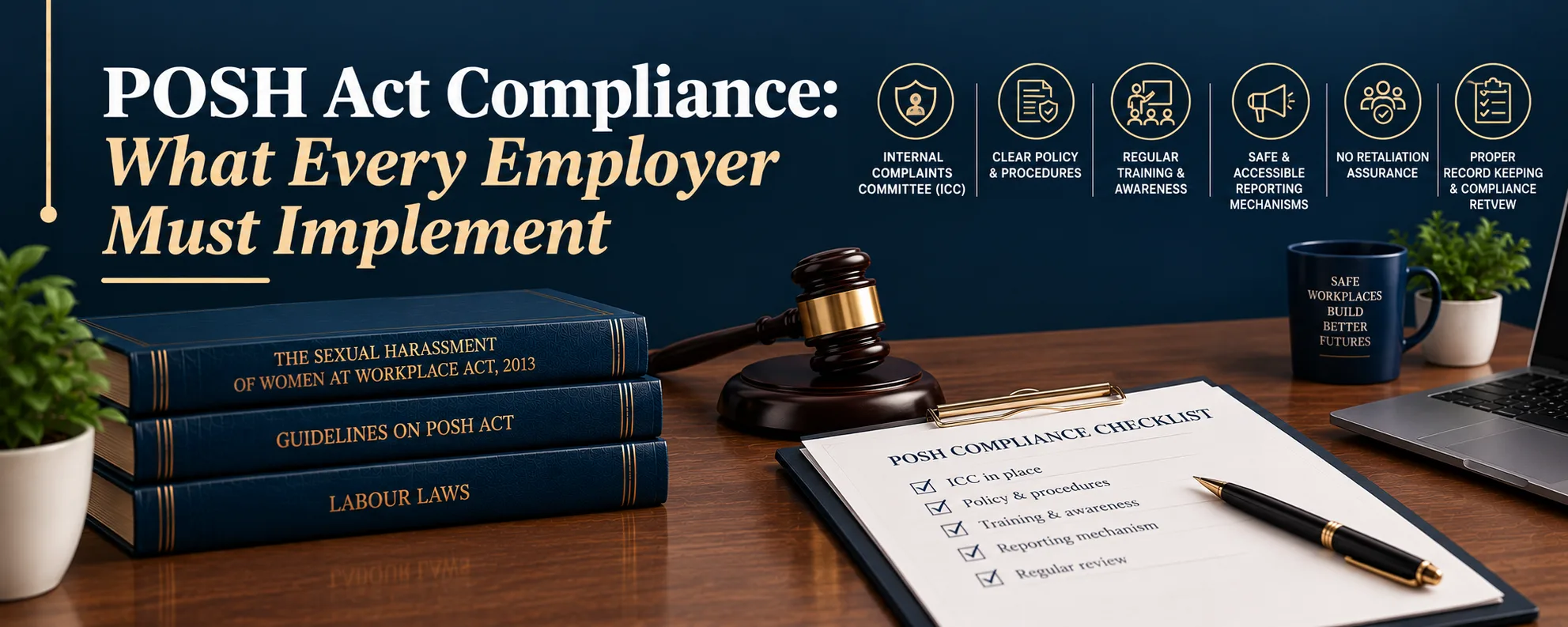
A safe workplace is not created simply by having a policy against sexual harassment or putting up a notice on the office board. It requires a system that employees can understand, access and trust.
The Sexual Harassment of Women at Workplace (Prevention, Prohibition and Redressal) Act, 2013, commonly known as the POSH Act, was introduced to protect women from sexual harassment at the workplace and provide a mechanism for addressing complaints. It places responsibilities on employers that go beyond setting up a committee. These include creating awareness, providing a safe working environment, supporting inquiries and ensuring that complaints are handled within the prescribed timelines.
For employers, compliance is therefore an ongoing responsibility, not a one-time formality.
1. Understand the Scope of the POSH Act
The POSH Act applies to both organised and unorganised workplaces, across public and private sectors. Its definition of an employee is broad. It includes regular, temporary, ad hoc and daily-wage workers, as well as contract workers, trainees, apprentices and persons working voluntarily, whether or not they receive remuneration.
The Act also gives a wide meaning to the term “workplace”. Apart from offices and commercial establishments, it includes hospitals, educational and sports institutions, places visited during the course of employment, employer-provided transportation and dwelling places where domestic workers are employed.
Sexual harassment is not limited to physical conduct. Section 2(n) covers unwelcome physical contact or advances, demands for sexual favours, sexually coloured remarks, showing pornography and other unwelcome physical, verbal or non-verbal conduct of a sexual nature. Section 3 also recognises circumstances such as threats relating to employment, interference with work and the creation of an intimidating, offensive or hostile work environment.
This matters because employers should not restrict their policies to incidents occurring within office premises or between permanent employees.
2. Constitute an Internal Committee
Under Section 4, every workplace employing ten or more employees must constitute an Internal Committee (IC) through a written order. Where an organisation has offices or administrative units at different locations, an IC must be constituted at each such office or unit.
The committee must have the following composition:
- A woman employed at a senior level as the Presiding Officer.
- At least two employee members, preferably committed to the cause of women or having experience in social work or legal knowledge.
- One external member from an NGO or association committed to the cause of women, or a person familiar with issues relating to sexual harassment.
At least half of the nominated members must be women. The Presiding Officer and members can hold office for a period not exceeding three years.
The external member is important because the committee should not function merely as an internal management team. The member brings an independent perspective to the process.
A common compliance mistake is confusing the qualifications prescribed under Rule 4 of the POSH Rules with the qualifications for every external member of an IC. Rule 4 specifically concerns a member of the Local Committee under Section 7(1)(c). It recognises specified social-work experience or familiarity with labour, service, civil or criminal law. It should not be treated as the universal qualification rule for an IC’s external member.
Where a workplace has fewer than ten employees, or the complaint is against the employer, the complaint is to be made to the Local Committee constituted by the District Officer under Section 6. Employers should therefore identify the relevant Local Committee and make its contact details accessible.
3. Prepare and Communicate a POSH Policy
A written POSH policy gives employees a clear understanding of prohibited conduct, available complaint mechanisms and the procedure followed after a complaint is made.
The policy should explain what constitutes sexual harassment, identify the IC members and provide their contact details. It should also describe how a complaint can be submitted, the applicable timelines, the inquiry process, confidentiality requirements and the consequences of misconduct.
Rule 13 requires employers to formulate and widely disseminate an internal policy, charter, resolution or declaration relating to the prohibition of sexual harassment. Merely drafting a policy and keeping it in the HR department is not enough. Employees should be able to access and understand it.
The employer must also display, at a conspicuous place, the penal consequences of sexual harassment and the order constituting the IC, as required by Section 19(b).
4. Conduct Regular Awareness and Training Programmes
Employees should know what behaviour is prohibited and how to report it. Similarly, IC members must understand their responsibilities and the procedure they are expected to follow.
Section 19(c) requires employers to organise workshops and awareness programmes at regular intervals and orientation programmes for IC members. Rule 13 further addresses employee awareness, member orientation and capacity-building.
Training should not be limited to reading out the policy. It should explain workplace examples, complaint procedures, confidentiality and the importance of preventing retaliation. Managers and HR personnel should also understand that complaints must be handled through the prescribed mechanism rather than dismissed informally.
Employers should maintain records of workshops, attendance, training material and orientation programmes. These records can help demonstrate that awareness obligations are being taken seriously.
5. Follow the Complaint and Inquiry Procedure
Under Section 9, an aggrieved woman may submit a written complaint to the IC within three months of the incident or, in the case of a series of incidents, within three months of the last incident. The committee may extend this period by a further three months if circumstances prevented the woman from filing it earlier. Assistance must be provided where she is unable to make the complaint in writing.
Conciliation may be attempted under Section 10 only at the request of the aggrieved woman and before the inquiry begins. Monetary settlement cannot be made the basis of conciliation.
If an inquiry is required, the IC must follow the applicable service rules and principles of natural justice. Where no service rules exist, the prescribed procedure under the POSH Rules applies. The Rules require the committee to send the complaint to the respondent within seven working days. The respondent is given up to ten working days from receipt to submit a reply and supporting documents.
The inquiry must be completed within 90 days. The committee must provide both parties a reasonable opportunity to be heard and follow the procedural safeguards under the Rules. Legal practitioners cannot represent parties before the committee.
During the inquiry, the IC may recommend interim relief under Section 12 on the written request of the aggrieved woman. This may include transfer of either party, additional leave of up to three months for the woman, or other prescribed relief.
After completing the inquiry, the committee must submit its report within ten days. If the allegation is proved, it may recommend action under the applicable service rules and compensation in accordance with Section 15. The employer or District Officer, as applicable, must act on the recommendations within 60 days.
6. Fulfil the Employer’s Duties Beyond Committee Formation
Section 19 sets out responsibilities that are sometimes overlooked. Employers must provide a safe working environment, including protection from persons who come into contact with employees at the workplace. They must provide the IC or Local Committee with facilities needed to conduct inquiries, assist in securing the attendance of respondents and witnesses, and make relevant information available.
The employer must also assist a woman who chooses to file a criminal complaint and ensure that appropriate action is initiated under applicable law. Where the alleged perpetrator is not an employee, action under applicable law must be initiated if the aggrieved woman so desires. Sexual harassment must be treated as misconduct under the applicable service rules, and employers must monitor timely submission of IC reports.
Confidentiality is equally important. Sections 16 and 17 prohibit publication or communication of the contents of a complaint, identities and addresses of the aggrieved woman, respondent and witnesses, and details of inquiry proceedings or recommendations. Employers should restrict access to case records and ensure that employees, managers and committee members do not disclose protected information.
The IC must submit its annual report to the employer and District Officer. The Local Committee submits its report to the District Officer. Under Section 22, employers must include the number of cases filed and disposed of in their organisation’s annual report, or intimate the District Officer where no annual report is prepared.
7. Consequences of Non-Compliance
Failure to comply with the Act can have financial and operational consequences. Under Section 26, an employer who fails to constitute an IC, fails to take action under specified provisions or otherwise contravenes the Act may face a fine of up to ₹50,000.
A subsequent conviction for the same offence may attract twice the punishment, along with possible cancellation, withdrawal or non-renewal of a licence or registration required for carrying on business or activity.
The Rules also provide for a penalty in certain confidentiality breaches where service rules do not prescribe one. Under Rule 12, a sum of ₹5,000 may be recovered from the person who contravenes Section 16.
8. What the Supreme Court Has Emphasised
In Vishaka v. State of Rajasthan (1997), the Supreme Court recognised workplace sexual harassment as a violation of women’s fundamental rights and laid down guidelines that operated until legislation was enacted.
In Aureliano Fernandes v. State of Goa (2023), the Supreme Court examined serious procedural shortcomings in disciplinary proceedings arising from events that pre-dated the POSH Act. The Court stressed the importance of fair hearings and natural justice. Separately, it issued directions to improve implementation of the POSH framework, including verification of committees and awareness measures.
In Initiatives for Inclusion Foundation v. Union of India (2023), the Court addressed systemic gaps in implementation and clarified the responsibilities of authorities and employers, including the constitution of committees and monitoring mechanisms.
Further directions were issued by the Supreme Court on 3 December 2024 in the continuing proceedings connected with these matters. They addressed, among other things, the identification of District Officers, constitution of Local Committees, functioning of Internal Committees and access to complaint mechanisms.
These decisions show that compliance cannot be reduced to the existence of a policy or committee on paper. The mechanism must be properly constituted, accessible and functional.
Conclusion
The POSH Act places a continuing responsibility on employers to prevent sexual harassment and provide an effective mechanism for redressal. Constituting an Internal Committee is only the starting point. Employers must also communicate the policy, conduct regular training, support fair inquiries, protect confidentiality and complete statutory reporting.
A workplace becomes safer when employees know where to seek help and can trust that their complaints will be handled seriously. POSH compliance should therefore be treated as an essential part of workplace governance, rather than a formality undertaken only to meet legal requirements.
Disclaimer: This article is intended for general informational and educational purposes and should not be treated as legal advice. The application of the POSH Act may depend on the facts and circumstances of each case.