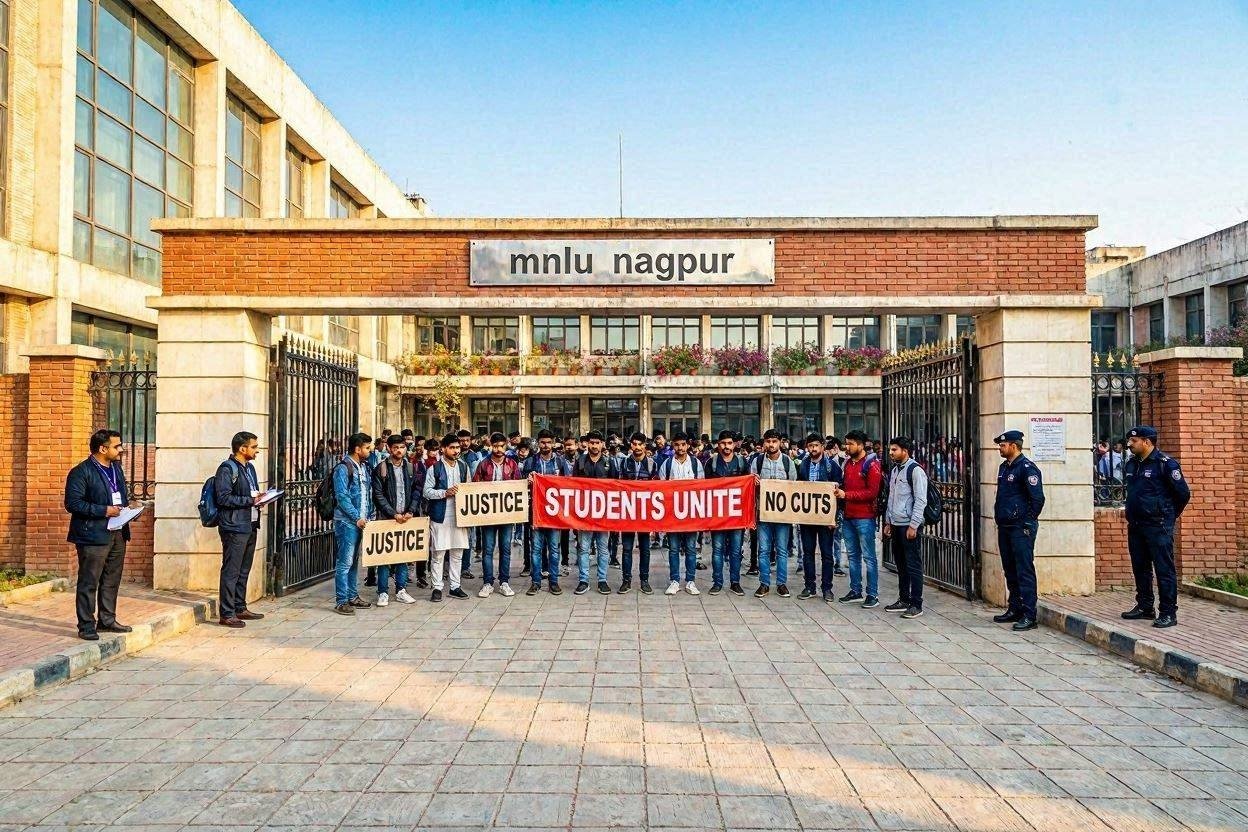
MNLU Anti-Ragging Committee Convenes After Protests Over FIR in Alleged Ragging Case
The Anti-Ragging Committee of Maharashtra National Law University (MNLU), Nagpur, has convened to examine allegations of ragging involving four students following widespread protests on campus over the manner in which the university handled the matter.
The controversy stems from an alleged ragging incident that reportedly took place on June 25, 2026, inside the university hostel. According to the complaint, a junior student and several other freshers were allegedly called to a senior student's room and directed to introduce themselves in multiple languages. The complainant alleged that students were subjected to physical exercises and asked to repeat obscene language when they made mistakes.
The student formally submitted a written complaint to the university on July 8. Subsequently, on July 10, an FIR was registered against four hostel residents under Sections 3 and 4 of the Maharashtra Prohibition of Ragging Act, 1999. The complaint also referred to obligations under the UGC Regulations on Curbing the Menace of Ragging in Higher Educational Institutions, 2009.
The filing of the FIR triggered significant unrest within the university community. Hundreds of students reportedly assembled on campus to protest what they described as a hasty resort to police action without first conducting an internal inquiry through the Anti-Ragging Committee. Protesters questioned whether due process within the university framework had been adequately followed before involving law enforcement.
Reports indicate that the Anti-Ragging Committee had not completed an inquiry before the police complaint was lodged. Following criticism from students and growing public attention, the committee has now convened to assess the allegations and review the circumstances surrounding the incident.
Police authorities have clarified that the accused students were issued notices as part of a preliminary inquiry and denied allegations that they were formally detained. Nevertheless, the matter has raised broader questions about balancing institutional disciplinary mechanisms with statutory obligations to report ragging incidents.
The case highlights the continuing challenge faced by higher educational institutions in addressing ragging complaints while ensuring procedural fairness, transparency, and compliance with anti-ragging laws. The findings of the Anti-Ragging Committee are expected to play a significant role in determining the university's subsequent disciplinary actions.
The incident has also reignited discussion within legal academia regarding the implementation of anti-ragging regulations, the rights of complainants and accused students, and the extent of a university's duty to involve law enforcement at the initial stages of a complaint.