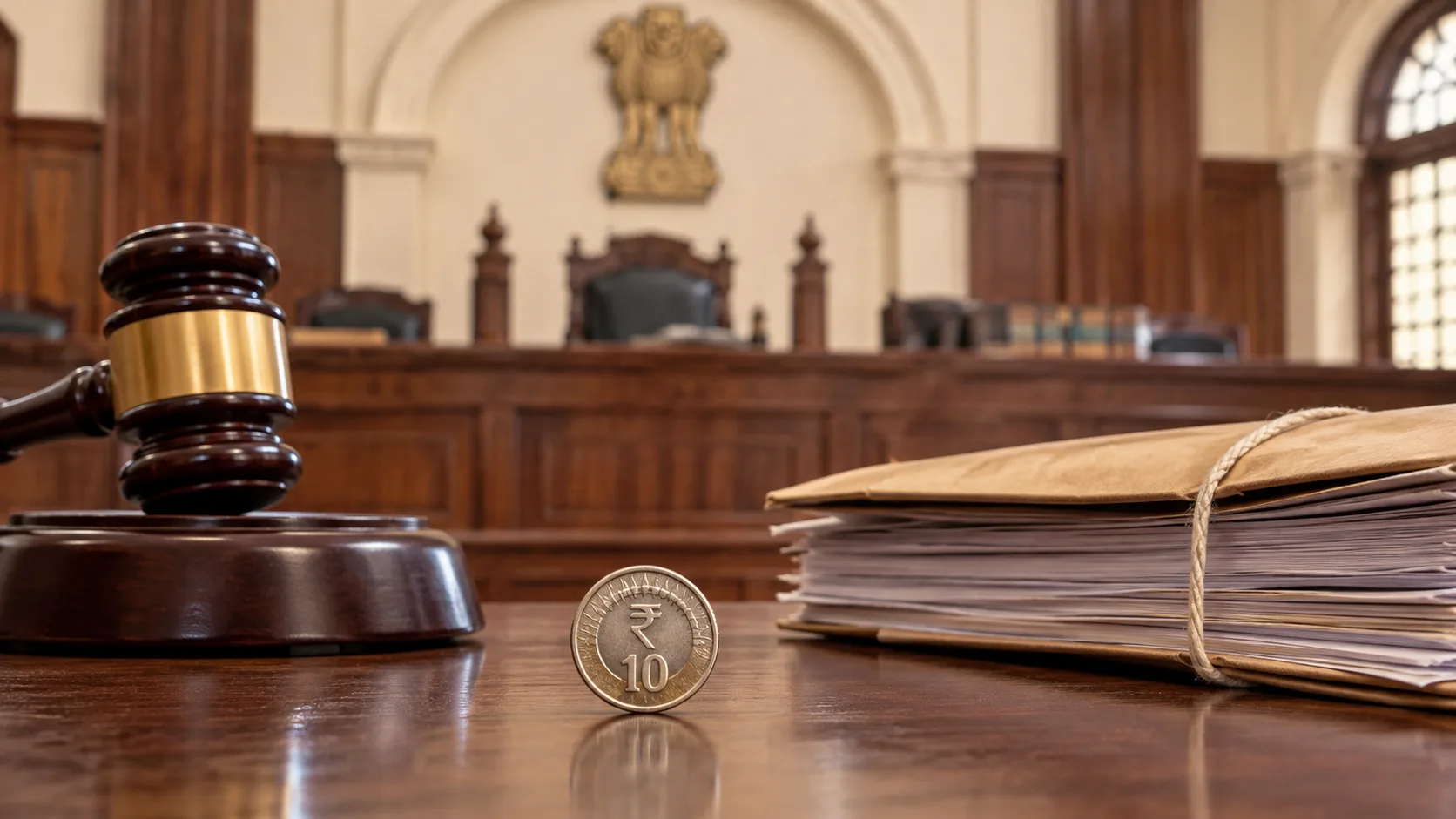
Madras High Court Slams Litigant for Paying Just ₹10 Court Fee on ₹2.5 Crore Recovery Claim
The Madras High Court has strongly criticised a construction company's managing director for paying only ₹10 as court fee while filing a civil suit seeking recovery of approximately ₹2.5 crore. The Court observed that the conduct amounted to an abuse of the judicial process and imposed costs of ₹50,000 on the appellant.
A Division Bench comprising Justice N. Sathish Kumar and Justice G.K. Muthukumaar dismissed two appeals challenging orders that refused to condone substantial delays in re-presenting the plaint and paying the deficit court fee.
Background of the Dispute
The dispute originated in 2019 when a construction company instituted a recovery suit against another construction company over unpaid bills arising from a contractual relationship. Although the claim amounted to approximately ₹2.5 crore, the plaintiff initially paid only ₹10 towards court fees.
The Registry returned the plaint and directed the company to pay the deficit court fee, reportedly amounting to approximately ₹2.5 lakh. However, the company took around three years to re-present the plaint and complete the required payment.
The appellant subsequently sought condonation of two separate delays: 1,161 days in re-presenting the plaint and 1,181 days in paying the deficit court fee. Both applications were rejected by the Court Master on December 2, 2022. A Single Judge subsequently upheld the rejection on September 3, 2024.
COVID-19 Pandemic Not a Sufficient Explanation
Before the Division Bench, the appellant argued that the delays resulted from the COVID-19 pandemic and difficulties in arranging the necessary funds. It was also contended that the underlying recovery claim was genuine and arose from commercial transactions.
However, the Bench observed that although the pandemic could potentially constitute sufficient cause for delay, the litigant was still required to provide a satisfactory explanation for the entire period of delay. The explanation offered was considered vague and inadequate.
The Court expressed serious concern over the fact that the litigant had initially paid merely ₹10 towards a claim of approximately ₹2.5 crore and subsequently failed to comply with the Registry's directions for an extended period.
Conduct Amounted to Abuse of Judicial Process
The Bench observed that the litigant's conduct demonstrated disregard for the legal system and unnecessarily prolonged the proceedings, causing hardship, expenses and prolonged uncertainty for the opposing party.
The Court characterised the conduct as a mockery of the judicial system and held that such misuse of legal proceedings should not be encouraged.
₹50,000 Costs Imposed
Consequently, the Division Bench dismissed both appeals and imposed costs of ₹25,000 in each appeal, amounting to a total of ₹50,000. The amount was directed to be paid to the respondent within six weeks.
Key Legal Significance
The decision highlights the importance of complying with procedural requirements relating to court fees and the need to provide convincing reasons when seeking condonation of delay. It also reinforces that the COVID-19 pandemic cannot automatically justify prolonged procedural defaults without a satisfactory explanation for the delay.
The ruling serves as a reminder that access to judicial remedies must be accompanied by procedural diligence and respect for the judicial process.