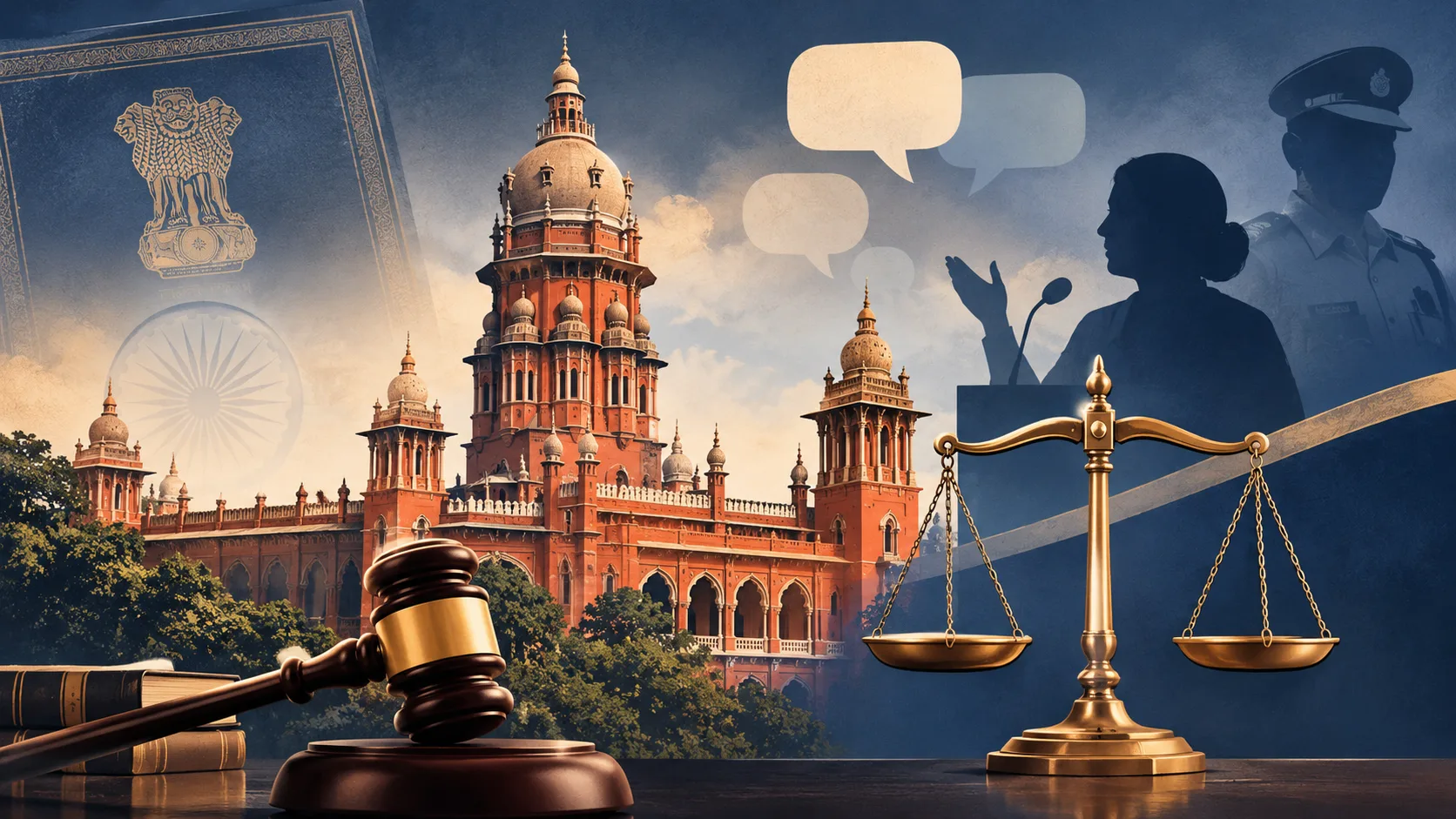
The Madras High Court has granted anticipatory bail to D. Sudha, a councillor of the Greater Chennai Corporation and a functionary of the Dravida Munnetra Kazhagam (DMK), in a criminal case arising from allegedly derogatory remarks against Tamil Nadu Chief Minister Joseph Vijay. Justice N. Ramesh passed the order on November 2, 2026, in D. Sudha v. State, Crl.O.P. No. 30986 of 2026.
Background of the Case
The case originated from a speech delivered by Sudha at a DMK function held at Raja Annamalai Mandram, Chennai, on October 7, 2026. She allegedly made abusive and derogatory remarks against the Chief Minister. A video of the speech subsequently circulated on social media.
On October 19, 2026, a functionary of the ruling Tamilaga Vettri Kazhagam (TVK) lodged a complaint with the B-2 Esplanade Police Station, Chennai. The police registered Crime No. 157 of 2026 under Sections 296(b), 352 and 353(1)(c) of the Bharatiya Nyaya Sanhita, 2023.
Sudha approached the High Court seeking anticipatory bail under Section 482 of the Bharatiya Nagarik Suraksha Sanhita, 2023, apprehending arrest in connection with the case.
Political Speech and Constitutional Protection
Examining the allegations, the Court observed that the remarks were directed against an individual political leader and did not target any particular community or class. It also noted that the speech did not exhort anyone to commit an act of violence or other unlawful activity.
Justice N. Ramesh emphasised that political speech, including hostile, unfair and intemperate criticism of public office holders, falls within the protection of Article 19(1)(a) of the Constitution of India. Such expression can be restricted only on the constitutionally recognised grounds under Article 19(2), applying the relevant tests of incitement and proximate danger to public order.
The Court clarified that protecting freedom of expression does not mean approving abusive or offensive language. However, criticism, ridicule and even intemperate political remarks cannot automatically become grounds for criminal prosecution.
Police Must Remain Politically Neutral
One of the most significant aspects of the judgment concerned the constitutional responsibility of police authorities to maintain impartiality, irrespective of which political party holds power.
The Court observed that the complaint was lodged twelve days after the speech, and the police registered the case within an hour of receiving it. Although the Court did not conclude that the police had acted at the instance of any political party, it emphasised that law enforcement authorities must remain conscious of how their actions appear to ordinary citizens.
In a strong observation on institutional neutrality, the Court stated:
"The police serve the State, which endures, and not the party in government, which changes."
The Court further observed that maintaining an even hand between the ruling party and its political opponents is not merely a matter of administrative courtesy but a condition of the constitutional legitimacy of the police force.
Observations on Arrest and Criminal Proceedings
The Court examined whether custodial interrogation was necessary in the circumstances. It noted that the alleged remarks had already been recorded and circulated, and the relevant material was available to the investigating authorities.
Consequently, the prosecution had not demonstrated any specific requirement for custodial interrogation. The Court also highlighted the importance of following the applicable procedural safeguards under Section 173(3) of the BNSS in appropriate cases involving offences punishable within the prescribed statutory threshold.
The Court further noted that allegations essentially concerning defamation must be examined in light of the separate legal procedure prescribed under Section 356 of the BNS and Section 222 of the BNSS.
Refusal to Impose a Restriction on Political Speech
The State sought a condition restraining Sudha from speaking against the Chief Minister. However, the Court refused to impose any such restriction as a condition of anticipatory bail.
It observed that bail conditions must be reasonable, necessary and proportionate, and should serve legitimate purposes such as securing the accused's presence, protecting evidence and witnesses, or preventing repetition of the alleged offence.
The Court held that a blanket restriction on political expression would not serve these purposes. It further stated:
"A court that gags a politician as the price of liberty does indirectly what Article 19 forbids the State to do directly."
The Court recorded the petitioner's voluntary undertaking to exercise restraint in future public statements, clarifying that it was her own promise and not a condition imposed by the Court.
Final Decision and Bail Conditions
Allowing the criminal original petition, the Madras High Court granted anticipatory bail to D. Sudha, subject to the following conditions:
- The petitioner must execute a bond of Rs. 25,000 with two sureties for a like sum before the concerned Magistrate.
- She must appear before the 7th Metropolitan Magistrate Court, George Town, within fifteen days from the date on which the order copy is made ready.
- She must report to the respondent police daily at 10:30 AM until further orders.
- Failure to surrender before the concerned Magistrate within the prescribed fifteen-day period would result in automatic cancellation of the order.
- Any breach of the bail conditions may invite appropriate legal action in accordance with law.
Significance of the Judgment
The decision reinforces the constitutional importance of freedom of political expression, police impartiality and safeguards against unnecessary arrest. It highlights that public office holders must remain open to criticism and that criminal law cannot be employed merely because political speech is offensive or uncomfortable.
At the same time, the judgment does not endorse abusive language or determine the petitioner's guilt or innocence. The criminal investigation remains a separate process, and the allegations have not been finally adjudicated.
By refusing to make silence a condition of liberty, the Madras High Court has underlined an important constitutional principle: freedom of expression and the rule of law must operate independently of political power.
Case Details
- Case Title: D. Sudha v. State represented by the Inspector of Police, B-2 Esplanade Police Station, Chennai
- Case Number: Crl.O.P. No. 30986 of 2026
- Crime Number: 157 of 2026
- Court: Madras High Court
- Judge: Justice N. Ramesh
- Date of Judgment: November 2, 2026
- Relevant Provisions: Articles 19(1)(a) and 19(2) of the Constitution; Sections 296(b), 352 and 353(1)(c) of the BNS; Sections 173(3), 222 and 482 of the BNSS.
- Outcome: Anticipatory bail granted subject to conditions.
Source: D. Sudha v. State – Madras High Court Judgment dated November 2, 2026.