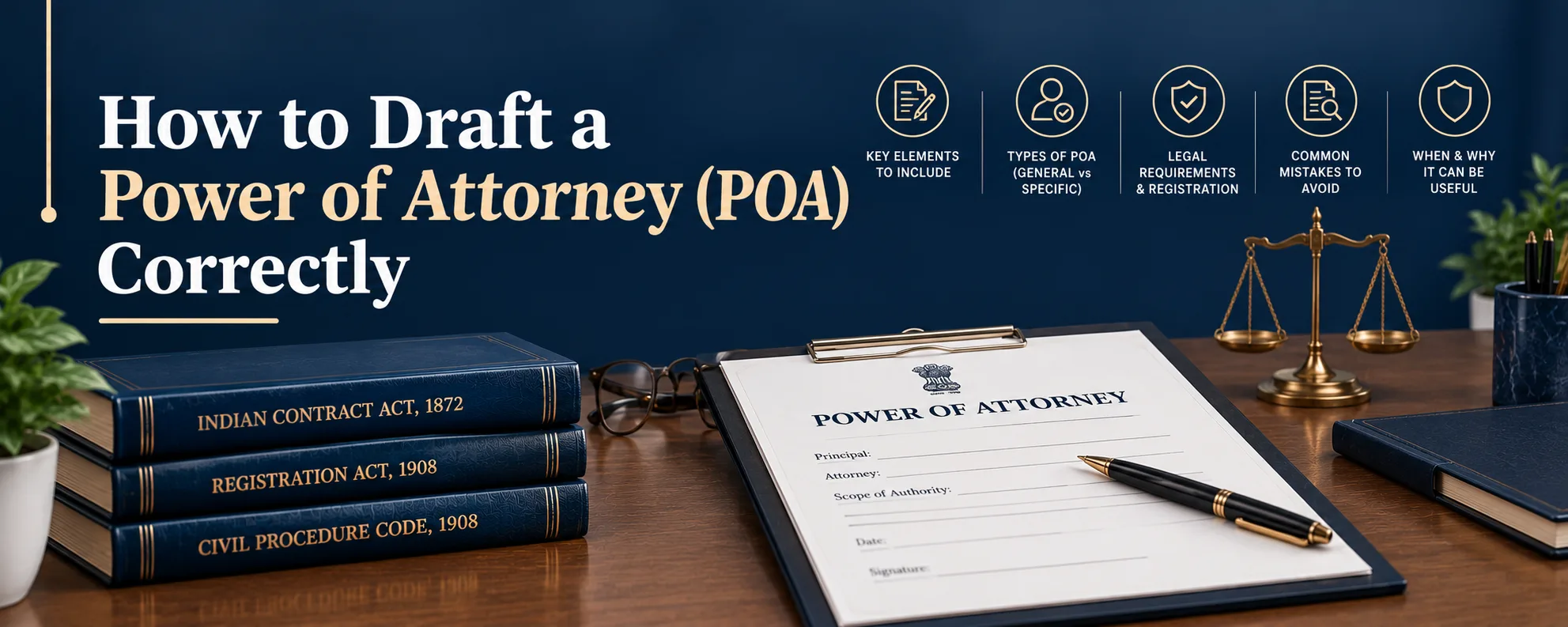
A Power of Attorney (POA) authorises one person to act on behalf of another for specified purposes. It can be useful when someone lives abroad, cannot attend a property transaction personally or needs assistance with banking, financial affairs or dealings with government authorities. Unclear wording or incorrect execution, however, can create difficulties when the document is needed.
Section 1A of the Powers-of-Attorney Act, 1882, defines a POA as an instrument empowering a specified person to act for and in the name of the person executing it. The person granting authority is commonly called the principal or donor, while the person receiving it is the agent or attorney-holder. The relationship is also governed by the agency provisions of the Indian Contract Act, 1872.
Drafting a POA correctly involves identifying its purpose, defining the authority precisely and complying with the formalities applicable to its intended use. Requirements may differ according to the transaction, the state concerned and whether the document is executed in India or abroad.
1. Choose the Correct Type of Power of Attorney
The first step is deciding how much authority is actually necessary.
A General Power of Attorney (GPA) authorises the attorney-holder to undertake several acts within the powers specified in the document. These may include collecting rent, paying property taxes, handling specified banking matters or representing the principal before identified authorities. A GPA does not automatically grant unlimited control over the principal's affairs.
A Special Power of Attorney (SPA) limits the authority to a particular purpose, transaction or defined set of acts. For example, a person living outside Pune may authorise a relative to complete specified formalities relating to a property transaction there.
The distinction matters because authority to manage property is not necessarily authority to sell it. If assistance is required for only one transaction, an SPA may be more appropriate than granting extensive powers under a GPA. The legal effect ultimately depends on the wording, purpose and applicable law, not merely the document's title.
2. Essential Clauses in a Power of Attorney
A useful POA should identify the parties, explain the authority being granted and establish clear boundaries for its exercise.
Identify the parties accurately. State the principal's and attorney-holder's full names, addresses and other identifying particulars required for the transaction. Where relevant, include age and identification details. For property-related POAs, describe the property accurately using its address and available particulars, such as the survey number or flat number. The exact details required may depend on the receiving institution or registering authority.
Define the powers expressly. The operative clause is the heart of the document. It should explain what the attorney-holder may do rather than rely on broad phrases such as "manage all my affairs".
For property management, specify whether the attorney-holder may collect rent, pay taxes, arrange repairs, enter into tenancy arrangements or represent the principal before municipal authorities. If the principal intends to authorise a sale, the document should expressly address the authority to execute the relevant conveyance, receive consideration and complete the necessary formalities, as applicable.
A power to receive rent should not be drafted as though it automatically includes a power to sell or mortgage the property.
Sections 186–188 of the Indian Contract Act, 1872, address express and implied authority and its extent. For significant transactions, clear and specific drafting is safer than relying on implied authority. Section 190 generally restricts an agent from delegating authority unless permitted by the applicable rules or circumstances. If delegation is intended, the document should address it expressly and lawfully.
Include limitations and safeguards. State what the attorney-holder cannot do, particularly where valuable assets are involved. The principal may restrict the POA to a specified property, bank account, transaction or period. The document may also prohibit borrowing, creating a mortgage, transferring property or delegating authority to another person.
These safeguards are recommended drafting practices, not universal statutory requirements. They should be consistent with the powers granted elsewhere in the document and cannot override mandatory legal requirements.
Address duration, revocation and termination. Specify whether the authority ends on a stated date, completion of a transaction or another defined event. The document should also address revocation, subject to applicable law.
Section 201 of the Indian Contract Act, 1872, identifies general grounds for termination of agency, including revocation, completion of the business and certain events affecting the principal or agent. Sections 202–204 address important qualifications, including an agent's interest in the subject matter and limits on revocation after authority has been partly exercised. Section 205 concerns compensation in certain cases of premature revocation or renunciation, while Section 206 addresses reasonable notice.
Consequently, describing a POA as "irrevocable" does not automatically make it so. Section 202 may protect an agency where the agent has an interest in the property forming its subject matter, but its application depends on the circumstances and terms of the arrangement.
Record execution details. Include the date and place of execution, the principal's signature and any required attestation or authentication details. Witnesses, the attorney-holder's signature or acceptance, and additional declarations may be necessary depending on the document's purpose and applicable requirements.
Avoid blanks and unexplained alterations. The principal should understand the contents and sign voluntarily. If language is a barrier, the document should be explained in a language the principal understands.
3. Stamp Duty, Authentication and Registration in India
A correctly worded POA may still face objections if applicable formalities have not been followed. Three separate questions must be considered: whether the document is properly stamped, whether authentication is required in a particular form, and whether registration is compulsory or necessary for its intended use.
Stamp duty. Stamp duty depends on the applicable state legislation, the nature of the instrument and the circumstances of its execution or use.
In Maharashtra, the Maharashtra Stamp Act, 1958, particularly Article 48 of Schedule I, governs stamp duty on powers of attorney. Article 48 contains different categories of instruments, and the applicable duty depends on the authority granted and the relevant circumstances. A POA authorising a single transaction, a general authority and an instrument connected with a property transaction should not automatically be treated as equivalent. The current statutory provisions and amendments should be checked before execution.
Do not assume that a particular denomination of stamp paper is sufficient merely because it appears in an online template. An insufficiently stamped instrument may face evidentiary or procedural difficulties under the applicable stamp law.
Authentication and registration. Sections 32 and 33 of the Registration Act, 1908, are particularly important when an agent presents a document for registration. Section 32 identifies who may present registrable documents, while Section 33 specifies the powers of attorney recognised for that purpose and the relevant authentication arrangements.
These provisions do not mean that every POA must itself be registered. Authentication and registration are distinct processes, and the requirements depend on the instrument and its intended use.
Where the principal executes a POA outside India, Section 33 contains provisions concerning execution before specified authorities, subject to statutory conditions. The document may also require stamping in India within the applicable period and under the relevant state law.
Notarisation alone should not be assumed to satisfy every requirement. Before execution, confirm the applicable procedure with the relevant Sub-Registrar or a legal professional, particularly where immovable property is involved.
4. Revocation and the Limits of a Power of Attorney
A principal wishing to withdraw authority should follow the applicable legal procedure and communicate the revocation to the attorney-holder and relevant third parties. Depending on the circumstances, a formal revocation instrument and notification to banks or authorities may be necessary.
Section 208 of the Indian Contract Act, 1872, addresses when termination of an agent's authority takes effect against the agent and third parties. Revocation should therefore not be assumed to affect every third party immediately merely because the principal has decided to withdraw the authority.
A POA must also be distinguished from a conveyance. In Suraj Lamp & Industries Pvt. Ltd. v. State of Haryana, (2012) 1 SCC 656, the Supreme Court clarified that a POA creates an agency relationship and does not itself transfer ownership of immovable property. A GPA or SPA cannot replace a sale deed or another legally required conveyance merely because the POA is executed or registered.
5. Common Mistakes to Avoid
Common drafting mistakes include using a generic template without adapting it to the transaction, granting unnecessarily broad powers, describing property inaccurately and overlooking state-specific stamp-duty requirements.
Another mistake is treating notarisation, authentication and registration as interchangeable. Each serves a different legal or procedural purpose, and the applicable requirement must be identified rather than assumed.
Finally, trust alone is not a substitute for clear boundaries. Even when the attorney-holder is a close relative, the document should specify the limits of their authority, particularly where money, borrowing or immovable property is involved.
6. Practical Checklist Before Signing
Before finalising a POA, review the following points against the requirements of the particular transaction.
- Identify the transaction and decide whether a GPA or SPA is appropriate.
- Verify the parties' particulars and describe any relevant property accurately.
- List each power expressly, including authority to sell, mortgage, receive money or execute documents, where intended.
- Add appropriate restrictions and provisions addressing duration, revocation and termination.
- Check the applicable stamp law and determine the duty for the actual instrument.
- Confirm the required witnessing, authentication, registration and institutional formalities.
- Ensure that the principal understands the document and signs voluntarily.
- Keep a complete copy and notify relevant institutions where appropriate.
Not every item is a statutory requirement for every POA. The applicable obligations must be assessed according to the transaction and jurisdiction.
Conclusion
A well-drafted Power of Attorney makes the intended authority clear without granting powers the principal did not mean to confer. Choosing the appropriate type, defining the powers precisely and complying with the applicable formalities can prevent avoidable disputes. Where substantial financial interests or immovable property are involved, obtaining transaction-specific legal advice before execution is a sensible precaution.
Disclaimer: This article provides general legal information and is not a substitute for legal advice. Applicable legal and procedural requirements should be verified for the particular transaction and jurisdiction.